

Published on October 29, 2026. Updated on October 30, 2026.
On the evening of October 29, researchers noticed large transfers from Binance wallets to new addresses. Initial reports estimated the volume of moved assets at around $2.8–3 billion. Later, the exchange’s co-founder and former CEO Changpeng Zhao stated that the incident appeared to be a hack.
What is known about the transfers
According to BeInCrypto citing Etherscan, about 167,000 ETH and other tokens, including approximately $1.6 billion in USDT, were sent from Binance 14’s wallet. Twenty-four seconds later, Binance 16 transferred another 28,000 ETH to the same address. Some of the assets were then moved further.
On-chain researcher Spreek suggested a large-scale hack. He was alarmed that the contract call was funded via Tornado Cash—a service that makes it difficult to trace the origin of cryptocurrency.
Subsequent reports estimated the transfers at up to $5.6 billion. This amount has not yet been independently confirmed and is not the established size of the theft.
What Changpeng Zhao reported
In a post on October 29, Zhao thanked Tether and Circle for quickly freezing the funds. According to him, at that time the companies had frozen about $971 million in USDT and $823 million in USDC, respectively.
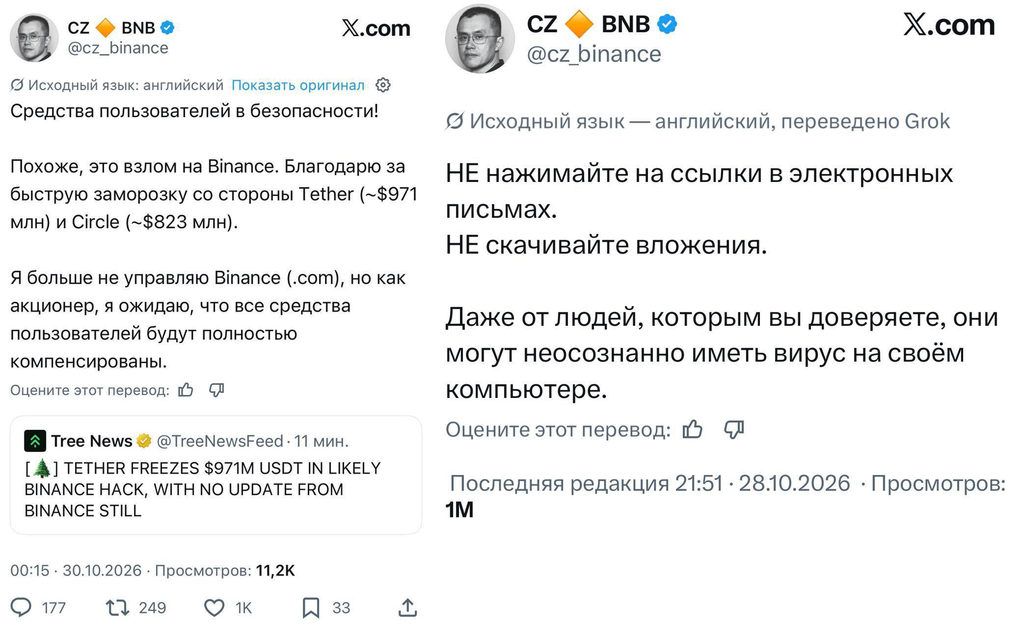
Zhao stated that user funds are safe. He clarified that he no longer manages Binance, but as a shareholder expects full coverage of losses. The terms of possible compensation were not disclosed in the message.
The frozen funds should not be added to the total transfers: the freeze concerns only part of the moved assets. The causes of the incident and the final amount of possible damage are still being clarified.
How attackers could have gained access
According to Binance’s preliminary version, the entry point was a compromised DevOps engineer’s laptop. Through it, the attacker could access a service container—a part of the exchange’s software environment—and send unauthorized withdrawal requests.
The company later clarified that the attack consisted of several stages and affected additional access points. A single computer and the privileges of one engineer were not enough to withdraw funds “in one click.” Binance found no evidence of wallet private key leaks. A full technical report will be published after the investigation is complete.
Current status of deposits and withdrawals
According to the latest update found on October 30, deposits are operating as usual, withdrawals remain suspended. Binance is checking and updating the withdrawal system and related addresses.
The company expects to restore withdrawals within 48 hours from the time of the corresponding announcement. This is a preliminary timeframe: the exchange will announce the actual resumption of operations separately. After the recovery work is completed, Binance also promises to publish an updated proof of reserves.


Comments (0)