

Picture a beginner affiliate marketer. Let’s call him Alex. Last night, he added his first $200 to his ad account, launched a Facebook campaign for a gambling offer targeting Brazil with a $30 payout per deposit, and went to bed expecting the campaign to turn a profit by lunchtime.
In the morning, Alex opens Ads Manager. He has spent $180, generated 15,000 impressions, and received 1,100 clicks. The money is gone. He checks the affiliate network, hoping to see decent earnings, but finds just two conversions and a $60 payout. The result of his first night: a $120 loss.
Alex opens the reports to work out what went wrong and finds a wall of abbreviations: CPC, CPM, CTR, CR, EPC, CPA, and ROI. Ads Manager shows one set of numbers, the tracker another, and the affiliate network a third. None of the tabs explains why more than a thousand people clicked the ad but the campaign lost money.
Below, we explain the main affiliate marketing metrics in plain English. We’ll look at what Alex pays the traffic source, what the affiliate network pays him for, and how comparing two numbers in a tracker can tell him when to stop a campaign.
Traffic Acquisition Metrics: What You Pay the Source
When Alex launches ads on Facebook, TikTok, or Google, the platform’s job is to sell impressions or clicks. Whether the user goes on to buy or register through the affiliate offer is the affiliate’s risk.
The ad account is charged for impressions or clicks, depending on the billing model. The cost of a thousand impressions is set by an auction, not a fixed price list. Three basic metrics show where the money goes at the ad delivery stage.
CPM (Cost per Mille): Cost per Thousand Impressions
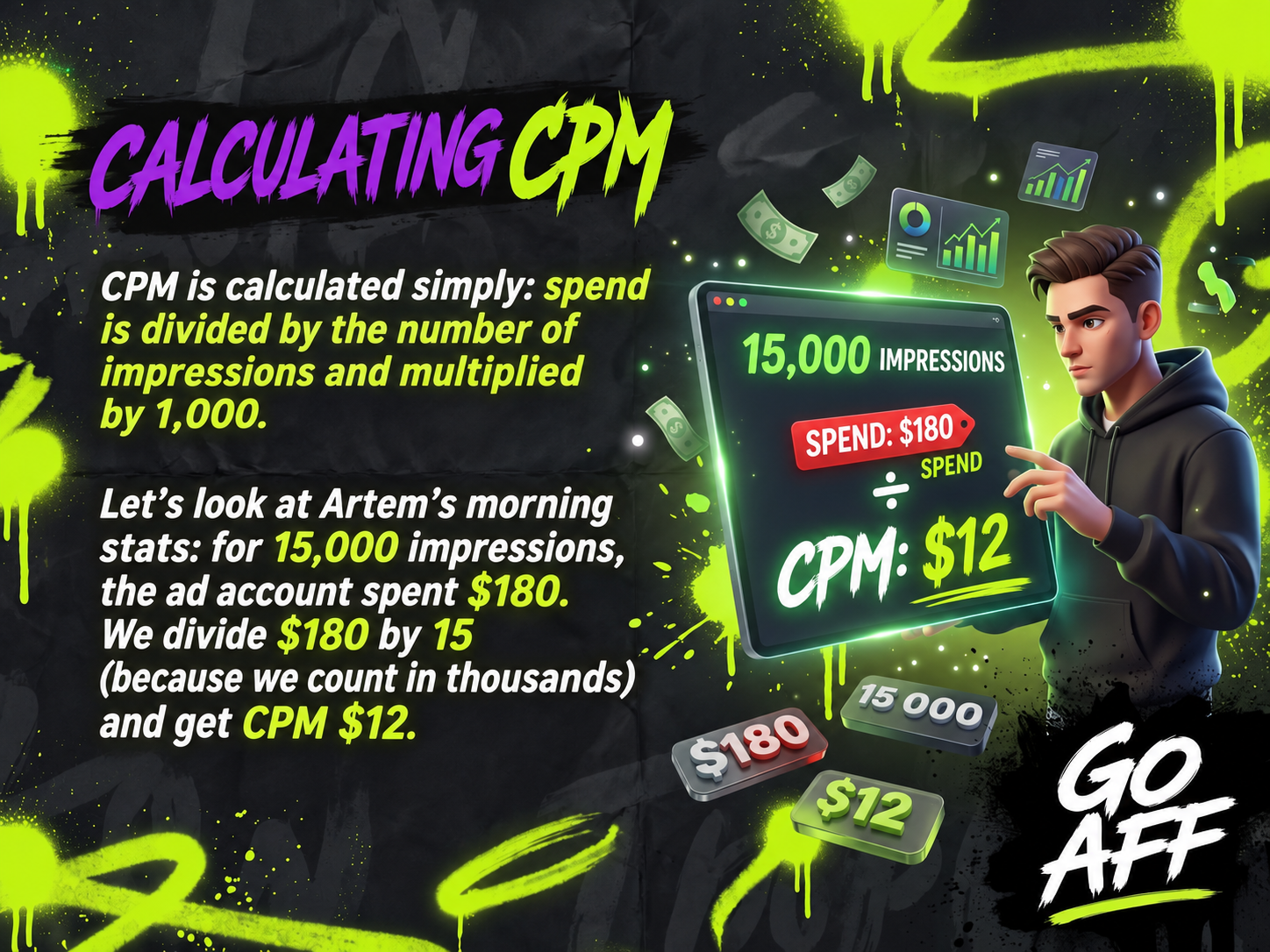
Mille is Latin for “thousand.” CPM tells you how much it costs to show an ad 1,000 times.
Ad networks do not sell impressions at a fixed price. Facebook, for example, allocates feed placements through an auction. Although you are charged for delivery, the cost of those impressions is calculated dynamically.
Audience response is part of the auction calculation. If people click the ad and do not hide it, the platform considers it useful and may reduce the cost of an impression.
If the creative is weak, users scroll past it or mark it as irrelevant, and a higher bid is needed to win the auction. This appears in the report as a higher CPM. Alex can therefore pay very different amounts for the same number of impressions: $25 per thousand with a strong creative, but $40 with an unappealing one.
Why CPM keeps changing:
- Target country. In Tier-1 countries such as the US, Germany, and Canada, hundreds of major advertisers compete for attention, so CPM is much higher. During peak periods such as Q4, US CPM can exceed $30. In markets such as Bangladesh or India, auction competition is lower, and a thousand impressions can cost $1–2.
- Audience response and reports. Users may hide or report an ad they dislike. Facebook reads those signals and reduces its chances of winning without a higher bid, which appears in the report as more expensive impressions.
- Competition at that moment. Before Black Friday, New Year holidays, or major sporting events, brands enter the auction with large budgets and raise bids to secure more impressions. CPM rises for many advertisers. In Q4, especially during Black Friday/Cyber Monday week, CPM can jump by 30–60%.
If CPM suddenly doubles in a familiar market for no obvious reason, several factors could be responsible. The ad itself is not always the problem.
Users may be submitting reports you cannot see, competitors may be targeting the same audience, or the optimization algorithm may have moved into a particularly expensive audience segment. Technical issues and volatility during major Facebook updates are another possibility: auction costs can fluctuate across much of the market.
What to do in practice:
- If industry chats are full of reports of unstable delivery and soaring CPM, pause campaigns until conditions stabilize.
- If the market is stable and only your campaign has expensive impressions, restart the ad set or try another creative.
CPC (Cost per Click)
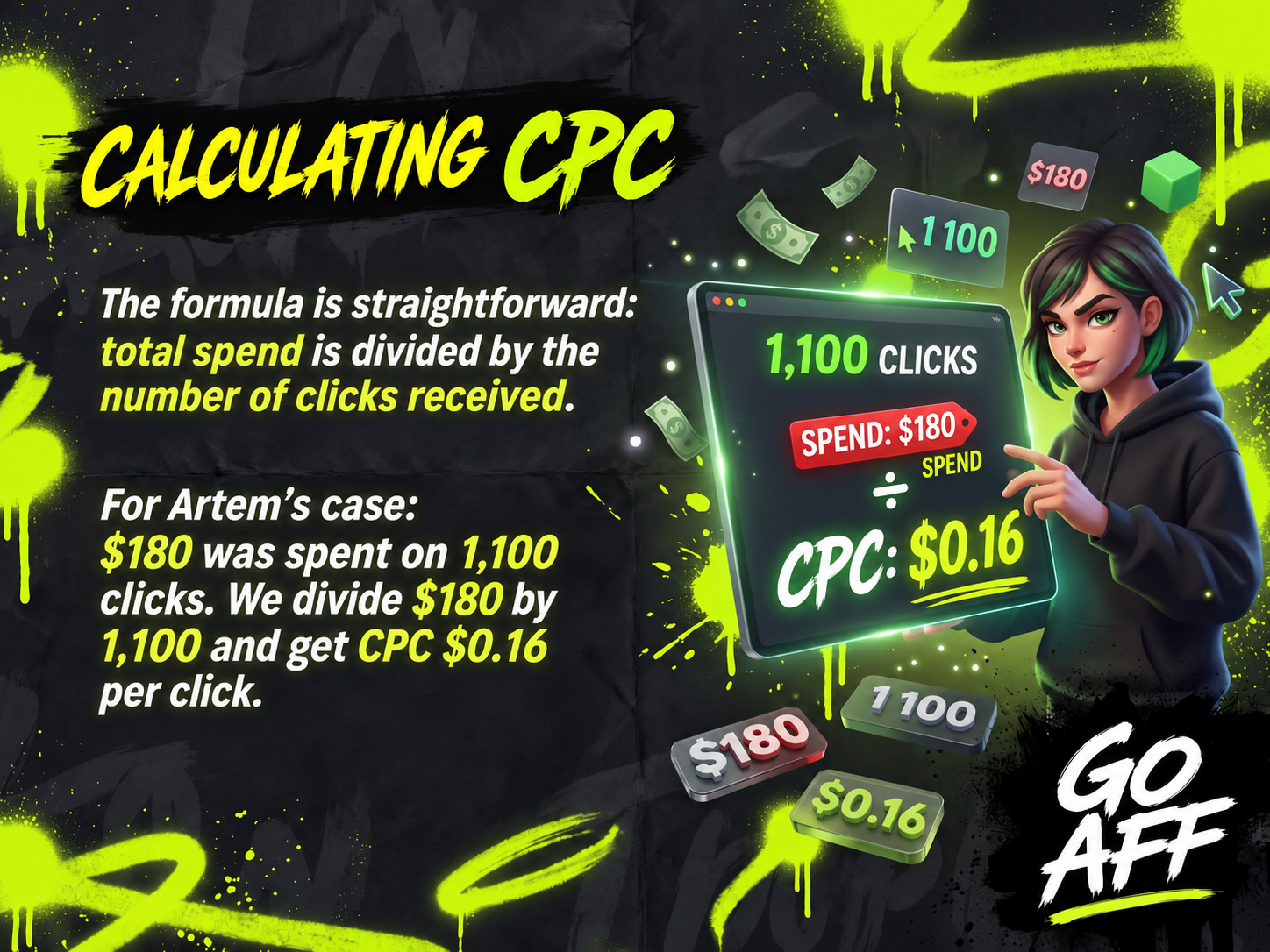
CPC tells you the cost of one user clicking the link in your ad.
The main trap for beginners is assuming that cheap clicks mean profit. Clicks costing 2–3 cents are possible in some markets and niches. But a placement breakdown may reveal that the ads are running in networks such as Audience Network, where people tap banners accidentally or bots generate clicks.
These clicks cost very little, but they consume the budget without generating affiliate conversions. One relevant $0.60 click from someone able to pay is worth more than a hundred accidental $0.02 clicks.
CTR (Click-Through Rate): How Well the Creative Attracts Clicks
CTR is the percentage of ad impressions that result in clicks. It shows how effectively the visual, headline, or opening video frame attracts attention.
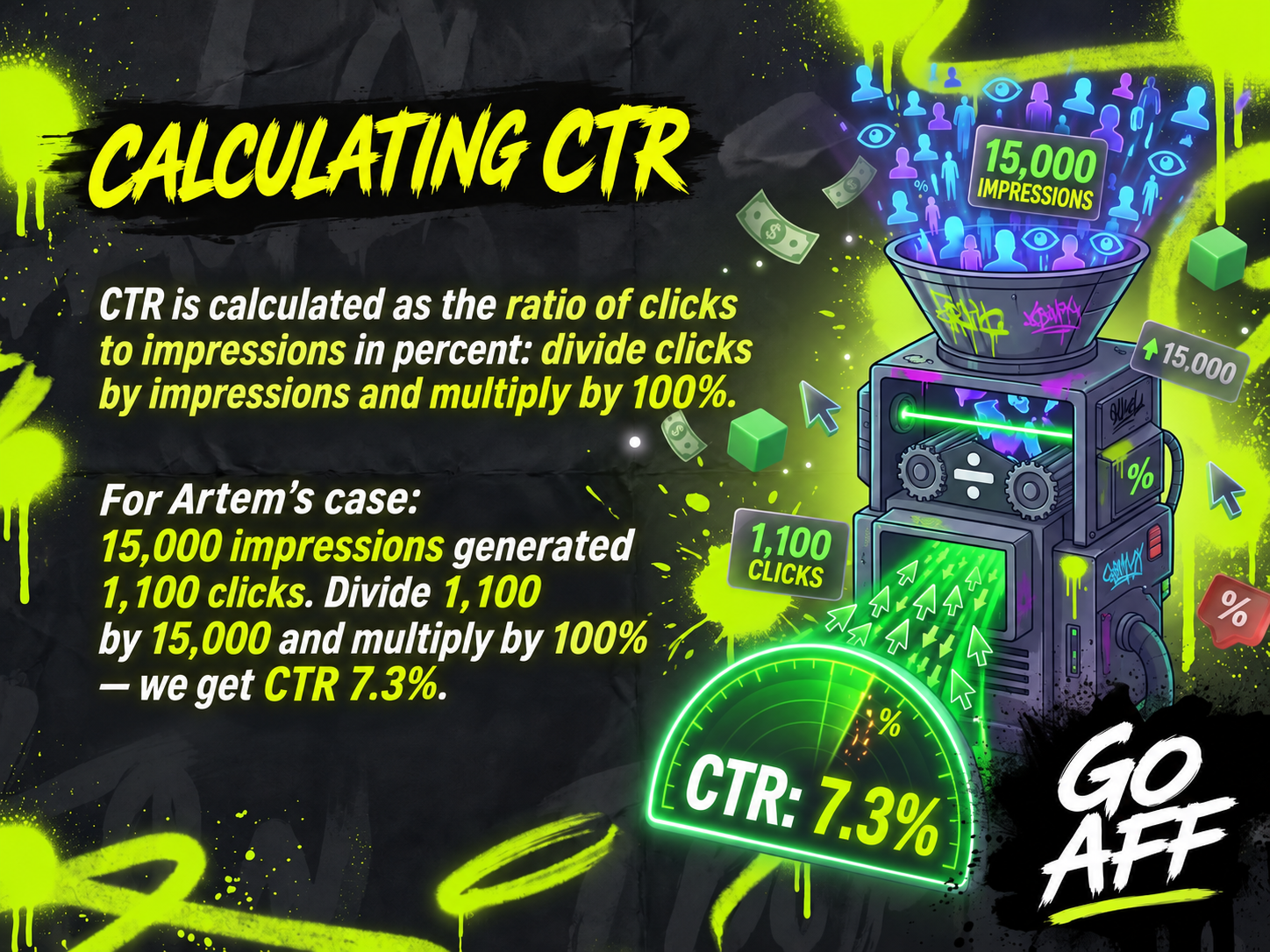
The result may look excellent, but this is the high-CTR trap: click-through rate alone is not enough. If Alex uses blatant clickbait, promises every user a $500 payout, or adds a sensational news claim, CTR can easily reach 10–15%.
People follow the link, see the actual offer, realize they were misled, and close the page immediately. Alex spends his budget on hundreds of empty clicks from curious users without getting a single lead. With traffic like this, CR is usually close to zero and the bounce rate is high.
As a benchmark, a reasonable Facebook feed CTR depends on the niche, but successful campaigns typically achieve around 1.5–3.5%. Below 1%, the ad is failing to attract attention and needs replacing. If CTR is unusually high but conversions are absent, the creative is probably making promises that the offer does not fulfill.
Conversion Metrics: Where Users Drop Out
A user clicks an ad, the platform charges for the traffic, and its part is done. The person then arrives on a website or in an app. What matters now is how many users complete the action that earns an affiliate payout.
CR (Conversion Rate): Overall Conversion
CR is the percentage of users who click and then complete the target action: submit a lead, register, or make a deposit.
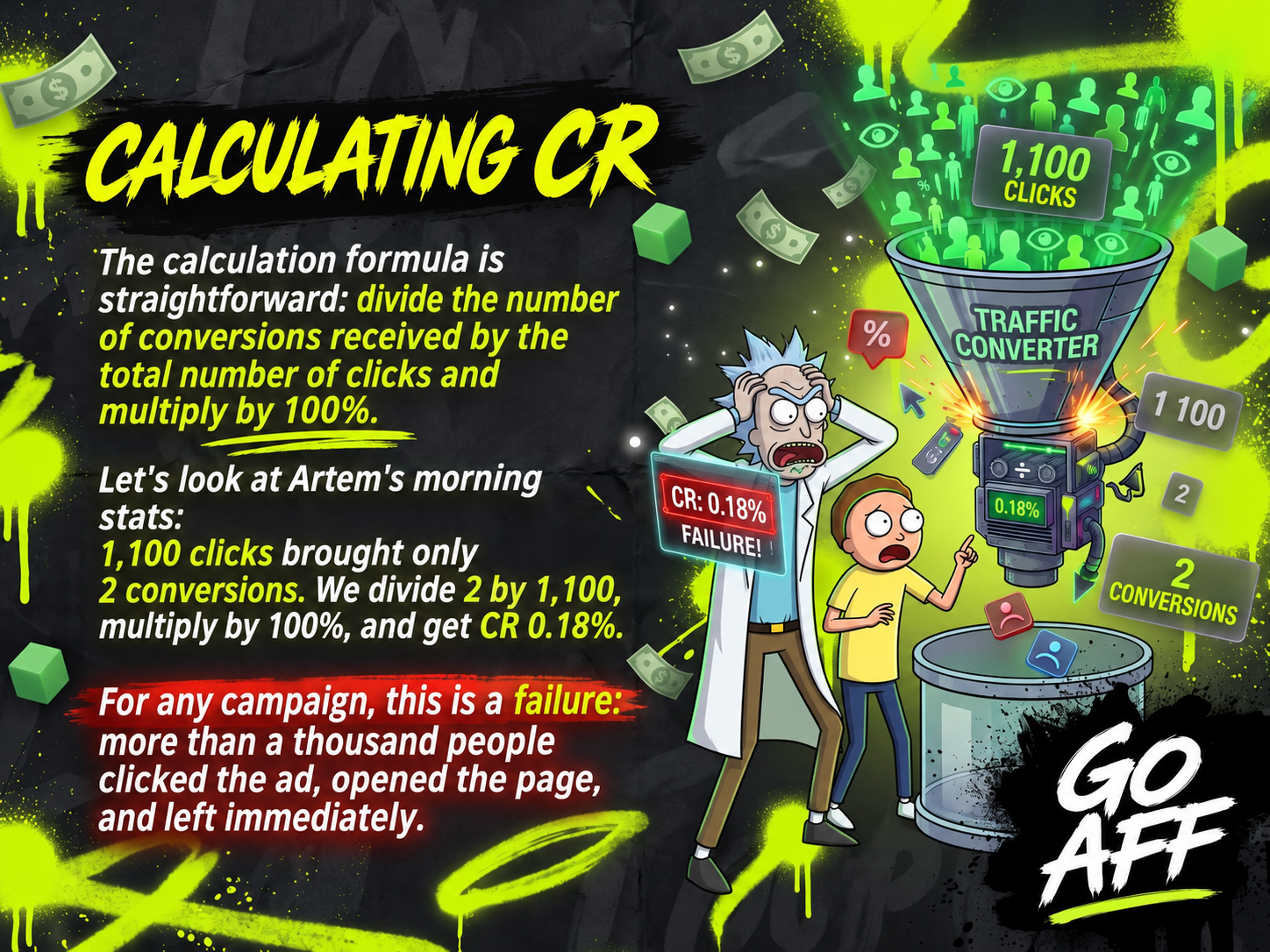
If clicks cost a reasonable amount but conversions are missing, the problem may be on the landing page:
- Loading speed. If the landing page loads slowly on a mobile connection, users will not wait. They close the tab and return to their feed.
- Misleading claims. The ad promises a generous gift or instant bonus with no payment, but the offer page requires a deposit first. Users see that the actual terms are different and leave.
- Broken layout or functionality. A button may sit outside the smartphone screen, a script may fail to submit data, or the mobile page may display incorrectly.
The Conversion Funnel: Click-to-Reg and Reg-to-Dep
For physical product offers, the journey is short: someone clicks the ad, submits a name and phone number in the order form, and the lead reaches the affiliate network. Gambling and betting work differently. The payout is for a first deposit, but the player must register before adding money.
Back to Alex: he sees 1,100 ad clicks and just 2 deposits in the affiliate network. Those two numbers alone do not explain what happened overnight.
Perhaps hundreds visited the site and 50 registered, but only two deposited. Or perhaps the registration form was broken, only two people managed to register, and both deposited immediately. Gambling and betting affiliates use two separate metrics to identify the stage causing the problem: Click2Reg and Reg2Dep.
Click-to-Reg (Click2Reg) measures the share of ad clickers who create an account on the website or in the app.
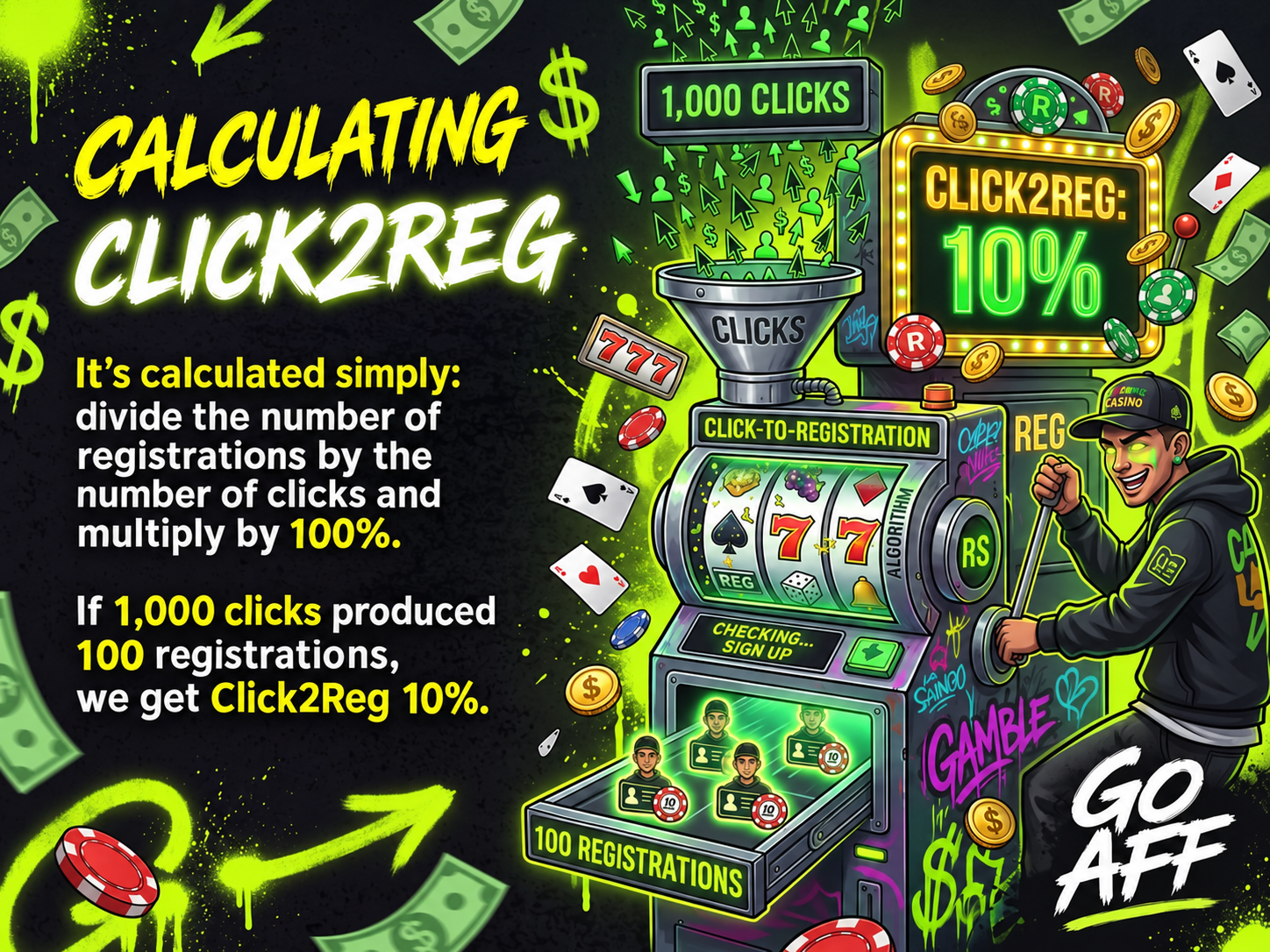
A low rate means people click the ad, view the landing page, and leave without even starting registration.
There can be many reasons: a lengthy form instead of quick phone-based signup, technical problems such as verification texts not arriving, or a creative that attracted people who never intended to register.
Reg-to-Dep (Reg2Dep) measures the percentage of registered users who make their first deposit.
To calculate it, divide first deposits by registrations and multiply by 100%. Ad clicks are not part of this calculation: it covers only people who have already created an account on the website or in the app.
Suppose 40 of Alex’s 1,100 clicks resulted in registrations, but only two users deposited.
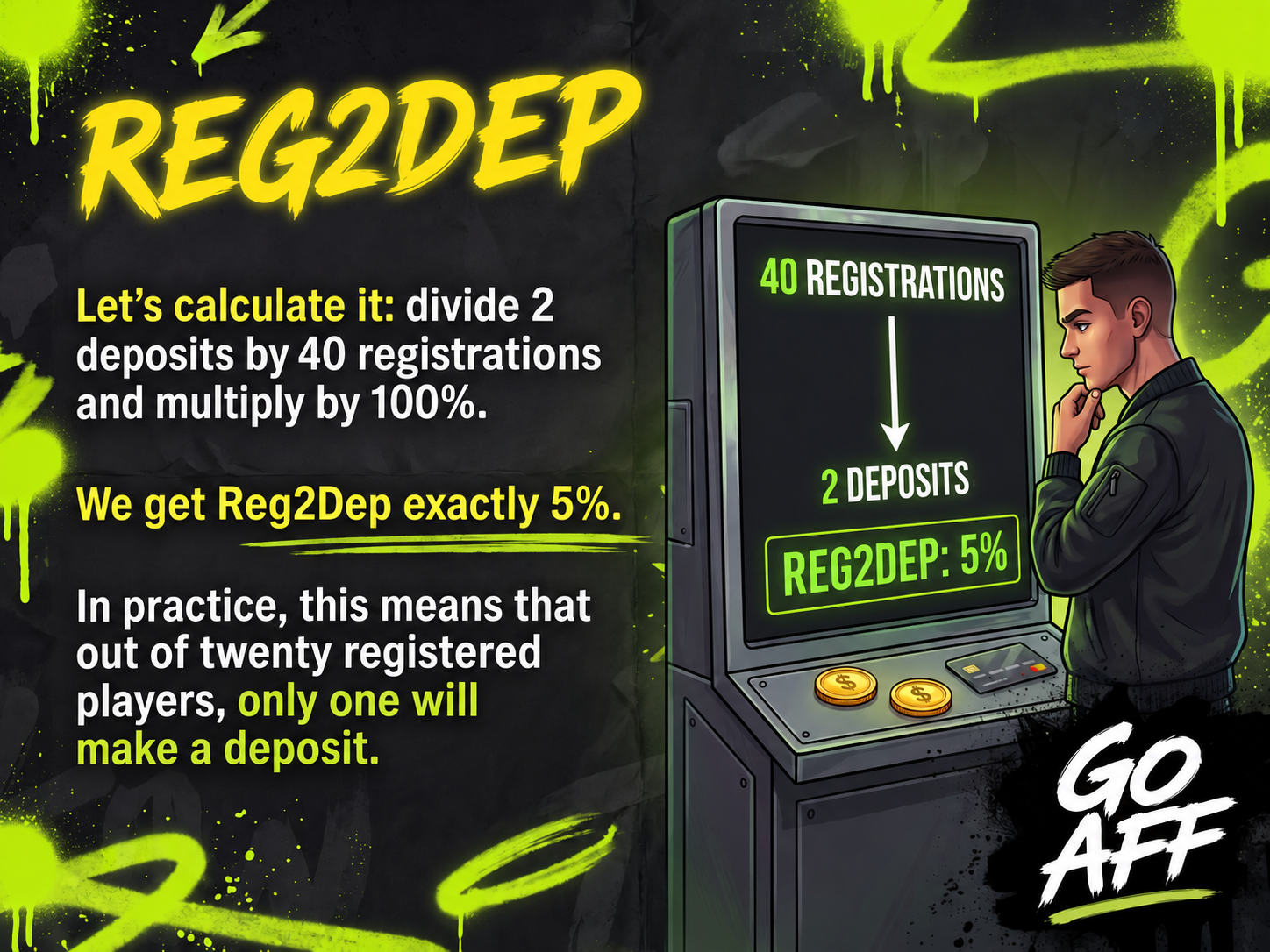
These two rates immediately reveal where the problem lies:
- High Click2Reg, low Reg2Dep. Users register easily but do not deposit. Possible reasons include misleading ad promises, such as a no-deposit bonus when a deposit is actually required; broken payment gateways or missing local payment methods; a high minimum deposit; or a requirement to verify identity with a passport before paying.
- Low Click2Reg, high Reg2Dep. Users who manage to register reliably deposit. The offer appeals to them, but few reach signup. Possible causes include a weak pre-landing page, an overloaded form, slow mobile loading, or submission errors. The offer works, but the pre-landing page and landing page need improvement.
With both stages tracked separately, Alex does not have to guess. If 1,100 clicks produce only two registrations, the advertiser’s payment methods are not the issue. The landing page is failing before users even create an account.
Financial Metrics: Profitability and Actual Revenue
Once clicks and conversions are counted, the key question remains: why did two confirmed deposits leave Alex $120 down? Three financial metrics reconcile ad spend with affiliate payouts: CPA, EPC, and ROI.
Actual CPA: The Real Cost per Deposit
On an offer page, CPA describes the payout model: a fixed payment for each new player. In Alex’s tracker, however, CPA is his actual acquisition cost: how much he spent on advertising to generate one deposit.
The calculation is straightforward: divide total ad spend by the number of conversions.
Alex’s morning report shows $180 spent and 2 deposits recorded by the affiliate network.
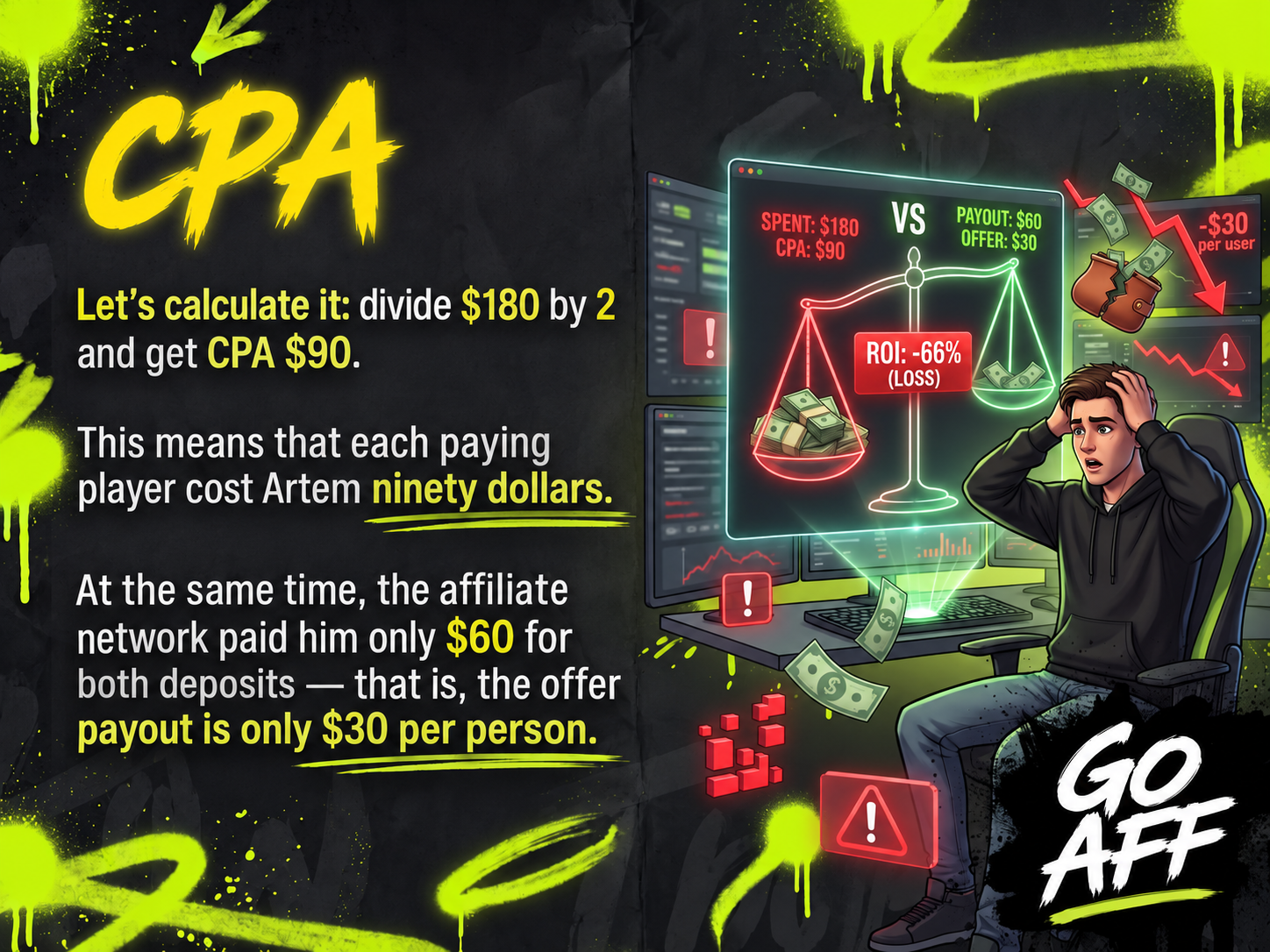
Alex spends $90 to receive $30 from the affiliate network. He loses exactly $60 on each player acquired. To make a profit, the actual advertising cost per deposit must be below the offer’s payout, rather than three times higher.
EPC (Earnings per Click): Average Revenue per Click
EPC tells you the average revenue generated by an ad click, based on the payouts for all deposits received.
Why calculate revenue per click if the affiliate network pays for deposits rather than clicks?
Because affiliates buy clicks by the hundreds and thousands. Waiting for every deposit to judge profitability can exhaust the budget before the problem becomes clear. EPC lets you compare the economics at the simplest level: what you pay for a click and what that click earns back from the affiliate network.
To calculate EPC, divide total affiliate payouts by the number of ad clicks.
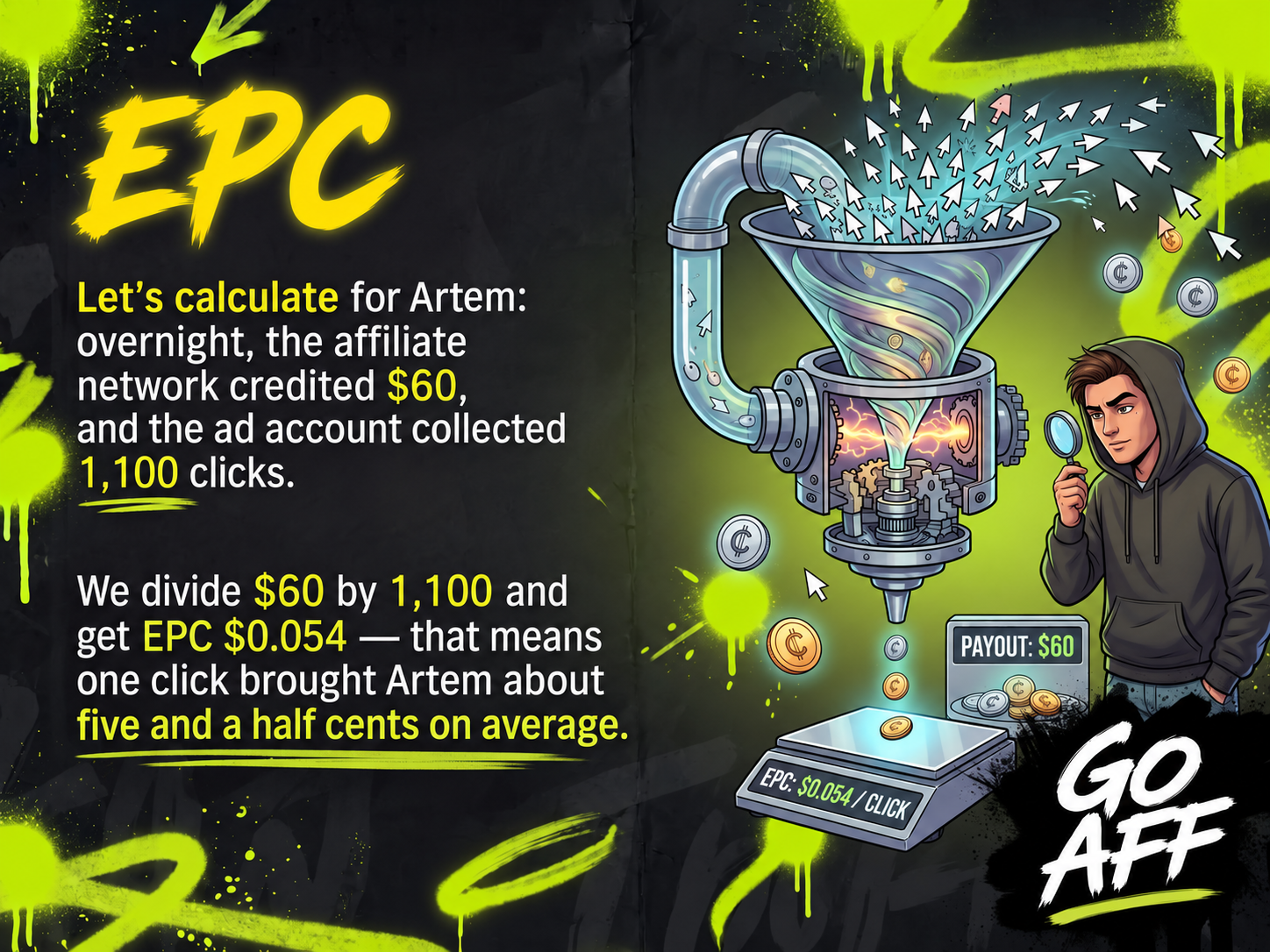
Now take CPC from Ads Manager: Alex spent $180 for 1,100 clicks, so each click cost $0.16, or 16 cents.
Comparing the two figures reveals the problem without complicated calculations:
- He pays the ad network 16 cents for every click.
- The affiliate network returns just 5.4 cents per click.
The difference of 10.6 cents per click is a net loss. As long as a click costs more than it earns, the campaign cannot be profitable: the longer it runs, the more money it loses.
ROI (Return on Investment)
ROI measures advertising profitability as a percentage. It is the final measure of whether an affiliate campaign made money or wasted the budget.
Subtract ad spend from revenue, divide the result by ad spend, and multiply by 100%.
Here is Alex’s overnight result:
- Affiliate revenue: $60.
- Ad spend: $180.
- Net result: $60 − $180 = −$120.
Divide the net result (−$120) by ad spend ($180) and multiply by 100%. The resulting ROI is −66%.
For every dollar invested, Alex lost almost 67 cents and recovered only 33 cents.
Together, the three metrics give Alex the full picture: a click costs 16 cents but earns 5 cents; a player costs $90 to acquire against a $30 payout; and the final ROI is −66%.
The campaign’s current economics do not work. Continuing with the same settings makes no sense. Alex needs to stop it and investigate the changes that could improve the numbers: reduce CPC, change the creative approach, or improve the landing page for the offer.
Affiliate Payout Models: What You Get Paid For
In the earlier calculation, the affiliate network paid Alex $60 for two players, or $30 each. That rate was stated on the offer page in advance. Payout terms vary considerably: some advertisers pay a fixed amount for a deposit, others for registration, and others share a percentage of their earnings.
The model determines more than the payout amount. It also affects the testing budget and how quickly earnings become available to reinvest.
CPA (Cost per Action): Payment for a Qualifying Action
Do not confuse CPA in the tracker with CPA in the affiliate network. The tracker shows Alex’s actual advertising cost per action. The network’s CPA is the advertiser’s agreed payout for a specific user action.
In gambling and betting, the qualifying action is a first-time deposit (FTD), usually with a minimum deposit requirement, or baseline. If the baseline is $10 and the player deposits only $5, no payout is credited until they add the remainder.
CPA also applies to physical product and nutra offers, where payment may be for an order confirmed by phone or a parcel collected and paid for by the customer.
Beginners find it particularly difficult to access CPA offers in gambling and betting. Advertisers are reluctant to accept new affiliates without a proven record. They often request campaign statistics from other networks or impose a strict test cap of just 10–20 deposits.
Traffic is then paused while its quality is reviewed: whether players remain active, make repeat deposits, and were acquired without being paid an incentive simply to deposit.
CPL (Cost per Lead): Payment for Contact Details
Under CPL, the network pays for verified contact details or a completed registration rather than a customer’s payment. This model is common in dating, short-term lending, and subscription services.
Users do not have to take out a card and deposit immediately. They follow the ad, complete a form or verify an email address, and the affiliate’s report records the commission.
The trade-off is a low payout per lead. A CPA deposit might pay $20–$150 depending on the country, while a basic dating registration pays $0.5–$7. Earning meaningful revenue with CPL therefore requires a high volume of inexpensive clicks.
An easy registration does not mean any traffic is accepted. Dating advertisers, for example, monitor what users do after signup: whether they complete their profiles, upload photos, and return to the website or app in the following days.
If most users register and immediately abandon their accounts, the traffic is considered low quality. The network may reduce the payout or remove the affiliate’s access to the offer. Audience quality matters just as much as it does with CPA.
RevShare (Revenue Share): A Share of Product Revenue
Under RevShare, there is no one-off payment for acquiring a user. Instead, the affiliate receives a share of the advertiser’s net earnings from that user for as long as they keep playing or using the service.
Rates typically range from 20% to 50% of the advertiser’s net revenue. If a user Alex refers registers, is attributed to him, and loses $1,000 betting during a month, a 40% share earns Alex $400. If the same user is still playing six months later, commissions continue without further acquisition spend.
For a beginner with a small starting budget, RevShare has two major limitations:
- Slow recovery of ad spend. Advertising is paid for today, but player revenue can arrive over months. With just $200, Alex may run out of advertising funds before his player base generates steady revenue.
- Negative carryover. Most advertisers carry negative balances forward. If a referred player wins a large amount, the affiliate balance goes negative. No further commission is credited until that player, or other referred users, loses the amount back to the advertiser.
Affiliate Marketing Metrics Cheat Sheet
| Metric | What it measures | How to calculate it | What to watch |
| CPM (Cost per Mille) | The cost of a thousand ad impressions. | Divide spend by impressions and multiply by 1,000. | Depends on country, seasonality, auction competition, and audience response. A spike may reflect platform instability, creative fatigue, or more competitors targeting the same audience. |
| CPC (Cost per Click) | The actual cost of an ad click. | Divide ad spend by clicks. | A low CPC is not enough. Irrelevant cheap clicks consume budget without results, so assess CPC alongside the next stages of the funnel. |
| CTR (Click-Through Rate) | The percentage of ad impressions that produce clicks. | Divide clicks by impressions and multiply by 100%. | Shows how well the visual and copy attract attention. Unusually high CTR without registrations often indicates clickbait that creates false expectations. |
| CR (Conversion Rate) | The overall percentage of clickers who complete the target action. | Divide conversions by total clicks and multiply by 100%. | Measures the funnel as a whole. If clicks do not convert, check mobile loading speed, layout, and whether the landing page matches the ad’s promise. |
| Click2Reg | The share of clickers who create an account. | Divide registrations by clicks and multiply by 100%. | A low rate means users leave before creating a profile. Causes may include an overloaded form, failed verification texts, or an ad that attracts people unwilling to register. |
| Reg2Dep | The share of registered users who make a first deposit. | Divide first deposits by registrations and multiply by 100%. | Reflects willingness to pay. A low rate often points to misleading claims, payment processing problems, or a high minimum deposit. |
| Actual CPA | The actual advertising cost of acquiring one conversion. | Divide ad spend by conversions. | Compare it with the affiliate offer’s payout. To make a profit, the actual cost per deposit must be below the payment received for that player. |
| EPC (Earnings per Click) | Average revenue per ad click. | Divide total affiliate payouts by clicks. | Compare with CPC. If a click earns less from the affiliate network than it costs in the ad account, the campaign loses money. |
| ROI (Return on Investment) | The percentage return on advertising investment. | Divide net profit (revenue minus spend) by spend and multiply by 100%. | Shows the net return on each advertising dollar and whether the margin is sufficient to scale the campaign safely. |
Conclusion: What Alex Should Do Next
Breaking Alex’s $120 morning loss down by metric shows exactly where the campaign struggled:
- Feed CTR was unusually high at 7.3%, with clicks costing $0.16.
- Users dropped out immediately after clicking: only 40 of 1,100 visitors registered, giving a Click2Reg of 3.6%.
- With so few users reaching registration, each deposit cost Alex $90 against a $30 payout. The result was a negative ROI of 66%.
A gap like this between clicks and registrations usually points to misleading ad claims or a problem with the landing page.
Rather than changing audience targeting, Alex checks two specific things:
- Misleading creative: did the ad promise easy money, a no-deposit bonus, or another freebie that attracted curiosity clicks, only for users to see the actual terms and leave?
- The landing page: Alex opens it on a mobile connection in the target country, checks smartphone loading speed, and completes registration himself. He tests form submission, delivery of the verification text, and unnecessary form fields.
If the ad overpromises, Alex removes the misleading claims and creates an ad that matches the actual offer. CTR falls to a normal level, but the clicks come from relevant users who are willing to register.
If the creative is accurate but website conversion cannot be improved, Alex stops the campaign to prevent further losses. This can happen when traffic goes directly to the advertiser’s site and the registration form cannot be changed. He then asks the affiliate manager for another landing page for the same product or chooses an alternative offer with a simpler signup process.
That is what metrics are for: breaking the funnel into stages and showing where users drop out. The buyer can then address a specific problem instead of rebuilding the entire campaign.

Comments (0)