


In recent years, Google has regularly rolled out updates that shake up the search results for gambling queries. Nothing is immune: sites built on expired domains, exact-match domains, generated content, carefully polished copy by native speakers, or sites backed by exclusive links secured by in-house link-building teams.
That is usually when affiliates remember mainstream niches, only to give up a week later because “the payouts are tiny.”
This article looks at what is actually happening in those markets. The focus is on SEO, but we will also cover paid traffic, Avito, and mainstream affiliate programs. The principles apply whichever traffic source you use.
What is a mainstream vertical, and where do you find offers?
A vertical is the niche you drive traffic to: gambling, betting, nutra, dating, or finance. A mainstream, or “white-hat,” vertical is one where the product is legal, the advertising complies with platform rules, and the advertiser operates as a regular registered business with accounts and bookkeeping.
That sounds like a textbook definition. The practical difference lies elsewhere:
- In mainstream verticals, companies often have no affiliate program. That disrupts the usual affiliate workflow before you even begin.
- Affiliate programs do exist in banking, insurance, and services, as covered below. But the more offline and high-value the niche, the less likely it is to have a “get offer” button.
“Affiliate programs in jewelry, heavy equipment, and other heavily offline sectors are almost unheard of. If one exists, it is an exception few people will have encountered. The usual arrangement is a client–contractor relationship.”
That is how Andrey, author of the Tikhiy Chas channel, explains it (in Russian). He works solo, running networks of heavy-equipment websites in Russia and Europe. His experience anchors this article because it offers what most lead generation guides lack: specific figures and specific failures.
This creates the first choice: client-funded traffic acquisition, whether through SEO, paid search, or another source, versus payment for results. The interesting arrangements sit between the two.
Lead generation explained in plain English
Lead generation means capturing the contact details of people interested in buying: a form submission, a phone call, an email, or a completed questionnaire. A lead is not yet a customer, just someone who has raised their hand. The advertiser’s sales team takes over from there, and its performance determines your income.
We will return to that point about someone else’s sales team. It explains the RUB 800,000 story below.
Why people say mainstream niches only pay pennies
This persistent myth has a straightforward origin: people compare opposite ends of the market.
The claim that mainstream SEO only pays pennies is greatly exaggerated. People typically compare an e-commerce affiliate program paying 3–7% with gambling, where a single player can generate hundreds of dollars. Between those extremes are many niches with valuable leads or high customer lifetime value, or LTV: services with average transaction values in the hundreds of thousands, B2B subscriptions, financial products, and offline businesses with high LTV. Two things determine whether you earn pennies or meaningful money: the value of the deal behind the lead and how you are paid for it. Let’s start with the payment models.
Three payment models in mainstream niches
Fixed fees: predictable, with a ceiling
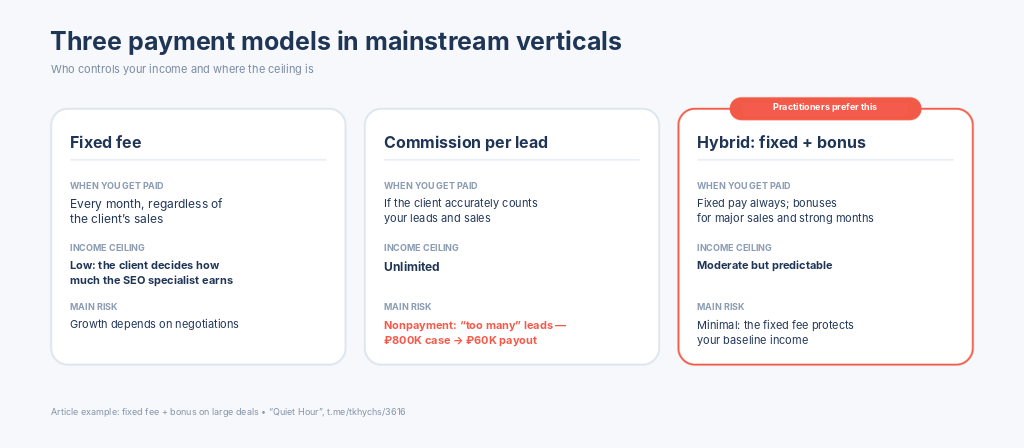
The classic client arrangement covers SEO, paid search, or ad campaigns: you manage the project and receive a monthly fee. The advantage is clear: you get paid regardless of how the advertiser handles the inquiries. The drawback is the ceiling imposed by the client’s idea of what “an SEO specialist should earn.”
Payment per lead or sale: more upside, more risk
You receive a fixed amount per inquiry or a percentage of the sale. In theory, there is no ceiling. In practice, the person calculating and paying your commission has their own idea of what is fair. The next section shows how that plays out.
A hybrid: where experienced practitioners often end up
A fixed fee plus a bonus for particularly large sales or profitable months. This is the arrangement Andrey reached with his main heavy-equipment client:
| “We eventually agreed on a fixed fee plus a bonus for particularly large sales or especially profitable months. The hybrid works for me. Above all, I count on the fixed fee.” |
The client was willing to pay for leads and paid on time. It was Andrey himself who dropped (in Russian) the commission model: “I was tired of the ups and downs.”
Why lead generation breaks down: a RUB 800,000 lesson
The most common failure in mainstream lead generation is not poor traffic or weak creatives. It happens when you ask for the commission you have earned.
| “Almost every time, I wasn’t paid the full amount I was owed. I once wrote about a case involving around RUB 800,000. They simply told me, ‘SEO specialists don’t earn that much. Here’s your RUB 60,000.’” |
Andrey then describes how the refusal works (in Russian). He attributes it to the client’s worldview rather than simple greed:
| “All our reasonable arguments, such as ‘But it’s just a commission, you’ve already made your profit,’ ran into the irrational response: ‘It’s too much.’” |
Your evidence carries little weight in that dispute:
| “Phone checks, call recordings, emails, and so on carry very little weight in a dispute. You need to be a very powerful lead supplier, practically holding the system and the business together, for your word to be decisive.” |
It is easy to dismiss this as one person’s bad luck with the wrong partners. The problem is that an unrelated practitioner tells a similar story.
Denis Vorontsov had RUB 39,000 marked “available for withdrawal” at a major mainstream CPA network for a second month. When he asked for his money, the manager said it could not be withdrawn until the advertiser completed its final reconciliation.
| “I suppose I got used to gambling affiliate programs meeting you halfway, offering early payouts, and understanding the value of an affiliate and their traffic. Here, simply asking for the money I had earned made me ‘the rude guy who thinks everyone owes him.’” |
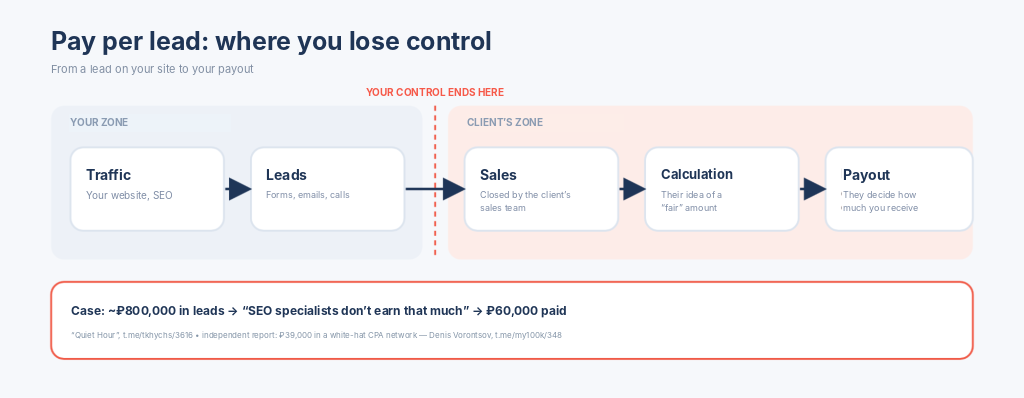
This is the biggest surprise in mainstream verticals (in Russian) for someone coming from gambling. You leave gray-area niches partly in search of predictability, only to find slower payments, more disputes, and a view of affiliates as contractors being done a favor. The irony is that the sector considered dirty is the one where payments arrive on schedule.
Who actually makes a living from leads?
Some people do live on commissions for years. But it is a separate profession, and it looks very different from what most affiliates imagine.
Andrey describes his heavy-equipment client, who works with four webmasters, runs many websites, and pays partners for leads:
| “It takes a completely different temperament: no family, psychological manipulation, constant checks, your own people answering the phones, and so on. Sometimes holding back traffic, sometimes placing a fake order, then a test order. Most people would find this way of doing business unbearable. He simply enjoys it.” |
Read that again and compare it with the list of things people usually hope to escape by moving into mainstream niches. Holding back traffic, submitting fake inquiries, and having your own people answer the phones are the same practices that give gray-area markets their reputation. Here, they are directed at a business partner rather than the end user.
The lesson: in lead generation, the money goes to whoever controls the point where an inquiry enters the sales process, rather than simply to whoever supplied the traffic. Every time.
What control over incoming leads looks like
A story retold by the Mike Blazer SEO channel (in Russian), citing Szabo, illustrates the mechanism particularly well.
A plumber in Tucson died in 2023, but his Google listing stayed online: 212 reviews, a 4.9 rating, and eleven years of local recognition as the number to call when water covered the floor. His family canceled the phone plan and the number went back on sale, but its reputation remained.
An acquaintance of Szabo bought the number for $40, pays $12 a month for call forwarding, and answers as a dispatch service. Each call goes to a licensed plumber two miles away, and the number’s new owner takes 15% of each completed job.
The results for one month:
- 34 calls;
- 19 genuine inquiries;
- 11 completed jobs;
- an average order value of $740;
- around $1,200 in income.
For comparison, Google charges active plumbers in the same city around $55 per lead.
No website, traffic acquisition, or SEO work. He simply owned the point where inquiries arrived. The arrangement is clearly questionable: a legitimate niche does not make every tactic legitimate.
A map of mainstream verticals: where the money is
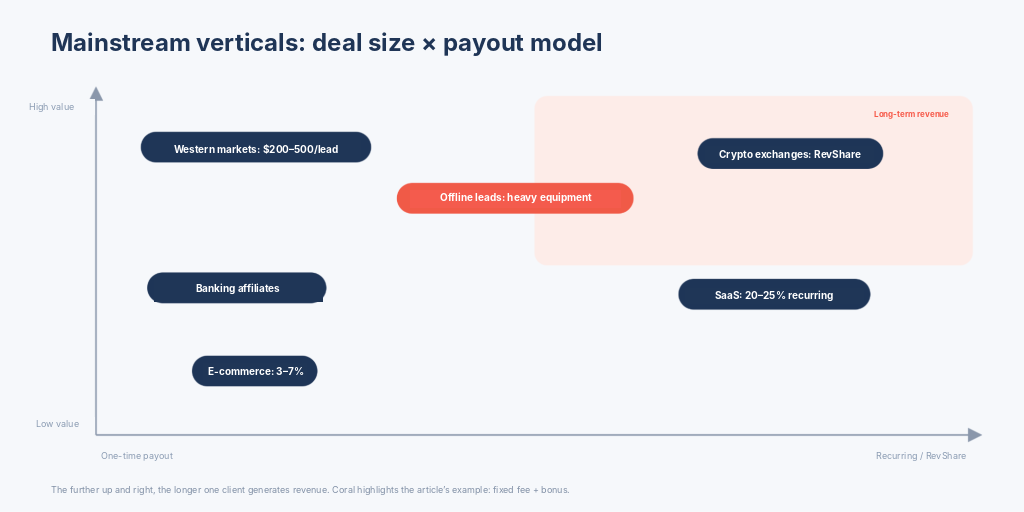
Bank affiliate programs: the largest mainstream vertical in Russian-language markets
Banking is the mainstream niche most familiar to affiliates: offers, payout rates, tracking, and payment for an approved product. Demand is substantial. In Russia, Alfa-Bank’s affiliate program alone gets around 2,160 searches a month, while bank affiliate programs as a category get roughly 4,300.
For the same reason, it is also the most crowded. Finding programs is easy: major banks have their own CPA networks, such as T-Bank’s T-Partners. Banking offers are also collected by platforms such as Pampadu and networks such as GuruLeads.
Most queries are navigational, from existing partners looking for their account dashboard. Informational results are dominated by the banks’ own reviews. There is also an easily overlooked feature of the model: payment depends on approval. If the bank’s scoring system rejects the application, you receive nothing. Competing head-on with “top 10 debit cards” is a late move. More viable opportunities remain in specific use cases: business banking, products for the self-employed, and brokerage accounts.
Mainstream CPA networks: e-commerce, finance, services, and travel
Mainstream affiliate programs exist, and there are more of them than the gambling community might suggest. Payouts are more modest: commissions are usually measured in hundreds of rubles rather than hundreds of dollars. But this is the part of the market where getting started looks familiar: register, choose an offer, and drive traffic.
Here is a short selection to show where to start looking.
- Admitad — e-commerce and services. The largest mainstream CPA network in the Russian-language market, with 1,700+ offers ranging from marketplaces to subscription services, payouts in rubles, and Russian-speaking support. Many people start here, and its variety makes it the broadest entry point.
- Leads.su — finance in all its forms. Operating since 2010, with 1,000+ offers and 300+ advertisers covering microloans, credit and debit cards, mortgages, business banking, insurance, and even bankruptcy services.
- Pampadu — insurance and banking products. OSAGO compulsory motor liability insurance, CASCO comprehensive motor insurance, mortgage insurance, cards, deposits, and HR offers. More than 340 advertisers and 57,000+ webmasters and agents.
- ServiceLead — repair and household-service leads. RUB 550–3,000 per confirmed inquiry, with weekly payouts. More on this network in the Avito section below.
- Travelpayouts — travel. More than 90 brands, including Aviasales and Ostrovok. Hotels pay up to 8% commission and excursions from 10%. Transaction values are modest, but demand is ongoing.
- Perfluence — for people with an audience rather than websites. A CPA marketplace for content creators, with 200+ projects from banks to marketplaces. It uses promo codes and accepts creators from 2,000 followers.
Crypto exchange programs: lifetime revenue share without negative carryover
This niche gets surprisingly little attention in affiliate circles. Denis Vorontsov describes it (in Russian) as revenue share: a referred user stays attributed to you and generates income throughout their active lifetime. The activity has much of gambling’s speculative appeal, yet the niche is considered mainstream.
The key difference from gambling is how you earn and the risks involved:
| “You earn a percentage of the exchange’s revenue from the user’s trading fees. No trading signals, no calls pressuring people to deposit, none of that shady business. You simply bring a trader to the exchange and earn a lifetime percentage of the revenue it makes.” |
An important distinction: these are exchanges’ affiliate programs, rather than “invite a friend” links in a personal account that pay a one-off $10. They are also different from binary-options crypto offers built around extracting as much money as possible from a user before moving on.
The revenue distribution resembles gambling: small depositors generate little, while one high-volume trader using leveraged futures can account for a large share of earnings.
The niche accommodates many traffic sources. Vorontsov lists them directly: “SEO, free organic traffic, PPC, paid placements, and influencer marketing, without the scam schemes. Work with whichever source you know best.”
B2B and SaaS: recurring commissions instead of one-off payouts
This is one of the most overlooked areas for people with content and SEO skills. Andrey recommends looking here first (in Russian):
| “CRMs, hosting, VPNs, email marketing, SEO tools, website builders, AI services, accounting software, business automation, telephony, help desks, HR, and developer tools. These include affiliate programs with recurring commissions: refer a customer and receive a percentage of their payments for several months or longer.” |
Market data helps put the estimate in perspective. An analysis of 116 active programs as of June 2026 found a median SaaS commission of 20%, an average of 23.3%, and a most common range of 20–25%. Moreover, 83% of programs paid a percentage rather than a fixed amount. In other words, the lower end of Andrey’s range is the market norm; 50% is considerably less common than you might hope.
For specific examples, HubSpot pays a 30% recurring commission with a 180-day cookie window, Hostinger pays 40% on hosting sales, and Shopify pays $150 per referral. Terms vary widely, so check each program rather than relying on general roundups.
Here is the most practical advice in the material. Instead of publishing another “10 best CRMs” article, Andrey suggests installing those ten products, running the same scenarios, and comparing pricing for 5, 20, and 100 employees, database imports, integrations, APIs, plan limits, and support response times. Another option is a calculator showing which plan offers the best value for a given team size. The difference between that and rewriting other people’s reviews is the difference between a useful website and a doorway page.
Taking offline businesses online: equipment, warehousing, and construction
This is Andrey’s own niche and, in his words, the easiest on your mental health:
| “Any business that exists offline can be enjoyable and straightforward to develop online. The search results and competition are understandable, and the outcome is predictable. There is plenty of real interaction and less burnout: a sense of living, rather than spending all day stuck at a computer.” |
Demand in these niches is substantial. “Heavy equipment rental” alone gets more than 20,000 monthly searches in Russia, before adding brands, cities, and equipment types. There is unlikely to be an affiliate program. Instead, you negotiate directly with a specific business owner.
Services and media for the industry: selling shovels
This is a mainstream vertical that affiliates rarely think of as a vertical, even though they use it every day. The logic is simple (in Russian):
| “If the gambling gold rush is happening right beside us, and more prospectors arrive every day, perhaps we should put our effort into making shovels?” |
The shovels are agency ad accounts, payment platforms, CRMs, payment processing, PWA app services, anti-detect browsers, and tools for generating and running behavioral-signal campaigns. Everything the prospectors need. Vorontsov says his favorite type of shovel is media: from affiliate publications to Telegram channels for webmasters.
By the same analogy, this article was made by people selling shovels too.
High-value Western niches: Charles Floate’s list
For English-language traffic, the benchmarks differ. SEO specialist Charles Floate compiled a list of mainstream niches ranked by investment relative to potential profit:
- Timeshare exit — leads pay $200–500 or more. Floate estimates that a 30-page site, a year of link building, and around $15,000 invested can be enough to reach $10,000–20,000 a month.
- Rehabilitation centers — among the highest-value niches per lead. Legal restrictions and strict ad review create a high entry barrier, but competition is easier once you clear it.
- Tax debt relief — the hardest niche on the list and one of the most profitable.
- Medical tourism — veneers, hair transplants, and IVF. Clinics pay $10–1,000 per lead.
- Equipment financing — construction machinery, medical equipment, and restaurant fit-outs. Deals are large, while general finance sites with little specialist expertise often rank at the top.
- Citizenship and golden visas — services cost $10,000–50,000, supporting generous payouts.
- In-home senior care — demand rises as the population ages, with four- and five-figure commissions.
Floate’s formula: high transaction value + a boring topic + weak search results + geographic scale. Equipment financing is the heavy-equipment niche viewed from the financing side.
The economics: setup costs and returns
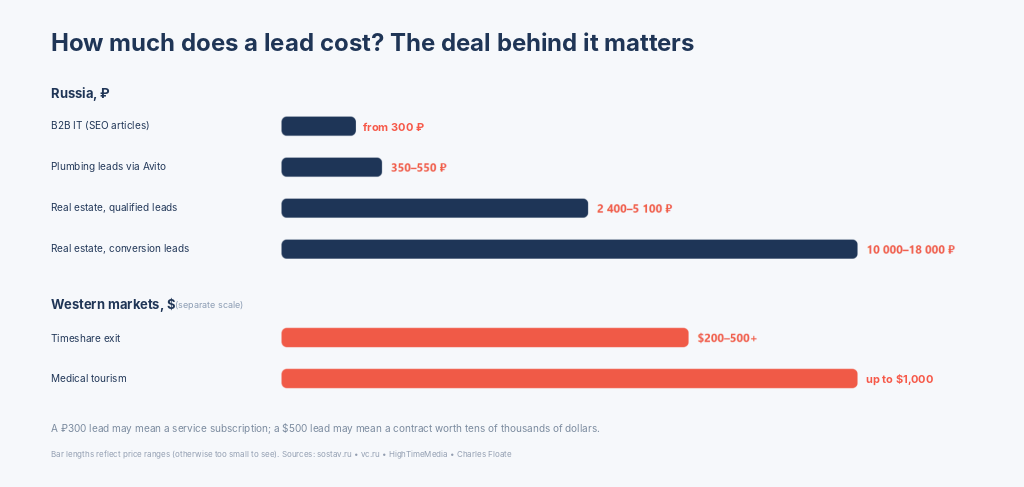
Let’s put actual figures behind the phrase “a valuable lead.” The heavy-equipment numbers come from someone working in that niche.
Website development costs:
- an optimized website for heavy-equipment sales: RUB 40,000–80,000;
- a basic catalog recreating an existing site: around RUB 40,000;
- the most expensive project, including all subsequent improvements: RUB 180,000 in total.
Filters and their functionality, ratings, comparisons, reviews, and the complexity of scraping and making content unique all add to the price. Then comes ongoing work: according to Andrey (in Russian), this is billed per project or at RUB 30,000–80,000 a month while work continues. He cautions that “there aren’t really any fixed price lists.”
What the sites generate in inquiries:
- warehouse equipment: 50–100 unique visitors a day generate 3–10 inquiries (in Russian) through email and forms;
- traction batteries: 20–50 unique visitors generate 2–5 inquiries.
An important detail: these figures are tied to traffic volume, not how old the site is. They cover only emails and forms. Calls are absent from the statistics because the client handles the phone.
For comparison, in real estate, a qualified lead costs from RUB 2,400 on VKontakte to RUB 5,100 on Cian and Avito (in Russian). Roman Makarov and Denis Borisov of HighTimeMedia report in their case study (in Russian) that industry-media publications generated B2B IT leads from RUB 300.
The gap between a RUB 300 Russian B2B lead and a $500 Western timeshare lead reflects the value of the deal behind each inquiry, rather than the marketer’s skill alone.
Avito and aggregators: competitors in search, channels for businesses
This is a common stumbling block for newcomers to mainstream niches. Avito has plenty of demand, so it seems logical to source inquiries there and sell them to businesses. But in organic search, aggregators compete against your site.
| “I’m not entirely sure about your location, but you’ll almost certainly see Profi.ru and Avito for nearly every query. You won’t outrank them, but after six months of persistent work you can still get your share of orders.” |
This was Andrey’s reply (in Russian) to someone entering a service niche. It is a realistic view: aggregators usually rank higher. Rather than trying to overtake them, you capture a share of demand alongside them.
Avito itself can still be a viable paid lead channel, viewed from the business’s side. An analysis of six niches found that a plumbing inquiry costs around RUB 550 in Moscow (in Russian) and RUB 350 in Tyumen. The difference comes from competition in bidding, rather than demand alone. For the business, the platform competes directly with your website on acquisition cost. If your inquiries cost more, the discussion about working together may be short.
Entire affiliate programs operate around this traffic. ServiceLead is a CPA network for repairs and household services, with 20+ categories ranging from washing-machine repairs to handyman jobs. It pays RUB 550–3,000 per confirmed inquiry. It accepts affiliates using classified ads and teaches them how to generate this traffic through its ServiceLead Business School.
Search demand around earning money on Avito is revealing. The Russian query equivalent to “how to make money on Avito” gets around 2,000 searches a month, and a shorter variation, “earning on Avito,” gets another 772. But the intent centers on reselling, reviews, and side jobs requiring no investment. Supplying businesses with leads barely registers as a model.
That is useful for you: resellers dominate the competition for attention in this topic, rather than lead generation specialists.
Moving into mainstream niches: gambling SEO methods can transfer
This section focuses on entering mainstream niches through websites, as Andrey does, rather than through an ad account. A common misconception is that everything is slow and each project needs years of polishing. Repeatable production methods from gray-area niches transfer with few changes and can work even better: competitors in these results are often unused to serious competition.
Andrey describes the transfer directly (in Russian) in a post titled “Gambling Approaches in Heavy Equipment”:
| “We’re trying the approach of producing single-brand sites on anonymous hosting and sending the inquiries to a fearless sales team. […] This may sound obvious, but those branded sites reach the top so easily! Some equipment-brand sites barely have time to get indexed before they start receiving traffic.” |
Single-brand websites for equipment manufacturers, expired domains, and fast indexing are all familiar tactics. The difference is that inquiries go to a real sales team rather than an affiliate program, and the domain is not blocked simply for its subject matter.
Andrey also places the entry barrier (in Russian) somewhere other than where people usually expect it:
| “Keyword research. Traffic forecasts for those keywords. Checking competitors’ traffic. […] Building the site is a pleasure. Optimizing it for the right keywords is no problem. But you need to understand your chances.” |
His niche-selection method deserves attention too. List 10–15 industries where you would actually be interested in testing a couple of dozen products and writing a hundred articles about them. Then assess affiliate economics and SEO competition for each. You should be left with two or three directions you understand and that offer workable economics.
Finding clients when the niche has no affiliate program
In offline business niches, the main organizational question remains: who will buy your leads? Andrey’s answer sounds unusual if you are used to signing up for an affiliate program and choosing an offer:
| “How do you find lead buyers? The same way you find SEO clients: social media, networking, conferences, negotiations, promoting yourself wherever you can, and alcohol.” |
An example appears in his recap of a Partnerkin voice chat (in Russian). A friend got him into an Admitad party, and the pass unexpectedly turned out to be VIP:
| “I’m sitting there having a drink and joking with some women. A man in a suit joins us and asks who I am. I say I’m just an SEO specialist. He points at my badge and says, ‘No, you’re not just an SEO specialist.’ We exchange contacts. That is how I started promoting a major jewelry store.” |
The lesson concerns relationships rather than alcohol. In offline niches, the decision to work together comes from a real business owner rather than an affiliate manager. You find that person the same way you find other clients.
What to do with this information
Mainstream verticals do not promise a safe haven. The risk profile is different: smaller one-off payouts and longer time horizons, but a single update is less likely to wipe you out along with the entire niche.
The trade-off is more work with people and less with an affiliate dashboard. Mainstream programs exist in banking, insurance, and services, but the payouts are noticeably smaller. The most lucrative niches still require sustained negotiation. You will need to agree terms directly, calculate payments yourself, and discuss commissions with someone who has their own view of what you should earn.
The key point is the payment model you agree on upfront. Andrey tried commissions, did the math, and has spent years working in mainstream niches on a fixed fee plus bonuses.

FAQ
Attracting contacts of people ready to buy: applications, calls, emails, completed forms. The lead becomes a buyer later — after the advertiser's sales team does their job.
It depends on the deal amount behind it. In household services, it's hundreds of rubles: a plumber request via Avito costs about 550 rubles in Moscow and 350 in Tyumen. In real estate, a qualified lead ranges from 2,400 to 5,100 rubles depending on the channel. In B2B IT, they claim to get leads for 300 rubles through publications in industry media. In expensive Western niches like timeshare exit — $200–500 and up.
You can't, if we're serious: fake reviews are a gray-area side job that gets both the seller and the executor banned by the platform. Making money on Avito for this article looks different: it's a lead generation platform for businesses — a plumber lead in Moscow costs about 550 rubles — and the money in this chain goes to the lead supplier, not the review writer.
In SaaS, the median recurring commission is 20%, the usual range is 20–25%, and some services go up to 30–40%. One-time payouts are around $150 per client. In e-commerce, the commission is 3–7% of the check — that's what created the myth about pennies in white-hat.
Attracting applications from companies, not individuals. The sales cycle is long, several people are involved in decision-making, and contract values are high — that's why leads are more expensive and quality requirements are stricter.
Someone who builds a flow of leads for a business: semantics, platforms, forms, analytics, responsible for the volume and quality of inquiries. In terms of payment, it can be a full-time employee, a contractor on a fixed fee, or a partner on a percentage.
Three working models: fixed fee for support, commission per lead or sale, or a hybrid of fixed fee and bonus. The third option is more stable — for reasons explained in the 800 thousand section.
What affiliate programs do banks have and how much do they pay?
Almost all major players have programs; it's the most popular white-hat vertical in Runet. Rates depend on the product: debit cards, loans, settlement and cash services, and brokerage accounts are all priced differently, so you need to check the terms of each specific program.

Comments (0)