


The phrase “I do traffic arbitrage” often makes people wary. The news is to blame: the general public only hears about high-profile scams, while the daily life of a regular arbitrage specialist is of no interest to anyone. Plus, some people still associate the term with the court system (which also breeds distrust).
In reality, it’s much more boring and honest. Traffic arbitrage is an advertising model where you pay for results. If you bring quality traffic, the advertiser pays you. If you bring junk or unprofitable traffic, you don’t get paid. That’s it. There are shady schemes and scammers here, just like everywhere else, but calling all arbitrage a scam is like calling the entire internet a scam because there are fraudsters online.
This is a breakdown of traffic arbitrage for beginners in 2026—what this money-making niche really looks like without rose-colored glasses: where to start, who shouldn’t get into it, and how much money you can actually make.
Spoiler: less than what clickbait YouTube videos and social media ads promise.
What is Traffic Arbitrage in Simple Terms
Imagine you buy a crate of tangerines wholesale for 100 rubles per kilo and sell them retail for 200. The difference is your profit. Traffic arbitrage works the same way, except instead of tangerines, you’re dealing with people’s attention.
You buy traffic (impressions and clicks) somewhere—for example, through the Facebook Ads manager. You send these people to an offer (the advertiser’s proposal—a product, game, subscription, or service registration). For each person who completes the desired action, the advertiser pays you. If you get paid more than you spent on ads, you’re in profit. If less—you’ve lost your budget and need to figure out what went wrong.
| Important. An arbitrage specialist almost always works for a specific action that the user must complete: a lead, registration, payment, first deposit, order purchase, etc. If you bring someone who registers or buys, you get paid. If not, you don’t. So all the risk is on you: you pay for ads upfront, and you only earn if the traffic pays off. |
The key word here is combo: a working combination of “traffic source + creative + offer + geo” that brings profit. Finding a combo is the main job. The bad news: combos burn out. The good news: new ones always appear.
| People often confuse arbitrage and affiliate marketing. While they’re related, they’re not the same. Affiliate marketing is broader: a blogger recommending a service to followers via their link is also an affiliate. Arbitrage is its aggressive version, where you don’t wait for organic audiences but buy traffic and send it straight to the offer. Simply put: affiliate marketing is “recommend and get a commission,” arbitrage is “buy ads, drive traffic, earn on the difference.” |
Who Is an Arbitrage Specialist and What Do They Do

If you take away the romantic flair, an affiliate is someone who spends all day testing hypotheses: launching ads, checking the numbers, turning off what doesn’t work, and scaling what takes off. Petya Solovyev, a practicing buyer, describes his daily routine — tautologically — as routine: “thorough analytics, meticulous tests… it’s not about Lambos.”
There are two related terms spinning nearby:
- Media buyer — essentially the same as an affiliate, but more often employed or working in a team, responsible for buying traffic.
- Webmaster — someone who drives traffic from their own websites and SEO, not from paid ads.
The boundaries are blurry, and in job postings “affiliate” / “media buyer” / “webmaster” often mean the same thing.
But here’s a fork in the road that really matters for beginners — how exactly to work. There are several paths:
- Solo. You’re your own boss: your own cash, your own decisions, all the profit is yours. The downside — everything is on you, and you need more money upfront per person.
- Your own team. This is already a business with roles, budgets, and hiring. Denis Denisenko, who moved from buying to management, shows that you can make money in affiliate marketing without buying traffic yourself: build teams, set up processes, and take a share of the results. According to him, team owners sometimes have “from 30 to 250 people.” But it’s not all roses: the main money drains aren’t on ads, but on people. “A high percentage of people fake stats, make up stories, get into the team and drive you into the red,” warns Denisenko.
- Employment. You can avoid risking your own hard-earned money and join a team or holding as a media buyer — for a salary plus a percentage of the profit.
- There’s also an advanced option — the SPEND model, where you run traffic not with your own money, but with the advertiser’s budget. However, as Petya Solovyev notes, “most either don’t understand how to get into it, or just burn through the budget.”
Is it legal to work in affiliate marketing?
Affiliate marketing itself is legal. You bring in clients for a reward, and that fits within advertising law. The questions start with WHAT exactly you’re promoting. Gray verticals (casinos, betting) and especially black-hat schemes are already risky territory, up to criminal liability. Plus, there are everyday details beginners don’t think about: banks in Russia can block cards under law 161-FZ (which the author of this article has experienced) if you don’t figure out how to register officially and legalize your income.
How affiliate marketing works
Traffic arbitrage is often called CPA marketing — from English cost per action. The mechanics are simple; in traffic arbitrage (in short), there are three pillars:
- Target action (action) — what the advertiser pays for: registration, deposit, purchase, order redemption.
- Conversion — the share of visitors who completed this action.
- Offer — the advertiser’s actual proposal with all the terms: what is being promoted, which action is paid for and how much, which GEOs, and what traffic restrictions apply.
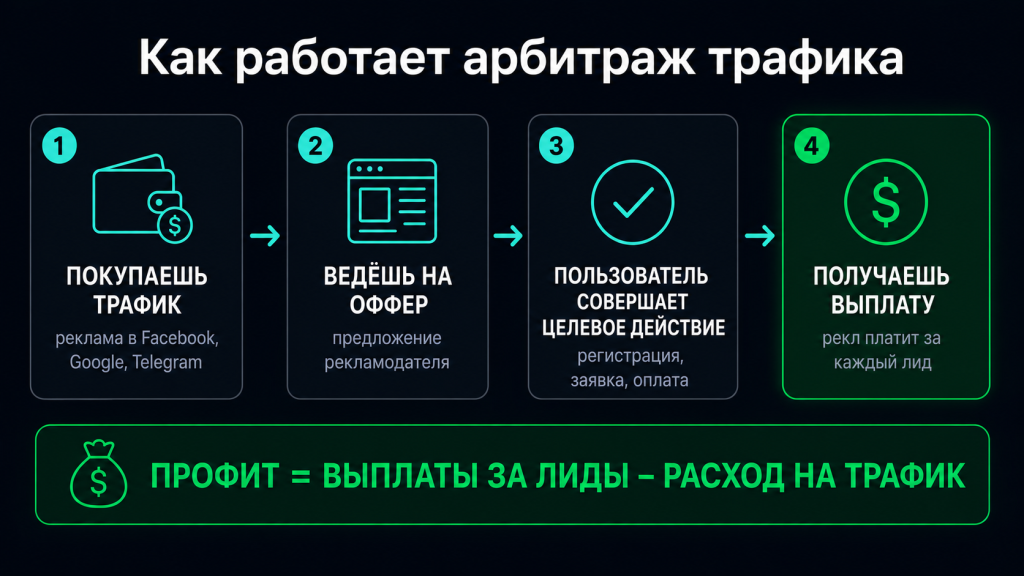
The entire arbitrage mechanic in one scheme: buy traffic cheaper — get more for target actions
Advertisers pay according to different models, and the model determines how you count the money:
- CPA (cost per action) — a general term: you get paid for the target action specified in the offer. Other models starting with “C” (like CPI) are specific cases. The most common ones are highlighted separately. For example, these three.
- CPL (cost per lead) — for a lead or registration.
- CPS (cost per sale) — for a confirmed purchase or order redemption.
- CPI (cost per install) — for an app install.
Opposing the CPA model and its derivatives is Revenue Share (also known as RevShare, RS, revshare).
- RevShare — a percentage of all spending by the referred user over time. For example, every casino player deposit or every in-app purchase. This is for the patient: the money comes in slowly, but for a long time.
- Hybrid — a combination of CPA and RevShare: a fixed payout for the first action (CPA plus a percentage of further spending). Common in gambling — you get paid for the deposit right away and a share of future play.
A bit of magic, let’s reinforce what we’ve learned with a real offer example:
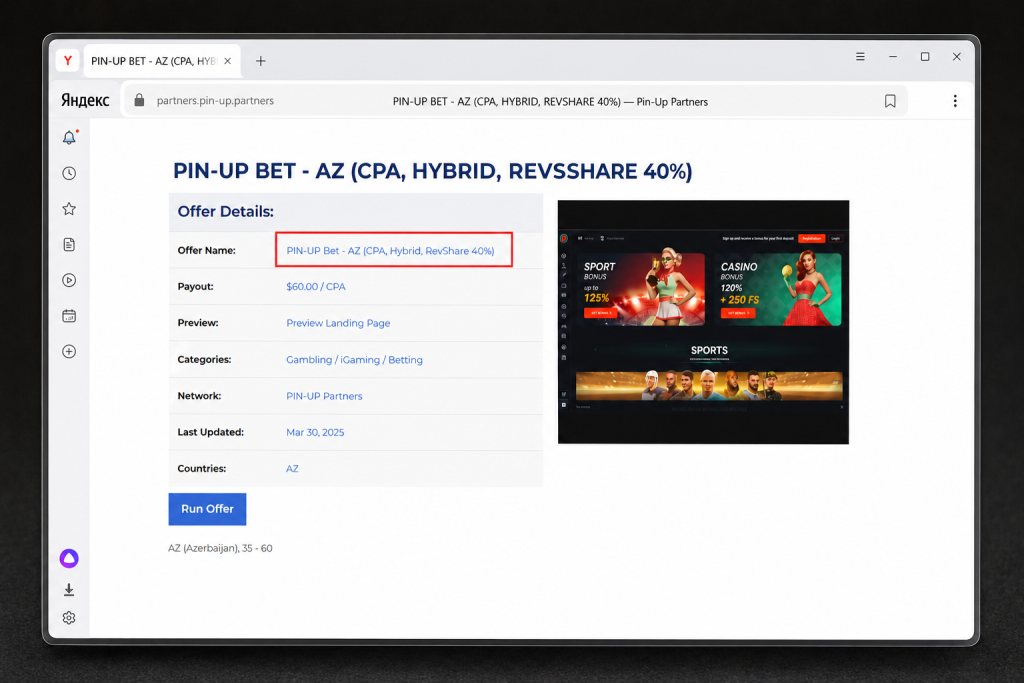
Now to the money — with real numbers, because this is where beginners face the main illusion. A simple example: you spent $100 on ads → brought in 5 leads at $30 each → revenue $150, profit — $50, ROI — 50%. Looks great! But this is a spherical example in a vacuum.
In reality, you need to calculate more than just ad spend. Petya Soloviev broke down the full math of launching in iGaming (casino) as of December 2025: anti-detect browser, proxies, accounts, cards — just these consumables add up to about $885. And to at least break even on those with an average ROI of 30%, you’ll need to run about $1300 worth of traffic. So, just to break even, your starting budget should be around $1685, and that’s in the best-case scenario. “When someone tells you ‘five hundred is enough to test’ — know that’s complete nonsense,” Petya sums up.
| Important. Consumables (accounts, proxies, cards, software) in arbitrage can cost as much as the ad budget itself. Calculating ‘how much I have for ads’ without them is the main rookie mistake in the math. |
Who to Work With: Affiliate Networks and Direct Advertisers
You’ve found a traffic source and you’re ready to run — but where to? Direct advertisers usually don’t accept beginners: it’s easier for them to work with proven partners. That’s why there’s almost always an affiliate network (affiliate program or CPA network, also called AP) between you and the money — an intermediary connecting advertisers and affiliates.
Advertisers need clients, you need offers. The affiliate network connects both sides and guarantees the rules of the game: tracking (counts your clicks and conversions), payments, and dispute resolution.
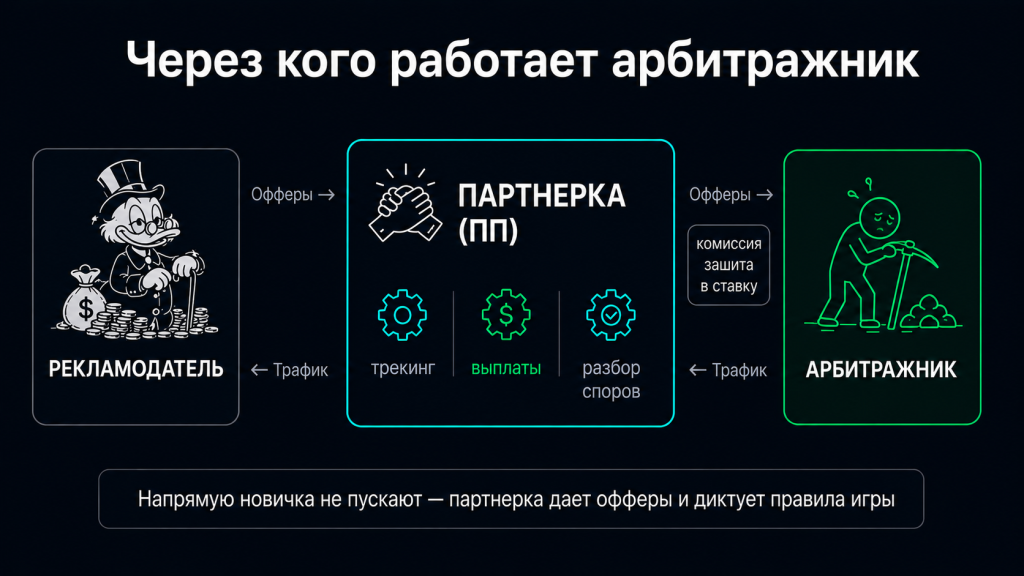
The affiliate network stands between you and the advertiser — provides offers, tracks traffic, guarantees payouts, and takes its commission from the rate
The mechanics are simple: go to the catalog → pick an offer → get your affiliate link with a unique ID — everything that comes through it is tracked in your stats. The advertiser pays the network, the network pays you. The network’s commission is already included in the offer rate, so you see the final amount.
Two nuances you should know from the start:
- Hold — the period while the advertiser checks the quality of your traffic before releasing the money: from a few days up to a month.
- Payout frequency — through a network, you usually get paid more often than direct: once or twice a month, some even weekly.
Networks can be niche (only gambling or only nutra — higher rates and deeper manager expertise) or multivertical (offers from different niches in one catalog, convenient for testing).
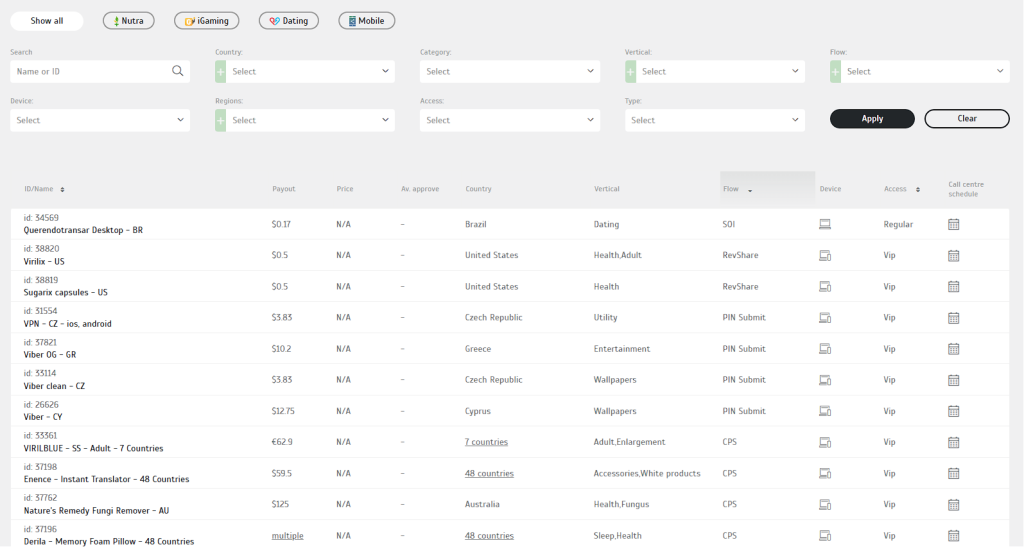
By how they work, affiliate networks can be divided into categories:
- Classic. Marketplace of third-party offers.
- Advertiser APs. Promote their own product, usually with better terms — for example, Pin-UP casino and the Pin-UP Partners affiliate program.
- Resellers (resell offers from other networks).
Important. Choose an affiliate network as a partner, not as a store. Look at five things: reputation (Google reviews—do they pay on time, do they shave leads), verticals and GEOs for the offer, terms (payout, hold, minimum withdrawal), a responsive manager (if they go silent for two days—that’s a red flag), and tech (reliable stats, postback support). The same offer can have a 10–30% payout difference across different networks.
Verticals: what people actually run
Verticals in affiliate marketing are thematic niches for offers. They’re usually divided into three colors, and Dmitry Leto explained it best:
- White — “normal products and services where people get clear value”: goods (e-commerce), apps, VPNs, antivirus, loans, insurance.
- Gray — things that live on the edge of ad platform rules.
- Black — outright fraud and theft. Leto is honest about these: “we condemn this and don’t teach it”; payouts are higher, but “you could end up in jail.”
Gray verticals are the industry’s bread and butter, so let’s break them down separately:
- Nutra — health and weight loss products, supplements, remedies “for joints and hypertension.” Low entry barrier, lots of offers, but tough moderation.
- Gambling (online casinos) and betting (sports betting) — the most lucrative and competitive niches, high payouts for deposits, but fierce competition.
- Crypto — exchanges, wallets, trading courses, “magic services.” Solvent audience.
- Dating — dating sites and apps, an evergreen niche.
Which should a beginner choose? The logic is simple: start with white or carefully with gray, where the rules are clearer. Jumping straight into gambling in expensive GEOs is a sure way to burn your budget before you understand the mechanics.
Traffic sources
Where to get people from—that’s the million-dollar question (sometimes literally). All traffic falls into three types: organic, conditionally free, and paid.
Organic — people come on their own, usually from search. You don’t pay for ads. Two main channels here:
- SEO — promoting websites in search results (Yandex for Runet, Google for international). It takes months to build up, but then (if you’re lucky) the site generates traffic on its own.
- ASO — same thing, but for mobile apps (App Store, Google Play). Especially relevant for gambling, dating, and gaming.
Conditionally free (CF) — you don’t buy ads, but you invest your time:
- Social media — Facebook, Instagram, TikTok, VK, YouTube. The mechanics are the same: create content (posts, Reels, Shorts, streams), add links, drive people to a pre-landing or Telegram.
- Messengers — Telegram, WhatsApp, often used as a bridge: warm up the audience and convert them in the channel. Moderation is softer, so they’re popular for gray verticals.
| Note. “Conditionally free” means “without direct ad buying,” not “free.” Time, equipment, editing, account farms—all of these cost money. Sometimes less, sometimes more. But one way or another, CFB ≠ free. |
Paid is classic affiliate arbitrage: you buy ads, get leads, and profit from the margin. There are dozens of formats; here are the main ones as examples:
- Contextual—ads shown to users already searching (Google Ads, Yandex Direct). Auction-based model: hot keywords are expensive, so you have to look for narrow niches.
- Social media targeting—Facebook Ads, VK Ads, TikTok Ads. Flexible targeting by gender, age, geo, interests. Grey niches only work via moderation bypass. Offers huge potential traffic, but accounts get banned in batches. For stable work, you need a whole arsenal of tools (anti-detect, proxies, cards, spy tools, etc.).
- Ad networks—push (cheap but cold traffic), popunders (more aggressive, open without request), teaser networks (clickbait on news sites). Low entry threshold, but without a good pre-lander, there will be no conversions.
- Influence—ads with bloggers. They don’t have to be million-follower stars: a microblogger with an engaged audience often converts better for less money.
And the main hidden expense that beginners forget about. According to Leto, on any paid source, expendables (accounts that “burn out constantly”) eat up the budget just as much as the ads themselves.
| Note. The cheapest way to start is through CFB or push on low-cost geos—the cost of mistakes is minimal. Facebook, Google, and SEO are about bigger budgets and patience; better to save them for later. |
Where to learn affiliate arbitrage
There are tons of courses online. But most of them sell a sugar-coated dream. Dmitry Leto, who creates educational content himself, doesn’t spare his fellow creators. In plain language: half the videos teach you not to run traffic, but to dream about easy money.
Dmitry Leto runs the MediaLeto channel—“arbitrage without fluff.” Part of this material is based on his experience and quotes.
The working approach is to combine. There’s enough free material:
- niche YouTube channels from practitioners (Leto, Petya, and others);
- forums like FB-killa—the largest CIS affiliate forum, nearly 64,000 members, with a free knowledge base, manuals, and case studies;
- official Facebook Blueprint—Petya directly recommends: “don’t underestimate training from Facebook itself.”
One of the training courses on the FB-killa forum: you’ll get the basics of how to run gambling and nutra offers on Facebook
Next, take a small budget and spend it on your own tests: that’s the best textbook you can get. How do you spot a scam course versus real training? Simple marker: if they promise a “secret combo” and guaranteed income—run. There are no working combos for sale that don’t burn out. In fact, there are no combos that never burn out.
| Important. Traffic changes constantly—what worked a month ago may not work today. That’s why any course is outdated by the time it’s released. As Petya says: training only makes sense in the moment and for a specific task, not as a memorized scheme for years. The industry changes very fast. |
How much do affiliates really earn—actual numbers
This is where the most important and most overlooked part begins. Ad case studies love to show off millions, but reality is much more modest.
Dmitry Leto writes about a female affiliate he knows: “she runs $2000 solo on nutra—not much, but 90% of this chat don’t make that much from campaigns.” So even among a niche channel’s subscribers, most don’t reach a couple thousand dollars. And he clearly articulates what it takes to start in the niche: a reasonable entry in 2026 is “from $300 to $1000, and you have to be ready to lose that money.”
To be specific, here are real numbers from both sides—successes and losses:
- Leto’s team on nutra—“$36.6k in 68 days” to be paid out (that’s a team, not solo).
- His own failure, straight up: “Lost $2000 on Bangladesh, 513 regs, 49 deposits”—and he has dozens of such posts.
- Yoda Traffic team started out “making $1k+ per week.”
- And top buying teams handle volumes like “200 million clicks”—but that’s a different league, not a solo laptop warrior.
Denis Denisenko notes the overall trend: “the era of easy money in affiliate is over. Affiliate marketing is evolving into a full-fledged digital business… only those who can build a system will survive.”
| Important. The money you start with isn’t for profit, it’s for testing. If you come in thinking ‘I’ll make quick cash’—you’ll almost certainly lose everything and get seriously frustrated. If you come in thinking ‘I’m buying experience’—there’s a chance you’ll learn something. That’s probably the main thing to understand before your first launch. |
There is a ceiling, and it’s high — teams and top performers make serious money. But only a handful of people can consistently earn over $5,000 a month solo, and the road to get there is long. Most never reach it, so don’t fall for the illusion of “Well, I’ll definitely make it.” It’s better to consider a backup, underrated option: get hired as a media buyer.
Is there demand for arbitrage specialists in the job market?
Yes, and it’s significant. As of mid-June 2026, there are 164 media buyer vacancies on hh.ru just in Moscow, and about the same number for “traffic arbitrage.” There are openings for both juniors and more experienced candidates.
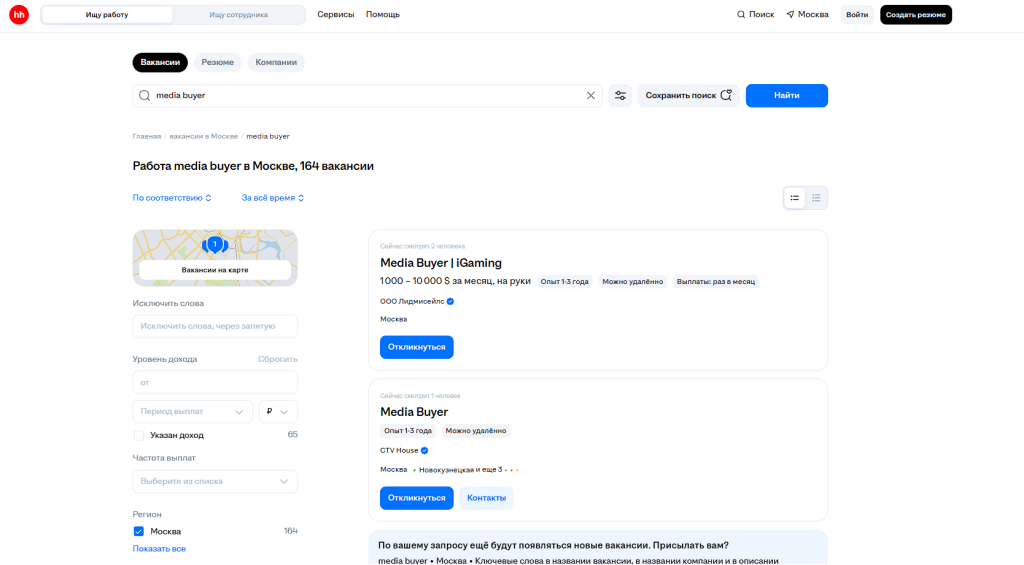
Salary grades look roughly like this (according to hh.ru editorial data and job listings):
- Junior — $350–900;
- Mid-level — $900–1,750;
- Senior — $1,750–3,500;
- some job listings report up to $9,250 or $5–10 thousand, but this is the ceiling including bonuses and commissions, not the base salary.
Many positions are remote, often specifying the vertical right in the job post (nutra, gambling, microloans). A fair disclaimer from hh itself: these numbers are stats for those who already have working funnels, and “a beginner may break even for several months.”
The flip side of the market: how things really work
Glossy guides skip this section because their authors have a commercial interest in pulling you into their affiliate program. We’re not selling anything, so we’ll show you the real deal — straight from those who are in the trenches.
The risk is always on the web. Petya Solovyov puts it bluntly: “our industry has no legal force. If you get scammed, the law will only work against you.” Advertisers and affiliate programs know how to cut your payout over a technicality: “there was a KPI for traffic, at the time of reconciliation it was short by 0.15%… they cut all our traffic and were ready to pay only 3K instead of 15K.”
Everyone copies each other. A newbie thinks they’ll find a unique funnel. In reality, as Petya describes, the market works like this: “an offer appears → everyone rushes to the spy service… sees a working creative → does the same thing → burns out → exits.” And right here comes the “survivorship bias”: in the spy service, you only see what everyone is already running, which means it’s about to burn out.
The market is squeezing out the small players. “Small teams have no place in gambling anymore,” writes Petya about 2026: major players are lowering caps, cutting margins for missed KPIs, and giving just 30 deposits for testing. Consolidation is underway—independent webmasters and solo affiliates are being pushed out by holdings.
Scam is part of the landscape. Kseniya Rusakova calls it as it is: “scams and high-profile scandals have become the calling card of our industry.” The classic scheme is simple: a partner is lured in with attractive terms, sends traffic, and then the endless “we’ll definitely pay, but we don’t know when” begins at payout. Check the reputation of a network before you send them large volumes of traffic, not after.
| Important. This is not a reason to avoid affiliate marketing—it’s a reason to enter a new niche with your eyes open. Understanding that the risk is on you and the law is not on your side separates those who survive and learn to make money from those who lose their first thousand and blame the world. |
Myths and Trends: Where Affiliate Marketing Is Heading in 2026
“Affiliate marketing is dying.” A statement that buries the industry every year. Petya breaks it down simply: those talking about the death of affiliate marketing admit that “the entry threshold is higher, but the field is growing and developing… it’s only dying for those who have nothing to do with traffic.” In other words, it’s not dying—it’s becoming more professional.
Artificial intelligence is changing the craft. Denisenko has already “rebuilt all media buying through AI agents”: they generate creatives, spy on competitors, set up campaigns, and build landing pages. The result—“the speed of launching new funnels has increased sevenfold.” For newcomers, this means AI is eating up more and more routine, and what matters is not “knowing which buttons to press,” but your mind and strategy. This also makes the entry threshold to the niche harder.
The end of easy money and consolidation. The main trend all four experts agree on: brands are counting the economics at the level of ROI and traffic quality, and the market is narrowing to major players with IT and analytics.
This is clearly seen in a real example—Petya notes that “the iGaming market has split into 1WIN and everyone else.” The major player closes geos for their own teams, making it harder for solo affiliates. According to Denisenko, those who survive are “the ones who know how to build a system and manage the economics.”
Who Should NOT Go Into Affiliate Marketing
A section that is usually quietly skipped.
Arbitrage is not passive income. It’s a job that requires a strong nervous system because you’ll regularly face budget drains, unstable tools, and unpredictable ad platforms. A real-life example is Dzmitry Leto, who, besides sharing successful cases, is not shy to write about the price of his journey. “Constant burnout takes its toll, sitting in a small town without a community is tough.” He also openly talks about overcoming alcohol and gambling addiction—the flip side of the “easy internet profession” was anything but easy.
Important. If you’re looking for a stable paycheck on the 1st and 15th, aren’t ready to work at a loss for months, and get stressed over bans—arbitrage is not for you. And that’s okay. It’s better to realize this now than after losing money on tests.
But if uncertainty doesn’t scare you, and you’re ready to calculate, test, and learn from losses—then you have a chance. But it’s just a chance, not a guarantee.
Conclusion
Traffic arbitrage is not a gold mine. It’s a regular advertising job with lots of stress and no guarantee of stability. There’s big money here, but the entry threshold is rising, easy profits are gone, and most beginners lose their first budgets.
But the niche is very much alive: there are many veterans who have gone through burnout and stayed. And the demand for media buyers on the job market is real and strong, so even if you don’t make it solo, you can earn a salary as an employee.
If you decide to try—start with a budget you can afford to lose, track every test, and don’t believe anyone promising a million from $500. And if you realize it’s not for you—that’s fine too. It’s better to run one honest test than live in illusions for years.

FAQ
It's earning money by reselling attention: you buy ads for less, bring customers to the advertiser, and get paid more than you spent. The difference is your profit.
Start with theory (free videos and forums), a small test budget ($300–$1000, ready to lose), and one bundle: one source, one offer, one geo. And with a clear understanding that your first tests will likely be unprofitable.
It varies. Most beginners break even or lose money in the first months. The average practitioner makes from a few hundred to a couple thousand dollars, but only a few consistently make over $5,000 a month. As a hired media buyer in Russia—anywhere from 30,000 to 300,000 rubles depending on your level.
Affiliate marketing is broader—it's any sale via a partner link, including through your own organic audience. Arbitrage is its paid, aggressive version: you buy traffic and immediately send it to the offer.
By itself, yes, it's advertising. The risks are in gray and black verticals (casinos, betting, scams) and in dealing with unclear money flows. If you go white—register as self-employed or as an individual entrepreneur.
Not necessarily. There are plenty of free materials (YouTube, forums, Facebook Blueprint), and any course becomes outdated quickly—traffic changes all the time. It's often more useful to spend your test budget on practice than to pay for a “secret bundle”.

Comments (0)