


Back in 2020, Mikhail Svinarev — a solo media buyer well known in Russian-speaking affiliate circles, where he co-owns the network Defo.cc and runs his own shop, Entropy LLC — told an interviewer that dating is an evergreen vertical that isn’t going anywhere. New users show up every day looking to connect with whoever they’re into, he said. Four years later, in August 2024, he said the exact same thing on stage at Kinza 360. Nothing had changed. Between those two comments: a pandemic, wave after wave of Facebook bans, a dozen traffic sources rising and dying off. Dating just kept standing there, unbothered.
That’s the whole pitch for this vertical. Beginners running $100 test budgets and full teams with six-figure monthly spend both end up here, because people never stop wanting relationships — or sex, for that matter. Somebody’s going to get paid for that. Let’s break down how dating traffic arbitrage actually works, what it pays, and which GEOs, networks, and sources to start with.
What Dating Traffic Arbitrage Actually Is
Dating is the vertical where you drive traffic to dating sites and apps, and the affiliate network pays you for every registered or paying user that traffic turns into.
It’s a solid entry point for beginners because you’re not selling a product or talking anyone into a loan. You’re pointing someone toward something they already wanted: a conversation with somebody on the other end of the screen.
Svinarev puts it plainly: “I do affiliate marketing — specifically, I buy traffic and convert it on offers.”
Translated out of arbitrage-speak: you buy impressions and clicks in one place (an ad network), send that traffic to a dating offer somewhere else (an affiliate network), and if what the network pays beats what you spent buying the traffic, you’re in the black.
The demand behind this isn’t manufactured. Kaspersky’s research puts it at roughly 48% of people downloading dating apps just to meet new people, 41% looking for friends, and 24% after something serious — an actual relationship. The online dating market runs around $6 billion, with an audience of roughly 360 million people worldwide. Match Group — the holding company behind Tinder, Hinge, and a stack of other apps — accounts for about $3.3 billion of that, and Tinder was the top dating app by downloads in 2025. Numbers like that are why Svinarev calls dating “an ocean with a hundred different ways to swim in it.”
The vertical splits into two camps: mainstream and adult. The difference isn’t just what’s in the creative — it’s how you get paid, where you’re allowed to run, and how often you get banned.
What is Mainstream Dating
Mainstream dating means “respectable” dating — people build a profile, swipe through photos, and message each other hoping for a date, a relationship, or at least some low-stakes flirting. This is Tinder, Bumble, and Badoo territory, products the whole industry studies as the gold standard: swipe mechanics, women get the first move, quizzes to boost engagement.
Mainstream is the white-hat side of the vertical. Most platforms approve these creatives without much friction, and payment processors rarely blink at the offers themselves. Payouts here usually run on a lead-gen model — you get paid for a registration or a verified profile.
Adult Dating — How It Differs
Adult dating means hookup sites, cam offers, 18+ content — built for one thing, fast. Different creative intensity, different offers (think OneNightFriend or FuckBook), and a completely different relationship with ad moderation.
The big difference: adult barely gets a foot in the door on “clean” platforms. Facebook, Google, and TikTok won’t touch it openly, so adult traffic runs through pre-landers, tube sites, and push and popunder networks that don’t blink at 18+ content. Adult also tends to pay out over the long haul rather than on a single registration, through upsells and a cut of what the user spends over time (more on that below).
Dating has its narrow sub-niches too — gay dating, casual hookups, speed dating.
Payout Models: SOI, DOI, PPS, and RevShare
Before you pick a GEO or a source, figure out what you’re actually getting paid for. The model decides how easy your first month in dating is going to be.
SOI (Single Opt-In) — you get paid for a registration, no confirmation needed. The user drops an email or fills out a short form, and that’s a counted lead.
DOI (Double Opt-In) — same thing, except the user also has to click a confirmation link in their inbox. The lead’s worth more, but you’ll convert fewer of them; some people just never open that email. Industry estimates put SOI converting 2-4x higher than DOI, depending on the GEO and offer.
PPS / CPS (Pay Per Sale) — you get paid when the user actually pays for something, a subscription or a service. Higher payout per conversion, but brutal to test: at $70 a lead, you need hundreds of conversions before you’re looking at real statistics.
RevShare — you get a cut of everything the user spends over a set window. In dating, that’s typically 30-70% over 30-180 days, and one paying user can be worth $100-300 total. This model rewards patience; the money trickles in, it doesn’t show up all at once.
Which one should a beginner run? Listen to someone who’s been doing this since 2018. Svinarev runs lead-based payouts on principle, not sale-based: “I don’t run CPS with dating… It’s just easier this way in most cases — I get credit for every lead that hits my tracker.”
The logic: dating advertisers don’t make their money purely off the sale. “There’s a whole complex operation on their end,” Svinarev says. “They resell that traffic inside membership areas, monetize it through push subscriptions.” In other words, the user might never buy anything, and the advertiser still cashes in through banners, popunders, and on-site push opt-ins. Run CPS, and — in his words — “you’re cutting your own EPC” before the advertiser even gets a chance to monetize the rest of that funnel.
Bottom line for beginners: start with SOI or DOI offers. They’re simpler, cheaper to test, and give you feedback fast.
Best GEOs for Dating and Adult
GEO decides almost everything: traffic cost, payout size, competition level. Dating GEOs split into three tiers based on how much the local audience can spend.
Tier-1: High Payouts, Brutal Competition
Tier-1 means the wealthy markets: the US, UK, Canada, Australia, Germany, France, the Nordics. Payouts are the fattest here, but clicks cost real money. LosPollos’ rate card, for example, lists CPL up to $4.95 for Norway, $4.00 for Australia, and $3.60 for the US, and other networks pay even higher depending on your volume.
Sounds great until you remember the competition. Walking into Tier-1 as a beginner is like opening a coffee shop directly across from a Starbucks: great foot traffic, but the guys who got there first, with real budgets, will flatten you. Even Svinarev admits native on Tier-1 “gets expensive fast: 20-cent clicks, $50 payouts on offers.” There’s almost no room for error.
Tier-2 and Tier-3: Where to Cut Your Teeth
Tier-2 covers markets that can still pay, just without the pressure: Poland, Czechia, Brazil, Mexico, Japan, Romania. Lower payouts, but clicks cost pennies. Tier-3 (Africa, Southeast Asia) gets you huge volume at up to $0.02 a click, though payouts drop to $2-15 a conversion.
This is exactly where Svinarev tells beginners to go, for cheap experience, not fast money: “You can safely tell people to try dating in some cheap-lead GEO, something like LatAm. Colombia’s got solid offers, for instance. You can test for $20 and already have real stats, a pile of leads to look at.”
Twenty dollars burned, and you’re looking at real clicks, real leads, learning to actually read your numbers. That’s when things start clicking, as he puts it. Infinitely more useful than torching that same $20 on Tier-1 and walking away with no idea what happened.
Where to Look in 2026: LatAm, Eastern Europe, and AI Dating
Beyond classic Tier-1, LatAm — Mexico, Brazil, Colombia, Chile — keeps showing up as a working region for dating. Eastern Europe gets mentioned too, though hard rate data is thin in public sources.
One trend worth watching for 2026: AI dating. Virtual companions and AI chat products are already spinning up their own offers. If you’re looking for where to plant a flag early, that’s the direction.
Traffic Sources That Actually Move Dating Offers
A source is wherever you’re buying, or scraping for free, people’s attention. Each one behaves differently with dating traffic. Here’s the rundown.
SEO: Doorways and Tube Sites
SEO in dating is a long game: you build sites for search traffic (or spin up doorway pages) and drop offers on them. In adult, the classic move is a tube site with an embedded smartlink. Upside: organic volume can get massive. Downside: it’s slow and technical, not something a beginner can just jump into.
Push and Popunder: The Workhorse
Push notifications and popunders (a window that opens behind your main browser tab) are the vertical’s workhorse, and the friendliest paid source for a beginner. The barrier to entry is low: you can fund a push network account with as little as $100, and clicks start around $0.005 CPC for push and $0.5 CPM for popunder, per RichAds’ numbers.
Push is basically a text from an unknown number, except it lives in your browser: a short message with a photo that pops up over everything. Svinarev flags one detail worth watching closely, subscription freshness: “0 to 3 days is your freshest subscriber pool, those users convert best. After that you’re usually looking at a 3-6 day bucket, and it drops off from there.”
In plain terms: the newer the push subscriber, the more likely they are to click and register. Check this number every time you’re buying traffic.
Native Advertising
Native ads get into dating through “article” and “review” pre-landers, something like “5 Dating Sites That Actually Work,” and the user clicks through. Clicks are cheap, starting around $0.001 CPC per RichAds. Native networks moderate adult content harder, so mainstream dominates here.
Facebook and Instagram
Facebook and Instagram mean huge reach, and the biggest headache in a dating affiliate’s life. The platform is, to put it mildly, cold on dating. Svinarev doesn’t hold back on this one: “Facebook is brutal on dating. Must be Zuckerberg’s personal thing or something. Forget Facebook, honestly.”
Behind that joke is a real wall of frustrated advertisers. Officially, Meta only allows dating-service ads after written approval; you have to apply and disclose details about your service, and in practice it’s a lot easier to clear that bar if you’re the actual dating brand rather than an affiliate. Everything else falls into a gray zone, which is why affiliates dress dating apps up as “entertainment,” enough to trigger the right association in a user’s head without tripping the moderation algorithm.
By 2026 the rules have only gotten tighter. AI moderation catches violations more precisely, and the “easy money” era on Facebook is over. Running here means a rotation of warmed-up backup accounts, clean pre-landers, constant monitoring, and bans you’ll never fully avoid. Test budgets start around $200. If you’re new, this isn’t your first source.
This is also the point where cloaking needs explaining, because you can’t really talk about Facebook without it. Cloaking is a setup where one URL shows two different pages: the moderator and the review bot see a harmless “white page,” while the real user lands on the “black page” with the actual offer.
One important distinction: gray-hat cloaking breaks a platform’s terms of service, but on its own it’s usually not against the law; it’s a contract violation, not a criminal one. The real risk isn’t legal trouble, it’s account bans, domain bans, and frozen ad balances.
The 2026 trend is a move away from cloaking and toward clean pre-landers, neutral-looking reviews and articles that walk the user toward the offer gradually, as the more sustainable play. For what it’s worth, Svinarev says the whole cat-and-mouse game with moderation isn’t for him: “I’m not a fan of all this account-ban stuff, even when you’re running something completely compliant. It doesn’t fit my idea of a normal business process.”
TikTok
TikTok is semi-free traffic territory: you run an account, post short videos regularly, and drive people through a bio link to a quiz, a pre-lander, or a Telegram channel. You can’t send traffic straight to the offer; you need to warm the audience up first. It barely costs anything, but it eats a ton of manual work — accounts, videos, rotation, even with AI in the mix. Works well for mainstream dating and traffic to dating sites.
YouTube
YouTube works for dating through Shorts: short clips that warm up the viewer with a link attached. It takes real content effort, but the payoff can be solid. One public case study had a “YouTube to dating” setup pulling in $1,229 over two months.
So which source should you actually start with? Asked this in 2023, Svinarev votes for push: “For beginners, I think push is one of the most forgiving sources out there right now, because the barriers to entry are lower than, say, native. The amount of training data you get per dollar spent is a lot higher.” Translation: the same budget buys you more clicks and more real experience on push than it would on expensive native or Facebook’s minefield.
How to Create Creatives for Dating and Adult Offers
A creative isn’t half the job. It’s most of the job. Svinarev doesn’t sugarcoat this: “An adult or dating offer, in any classic arbitrage setup, is half the battle at minimum. Sometimes it’s 90%.”
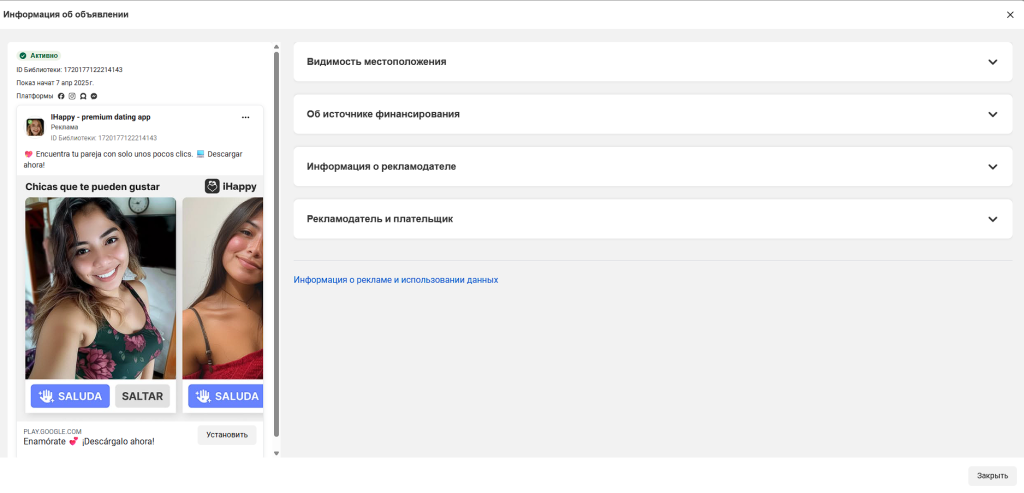
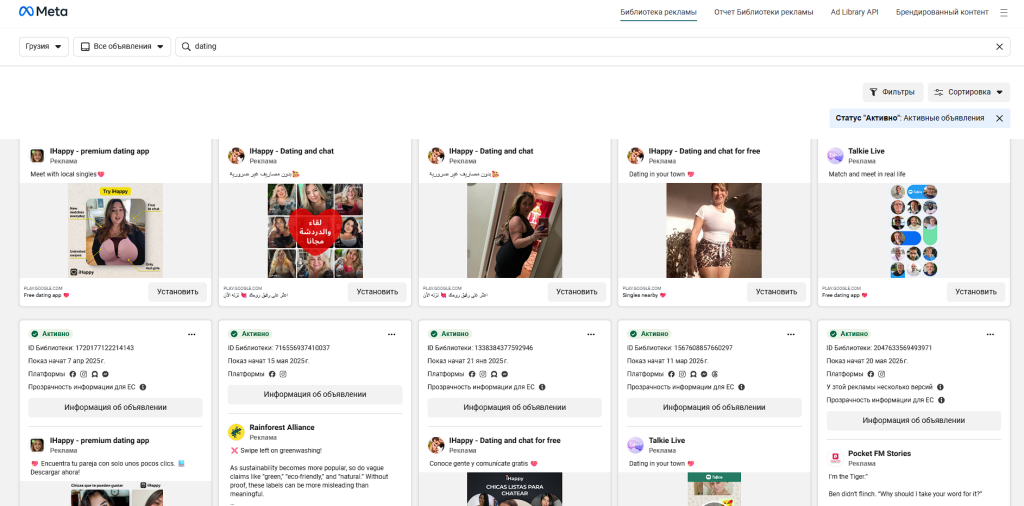
You can pull up Meta’s Ads Library, search “dating,” and dig through what’s currently running, including the full detail behind any individual creative.
What works in mainstream dating arbitrage
Mainstream lives or dies on feeling real:
- Photos of regular people, not glossy stock models. The second something looks like an ad, the brain scrolls past it.
- Fake personal-message push notifications: “You have a new message from Anna.”
- Quiz-style creatives with personal questions (“Who are you looking for?”).
- Short videos with a direct invitation.
| Rule one: don’t oversell it. Whatever the creative promises, the landing page has to deliver on it, or you lose the click in two seconds flat. |
What works in adult
In adult, the intensity is higher, but the principle is the same—use pre-landers, not vulgarity for its own Adult runs hotter, but the underlying logic is the same: hook, don’t just shock.
- Countdown timers and “2 profiles left in your city.”
- Fake chat windows, made to look like someone’s already messaging you.
- “Pass this quiz to get access” mini-games and age-verification hooks, both built to create a sense of exclusivity.
- Pseudo-news pages and fake review pages.
Different sources want different pre-landers: push does well with hyped clickbait, while Facebook and native teaser traffic respond better to Stories-style and pseudo-news formats. The classic beginner mistake is cramming the pre-lander with text. People don’t read, they skim. Every extra paragraph costs you conversions.
Spy services for analyzing competitors’ creatives
Spy tools show you what competitors are already running, which saves you weeks of blind testing; you’re not reinventing anything, just watching what’s working right now. The names that come up most often in affiliate write-ups:
- AdHeart — Facebook and Instagram, database of about 900 million creatives;
- AdPlexity — mobile, push, native, from $199 per month, with landing page export;
- Anstrex — push and native;
- AdSpy — Facebook and Instagram;
- BigSpy — TikTok, FB, YouTube, has a free plan;
- Facebook Ads Library — free, directly from Faceboo.
Don’t treat spy data as gospel, though. Svinarev, who’s used these tools for years, keeps expectations realistic: “Spy tools are often a funhouse mirror. What you see in there doesn’t fully match reality. I run big volume myself, and I regularly can’t even find my own ads in there.” Spy tools point you in a direction. Your own test is still the final word.
Direct Offers vs. Smartlinks
Every beginner hits this fork in the road: run specific dating offers, or route everything through a smartlink?
A smartlink is a “smart” URL that isn’t tied to one offer. On click, it reads the user in a fraction of a second — GEO, device, OS, browser — and automatically routes them to whatever offer fits best. Rough but useful comparison: a smartlink is a buffet, where the system puts whatever you’re most likely to eat on your plate; a direct offer is ordering off a menu, where you know exactly what’s coming.
When a smartlink makes more sense: during testing, when your traffic is mixed and you can’t narrow the segment yet; when the GEO isn’t locked in and you’re running broad; when you don’t want to build a dozen landers for a dozen countries. For a beginner, this is often the easier call, less manual work, and the system optimizes on your behalf.
When a direct offer makes more sense: once your GEO and segment are locked in and you’ve got a lander built for exactly that audience. A direct offer usually pays more per conversion and gives you more control over the funnel, since a smartlink by nature averages things out.
One practical tip: if your GEO’s already set, don’t guess at the offer alone; ask your network’s manager. Svinarev calls this one of the real, working paths for a beginner: “Ask a decent manager at a decent network. They’ll recommend landers, offers, all of it. More often than not, it just works.”
Picking a Dating Network (and Dodging Shave)
A network sits between you and the advertiser: it hands out offers, counts your leads, and pays you. Its honesty determines whether you ever actually see that money. First, what to check before signing up, then a list.
What to look at:
- Shave — the network under-reporting your leads to pay you less. The biggest risk in this vertical, more on this below.
- Hold — how long money sits before you can withdraw it. Dating smartlinks typically hold your first payout for 7 days, then release with no hold after that.
- Minimum payout and payout frequency. Beginners want a low withdrawal threshold and frequent payouts; it keeps you from running dry while you’re still funding traffic.
- GEO and offer fit. Does the network’s strength match your GEOs? Is it mainstream or adult? Mixing banned adult traffic into a mainstream offer is a fast way to get banned and lose your balance.
- Manager quality. A real person who suggests offers and pulls reports for you, versus a bot with copy-paste answers.
Shave is worth addressing directly, since most guides skip it. It’s real, but it happens less than beginners assume; networks that have been around a while protect their reputation, and it’s usually the newer ones that cut corners. One honest caveat: often the affiliate is the one at fault, running incentivized or bot traffic and assuming they’re getting “shaved.” Check your own links and source first.
How people actually catch shave: run the same offer through 2-3 networks at once and compare (30 leads on one network and 3 on another, on the same traffic, is a red flag); watch for a sudden drop in approval rate; run a test conversion yourself; keep your own tracker so you can see real clicks independent of the network’s reported numbers.
This is exactly what Svinarev’s talking about when he explains why he values networks that don’t reject after the fact: “If it hit your tracker through a postback, that’s your earned money, like a signed contract. Chargebacks and rejections after the fact feel really shady to me. It just opens the door to abuse.”
So the honest way to think about this isn’t finding some mythical “shave-free dating network.” It’s finding one with a track record. Nobody can guarantee anything; your own tracker, and running traffic through more than one network in parallel, is the only real protection you have.
Top Dating Affiliate Networks 2026
These are networks people actually run traffic through. Both the strengths and the complaints from reviews are worth knowing here; a glossy 4.9-out-of-5 score on an aggregator site means nothing on its own.
- LosPollos — a smartlink network a lot of people use to test dating for the first time. Global coverage, weekly payouts on Tuesdays, $100 minimum payout. Complaints in reviews: limited visibility into which offer your traffic is actually landing on, and occasional reports of conversion rates dropping sharply.
- Trafee — mostly adult smartlinks with AI-based optimization, and its own tracking platform. $100 minimum, 7-day hold on the first payout only. Some reviews mention account bans with balance still on them, so read the proxy and GEO rules before you run traffic.
- MyLead — a broad multi-vertical network (5,500+ offers by their own count) that also covers mainstream dating. Its edge for beginners: a $20 minimum payout and fast payments. The downside: complaints about accounts getting suspended with balances seized for rule violations, so read the terms carefully.
- Adverten — a dedicated dating network running since 2016, strong on Tier-1, Italy, and Brazil, with some exclusive offers. Reviews describe it as relatively clean on shave; it’s actually one of the networks people call out by name as low-shave.
- MTRAF — a newer dating network (mtraf.io), smartlink-based, $50 minimum. Not much of a track record yet, so if you try it, start with a small test budget. It effectively aggregates a few smartlinks under one roof.
If you’re not sure where to start, Trafee’s low barrier to entry and LosPollos’ reputation both make sense as first moves. Test everything on your own traffic regardless; nobody else’s results guarantee yours.
Cases: real results in dating and adult
The numbers below come from public case studies with actual proof attached. Screenshots of ROI shooting to the moon with zero verification don’t make the cut here; dating case studies get faked just as often as any other vertical’s.
- Native to smartlink, 111% ROI. Setup: native traffic into AdsEmpire’s dating smartlink, running the US, Sweden, Netherlands, Poland, and a few other GEOs. Over one month (November 2021): $3,894 spent, $8,238 earned, $4,344 profit, 111% ROI.
- Adult dating in the US via push, 167% ROI. Traffic from ExoClick and Clickadu push plus ClickAdilla banners, running AdsEmpire’s OneNightFriend offer. Over one week (early 2022): $1,500 spent, $4,000 earned, $2,500 profit, 167% ROI, roughly $600 a day in profit.
- Semi-free traffic on YouTube Shorts, 571% ROI. Almost no ad spend: free traffic from YouTube Shorts into an iMonetizeIt smartlink. October 2022: $210 spent, $1,408 earned, $1,200 profit, 571% ROI.
What do these have in common? A narrow setup: one source, one offer, one GEO, not “run everything at once.” That’s the exact replication principle Svinarev preaches: “We look at what people are running right now, in what GEO, and to start, we just copy that setup. Don’t try to invent anything of your own at the early stage.”
Now, the cold shower. Dating and semi-free traffic attract a lot of inflated case studies and outright scams: round numbers on TikTok screenshots, courses promising “run dating, make a million.” Don’t trust numbers without actual stat screenshots and a verifiable source. Behind a flashy case study, more often than not, is a course being sold, not real profit.
Bottom Line
Dating is a rare vertical that actually forgives beginner mistakes. You can start with $20 in LatAm, get your reps in on push, and not go broke on your first test. It’s evergreen not because some guide says so, but because people never stop looking for each other, and the market numbers back that up, as do the affiliates who’ve been running this for years.
That doesn’t make it easy. You won’t figure out dating in a weekend. Facebook is actively hostile to the vertical, and setups burn out fast, so you’re always hunting for the next one. Which is why the best advice for starting out is: don’t spread yourself thin. As Svinarev puts it: “You need to lock onto one thing and hit that one point hard.” Take one GEO, one source, one offer type, and push that single setup into profit before you touch the next one.
Keep his other warning in mind too, the one about early wins going to your head: “Sometimes winning too fast can actually hurt you. You lose your footing, start thinking you’ve already made it, that you don’t need to put in the work anymore. Then the setup dies — they always do — and that’s when the crash hits.” Dating is a marathon. Not a lottery ticket.

FAQ
It’s earning money by driving traffic to dating sites and apps. You bring users, the affiliate program pays for registration, profile confirmation, or subscription payment.
You can practice on LATAM with as little as $20. But to really get into the business and learn, you should have $3,000–$5,000. That’s a testing budget, not for a single campaign.
Mainstream means “decent” dating. These usually pass moderation on white-hat platforms. Adult is 18+ content, almost never allowed on Facebook and Google, run through push, popunders, and tubes, and more often monetized via sales and RevShare.
In theory, any. But of course, it’s best to start testing with push and popunder traffic. Low entry threshold (from ~$50), cheap clicks, and maximum experience per dollar spent. Facebook, SEO, and the rest are better left for later.
No one gives an absolute guarantee. 'No shave' means a proven reputation, not a promise. The only protection: your own tracker and running the same offer on 2–3 networks in parallel for comparison.
For testing and mixed traffic, usually a smartlink: the system will pick the offer itself. If you know the GEO and segment, a direct offer gives you more control and higher payouts. For certain GEOs, coordinate the offer with your affiliate manager.
It’s mainly needed to bypass Facebook moderation for adult and gray offers. This violates platform rules and risks account and domain bans.

Comments (0)