

Imagine you run three review sites targeting Czechia and all three need backlinks. A good outreach placement costs several hundred dollars, and your total budget is, say, $3,000. The top five results already belong to teams backed by hundreds of referring sites. What do you do?
Beyond the obvious solution (pies, as the editor puts it), there’s a more practical option: build your own network of sites and place as many links as you need without paying per placement. That’s a PBN.
Here’s how PBNs work, what they really cost, how Google responds to them, and why so many older tactics have stopped working by 2026.
What Is a PBN, and Why Do SEOs Build One?
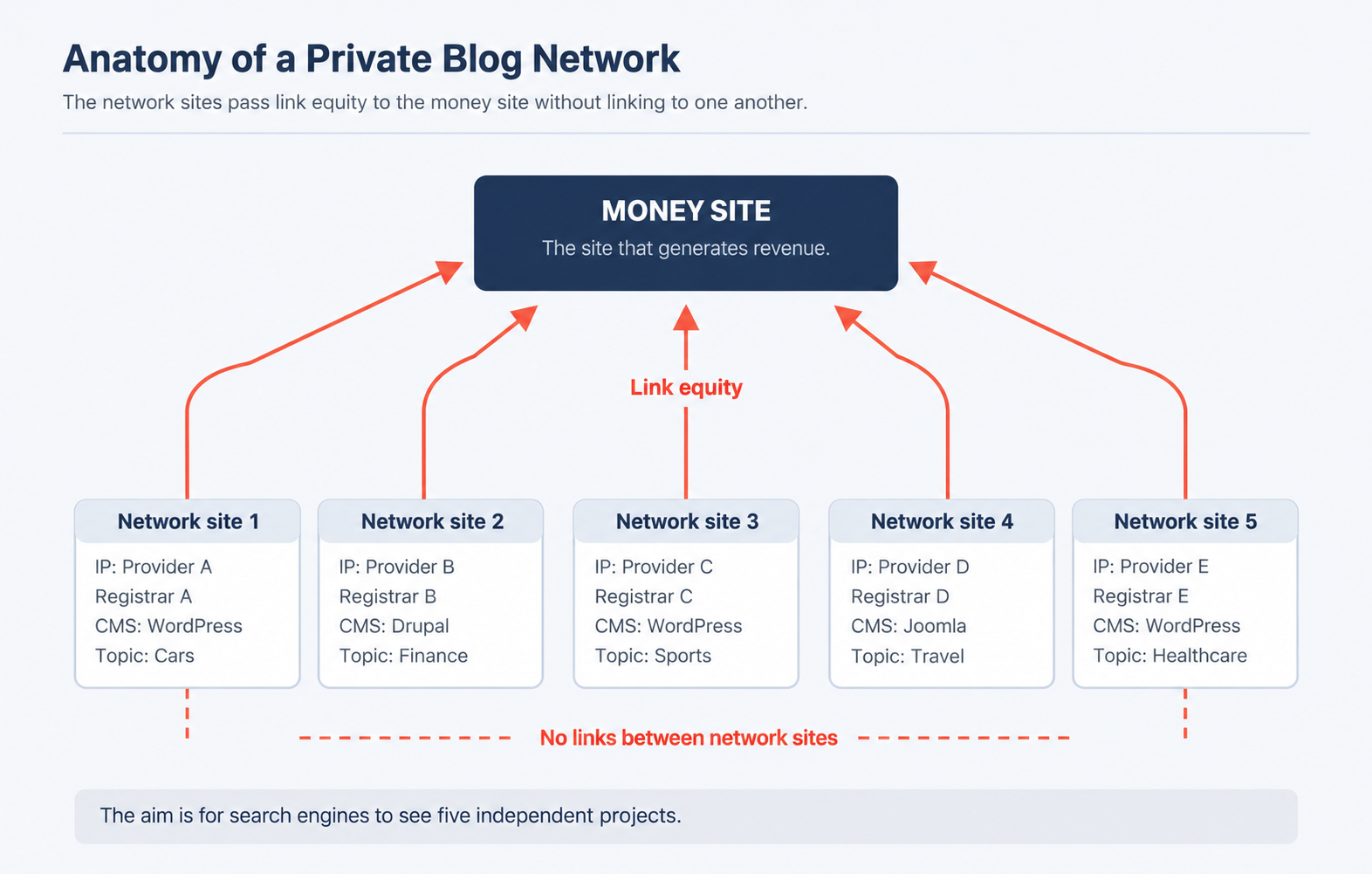
PBN stands for private blog network. It’s a group of sites you control, built to pass link equity to a primary site. That primary site, known as the money site, earns the revenue. The rest of the network supports it.
The logic is simple. With someone else’s site, you have to pay their rate or pitch them through outreach, and they can take the link down whenever they like. Once your own sites are running, you can place links at any time, choose the anchor text, and pay nothing extra beyond hosting. In effect, you start buying links from yourself.
This is no longer exotic. In the affiliate company TrafficConnect, according to its co-founder Egor in a 1win Partners voice chat (in Russian), the PBN team worked alongside three SEO teams and designers, and “PBN specialist” job openings regularly pop up in industry channels (in Russian).
PBNs, Satellite Sites, and Doorway Pages
- Satellite generates its own traffic: it collects search queries, converts, and acts as a separate entry point. The link to the main project is basically just a bonus, not its whole purpose.
- Doorway is a one-time page for redirect: the user comes from search and instantly lands on the landing page. It lives only until it’s discovered.
- PBN is a link donor. It doesn’t need traffic, just link equity. However, “promotion through a network of satellites” and “PBN” often mean the same thing in SEO conversations, it’s just that the first term looks more respectable on a resume.
PBN 3.0: Why Networks of Dormant Sites No Longer Work
The old playbook was straightforward: pick up a dozen abandoned domains, install WordPress, rewrite some content, add links, and walk away.
By 2026, the scheme is already on its last legs. Andrey Soroka frames the task differently — to turn the site into “a niche media outlet, not a dead and lifeless site like most PBNs on the market” (in Russian). His network sites publish 20–50 themed articles daily, collect keywords, and generate their own traffic.
This is about making the investment last. A site that publishes useful content can survive updates, while a placeholder can drop out of the index. Cheap, mass-produced networks stopped paying for themselves before they could generate much revenue.
PBN Benefits, Costs, and Risks
The benefits come with real costs and risks.
What you get. Control over which pages you link to, which anchors you use, and at what pace. The cost of a link after the initial investment approaches the price of hosting. The link won’t be removed in a month because the owner sold the site. And you can scale without hitting market prices.
What you pay with:
- money upfront — the network requires investment long before you see results;
- time for maintenance;
- risks — this violates search engine rules, and the asset can be wiped out in a single update.
The most sober opinions come from practitioners. Oleg Shestakov, 15+ years in SEO, writes (in Russian): “All this black magic with drops and PBN… most people don’t need it.”
What Google Says About This
Google’s wording matters here because its policies are often paraphrased loosely.
The word “PBN” isn’t in Google’s rules. In the spam policies, the term private blog network doesn’t appear. But the practice is covered by two points.
- The first — link schemes: prohibited are “buying or selling links for ranking purposes,” “automated programs or services to create links,” and “widely distributed links in footers or templates of various sites.” A network created for links falls entirely under this definition.
- The second appeared in March 2024. Along with the March core update, Google announced three new spam policies, one of which is expired domain abuse.
The wording is: buying an expired domain and repurposing it mainly to manipulate rankings, with content that provides little value. The examples are clear: affiliate content on a former government domain, a casino on a former school domain.
The timing matters. Google began enforcing the new policy through both algorithmic and manual actions as soon as it was announced. Site reputation abuse got a grace period until May. Expired domain abuse did not. Since 2024, Google has explicitly named and monitored the practice of repurposing expired domains to manipulate rankings.
There’s good news too: the June 2026 spam update didn’t affect link spam at all. According to DrMax’s analysis (in Russian), only content and technical policies were enforced — large-scale templated content, unedited generation, cloaking.
What Can Go Wrong
There are three ways you can take a hit:
- The network goes down (money spent on domains is lost, the money site survives).
- Links drop out (rankings roll back to pre-link building state).
- Manual penalties hit the money site itself.
The third scenario isn’t exactly a horror story: Search Console has a specific term for it — “unnatural links to your site,” and it’s sent directly to the recipient of the links. This is how the PBN purge looked in September 2014, when Google simultaneously took down PBN networks and their clients: Spencer Haws from Niche Pursuits had five out of nine sites in his account hit with manual penalties — exactly those that relied on network links. Traffic dropped by 80–90% over the weekend, and minus $5,000 per month. The label was “low-value content,” and Google didn’t explain what exactly triggered it, but the correlation was obvious.
Today, notifications are rare: since December 2022, SpamBrain quietly nullifies spam links algorithmically.
How to Find and Vet Expired Domains
A PBN typically starts with expired domains, often called drops, that already have a history and inbound links.
Where to Look
There are three main ways to find them:
- Public aggregators — ExpiredDomains.net, MyDrop, DomCop: metric filters, zero entry threshold.
- Auctions — GoDaddy Auctions, Dynadot, NameJet: price is set by demand.
- Drop catching — the domain is grabbed at the moment it expires, before it hits the open market.
And here’s the main dividing line. Link building expert Charles Floate in a review with Mike Blazer (in Russian) claims: domains that have fully dropped and been restored only successfully pass link equity 8–10% of the time. Millions see public lists, and valuable domains are picked up before you get to them.
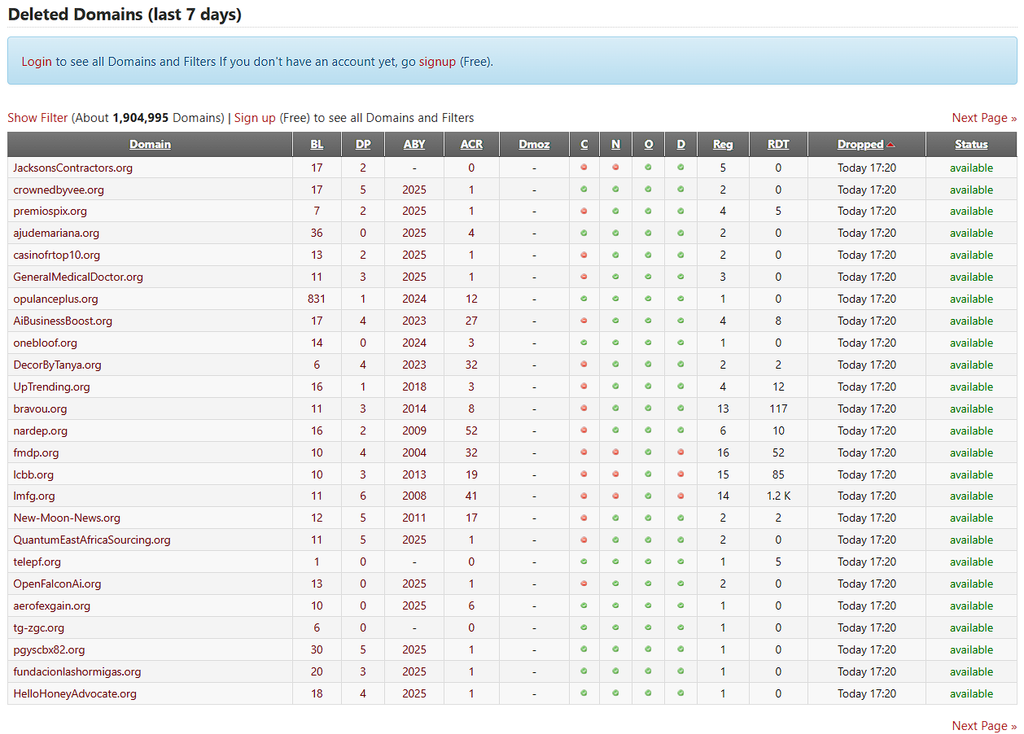
The same source suggests looking for external domains linked from relevant pages on authoritative sites such as Wikipedia or the BBC. Check their expiration dates and target those due to drop that week.
Which Metrics to Use
Start with these metrics:
- DR in Ahrefs,
- Trust Flow and Citation Flow in Majestic,
- number and quality of referring domains,
- topical relevance, age, and language of donors.
Next comes a warning that’s more important than any metric. Maksim Yarmukhametov, author of the channel “Po ushi v gemble,” in an interview for PressAff (in Russian) calls blind trust in tools the main mistake of beginners: “Both Ahrefs and SemRush often show something completely different from reality. Even specialized tools for finding hidden links and PBNs work less often than they don’t.” Where links are hidden behind cloaking, the picture from the tools and reality diverge fundamentally.
| Practical takeaway: a pretty DR often doesn’t reflect reality. Sometimes the number is artificially boosted right before a sale. |
How to Rule Out Low-Quality Domains
A must-do procedure is to check what the domain was used for in its “previous life.” Open Wayback Machine and scroll through the history: was the site ever a doorway, pharmacy, casino, or did it suddenly become Japanese-language (a classic sign of a hack, after which the domain drags garbage links for years).
Then check the anchor text. If 80% of the anchors are foreign-language commercial spam, the domain has little useful link equity to pass on.
Restoring Content on an Expired Domain
Once you buy a domain, you have to decide whether to restore the old site or build a new one.
Existing backlinks point to specific URLs. If those pages disappear, visitors and crawlers hit 404s, the links lose their value, and the site can look unusually new for a domain with a long history.
You can recover content from a web archive manually or with a service such as Archivarix. There are three options:
- Full restoration of structure and texts.
- Partial — restore the URL structure and rewrite the content for your own topic.
- New site with a redirect map — if the old one is hopeless, pages under the links are closed with redirects.
Keep Google’s expired domain abuse policy in mind. The further the new site strays from the domain’s previous purpose, the more closely it can resemble the kind of repurposing Google describes.
Hosting and the Footprints That Reveal a PBN
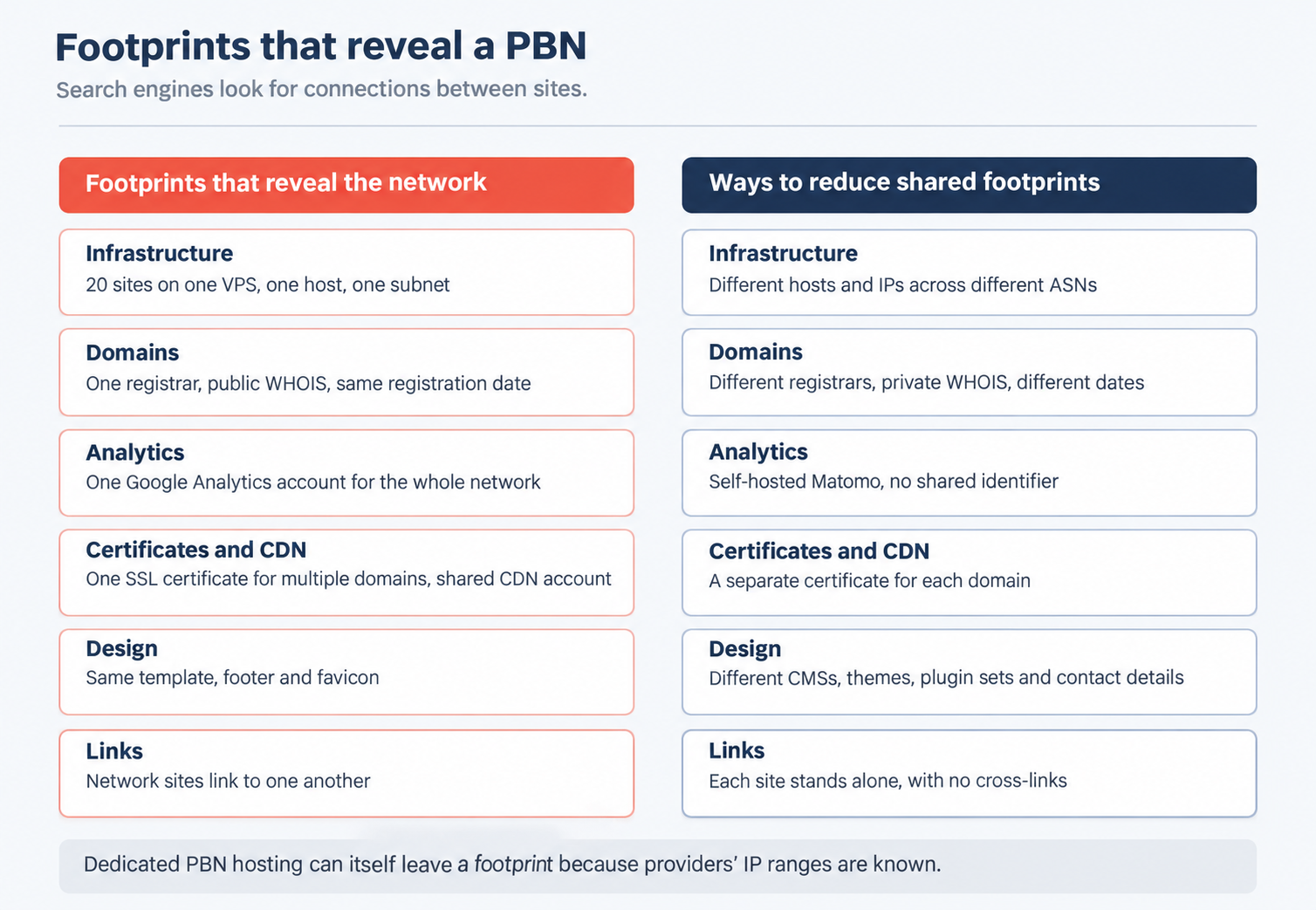
Google doesn’t look for “sites similar to PBNs” — it looks for connections between sites. The owner’s task: make twenty sites look like twenty unrelated projects.
Traces that expose networks are called footprints. The basic set is well-known: different IPs from different subnets and autonomous systems (ASN — a block of addresses from one provider), different hosts instead of twenty VPS with one, different registrars and hidden WHOIS, different CMS, themes and plugins, different domain registration times.
A separate irony: “specialized hosting for PBNs” is itself a footprint — the ranges of such providers are well-known. The market openly sells it: Netwall promotes itself in SEO channels (in Russian) specifically as infrastructure for PBNs and doorways, with abuse-resistance, DMCA complaint protection, and operation without KYC.
Beginner mistakes
- Analytics counters. One Google Analytics account for the whole network is a signature under every site. Mikhail Shakin uses Matomo for PBNs and satellites (in Russian): analytics is installed on your own server and doesn’t link projects with a shared identifier.
- SSL certificates. One certificate for several domains ends up in public Certificate Transparency logs, where anyone can read it.
- CDN. According to a breakdown on Mike Blazer’s channel, even standard masking via a popular CDN (in Russian) can link dozens of isolated projects at the routing level. The tool taken for anonymity works the opposite way.
- Small things: same favicon, copy-pasted footer, one contact template, one browser profile for the whole network without antidetect, identical typos in the header.
| Editor’s special opinion. What Kolya writes above is pure truth and sensible hygiene. But I personally know people with several hundred sites on one hosting, everything else just closed by Cloudflare. And it’s fine, they somehow live and earn. |
Content for PBN sites
Give the site regular posts, clear categories, internal links, and About and Contact pages. Its subject should fit the domain’s history or the site you’re promoting, ideally both.
Three Ways to Source PBN Content in 2026
Soroka on his 500 sites uses three schemes (in Russian), and they show well where the market has moved.
- Donor parsing. Category feeds are pulled from a niche site and assembled with a builder on your own site: two categories from one donor, three from another, with source attribution. It works as both a uniquifier and randomizer.
- Parsing with auto-rewriting. Same process, but the text is run through a neural network.
- Keyword-based generation. Semantics are collected, articles are written by ChatGPT via API, it picks images, publishes, interlinks, and sends for indexing. The pace is up to 20–50 articles per site per day.
And here’s the flip side. This is exactly the kind of mass generation Google targets with its separate scaled content abuse policy from March 2024. And the June 2026 update hit precisely this content (in Russian).
| Automation solves the volume problem, but editorial review still matters. Teams that pay for editing spend more and tend to keep their sites running longer. |
Link Strategies
- Anchor list. Exact keyword matches make up a smaller part of the profile, usually up to 10%. The rest: branded anchors, URLs, non-anchor “here” and “on the site,” vague phrases. Thirty links with the same commercial anchor look like a confession and the meme “punish me completely.”
- Quantity and speed. Links are added in batches, stretched over months. A real casino review case (in Russian) gives a benchmark: December — 8 links from PBN and 12 guest posts, January — 10 and 10, February — 10 and 14, March — 10 and 16, April — 10 and 20. Steady pace, and PBN is mixed with guest posts, not solo. Another detail from the same case: links from the main pages of the network were placed only two months after buying the domain — the site is left to age first.
- Where to link. Links only to the homepage look unnatural: real sites link to specific content, so internal pages of the promoted site should also get weight.
- Should you interlink sites in the network. No. Interlinking within the network turns separate projects into a graph.
Advanced Techniques: Tiered Links and Redirects
- Multi-level links. You need to boost not only the money site, but the network itself. Tier 1 — links from PBN to the main project. Tier 2 — crowd links, profiles, submits, web 2.0, which go to the network sites so they don’t look abandoned. Soroka does exactly this to boost his 500 sites (in Russian).
There are subtler schemes. Specialist Romain Pirotte describes link multiplexing (in Russian): instead of a guest post for 50 euros with one link, you take a placement for 80 euros where three are allowed. The first goes to the money site, the second — to a network node, the third — to a previously purchased guest post to refresh its weight. The price per link drops, and the link graph diversifies.
- Redirects. A dropped domain isn’t turned into a site, but a 301 redirect is set up from it to the main project to transfer weight directly. Fast and risky: along with the weight, the entire domain history moves, including penalties you didn’t know about.
A safer option is described by Shestakov for complex niches (in Russian): a neutral white site is made, outreach links are placed on it, and when 20–30 accumulate, a 301 redirect is set to the needed page. Some webmasters notice the scheme and remove links — “but out of 30 links, about 20 usually stay.” The cycle repeats.
PBNs and AI Answers: Visibility Beyond Search Rankings
Language models draw on publicly available sources. Mentions on sites relevant to a topic can influence which names those models surface in their answers.
Case study from Soroka, published on August 21, 2026 (in Russian). The tattoo artist’s website had a fresh domain and minimal optimization. Articles mentioning her by name appeared on 30 sites in the network. Almost no search traffic. But when asked about tattoo artists, ChatGPT recommends a specific artist and provides a link—and clients come mentioning the source.
In another experiment, Soroka added sitewide banners with UTM tags. The network itself drew several thousand unique visitors a day and could send referral traffic to the main project alongside the link equity.
Tools and Services
| Task | Solution |
| Drop search | ExpiredDomains.net, MyDrop, DomCop, GoDaddy and Dynadot auctions |
| Metrics evaluation | Ahrefs, Majestic, Serpstat |
| Domain history | Wayback Machine, search index check |
| Content restoration | Archivarix and similar tools |
| Network boosting (tier 2) | GSA Search Engine Ranker, crowd services |
| Analytics without common footprint | Matomo on your own server |
| Anonymity | anti-detect browsers, different registrars, WHOIS privacy |
Another option—ready-made solutions: links from other networks are openly sold. BootyBoost publishes pricing in SEO channels (in Russian): placement on an internal page of a Russian-language PBN—$25, homepage—$50, English-language from $40 and $80 respectively. This is a useful benchmark even if you’re not buying: it shows the market price of your own link.
How PBNs Differ on Yandex
The Russian-language web works differently. Tactics that work in Western markets don’t always carry over.
User behavior signals have long been a major ranking lever in Runet, so spending on them often takes priority over funding a network. For Yandex, a network can make sense when manipulating those signals is costly or risky and the network’s own sites already draw traffic. Otherwise, the budget is often better spent elsewhere.
PBN Costs and Payback
- Domains. Registering a new one—about $12. A drop with history—from a few dozen to several hundred, valuable lots at auctions are more expensive.
- Hosting. From a few dollars per month per site, multiplied by the number of sites plus the requirement to spread them across providers.
- Content. Either copywriters or generation: the latter is much cheaper and just as risky.
- Infrastructure and time. This line is often underestimated in calculations. Soroka spent 650,000 UAH (in Russian) on his own network management platform—automation of site creation, publishing, updates, scheduling, and monitoring. You can’t do three thousand sites manually.
Now, the opposite extreme. Mass cheap links are sold for 40 cents each, and on paper this looks more convincing than any network. Soroka breaks down the math (in Russian): out of a thousand such links, after three months only 150–200 remain, after six months about a hundred, of which roughly ten are indexed, with DR 0.1–0.5, no keywords or traffic. Paid for a thousand, received ten.
The point of no return. The main factor isn’t the domain price, but the network’s lifespan: the same amount invested for one year versus three years yields different results. So “how much does a network cost” is an incomplete question. The full question: how much does it cost per month of operation, and how many months will it last. And a practical budget tip: Yarmukhametov calls it a typical mistake to enter a niche with your last thousand dollars and adds that when calculating the budget, “it always turns out you needed 30–50% more.” Factor in this margin from the start.
PBN Case Studies
- Building a network of three thousand sites. Soroka announced the project on July 23, 2026 (in Russian): the goal is three thousand sites across seventeen topics, from media and IT to agriculture and fishing. The launch started with 34 sites in beta, then 500. Domains for Europe are registered and aged for 3–4 months before launch. By August, 500 sites are live (in Russian), content is being parsed and indexed, and the author expects the first traffic by September–October. The value here is transparency: every stage is documented with a date.
- A network as position insurance. A monobrand promotion strategy, analyzed in Alexander Flint’s report (in Russian): spam links help you reach the top, but drop off, while links from your own network let you stay at the top. Here, the network isn’t an engine, but an anchor: it holds positions when spam purchases disappear. About scale—launching ten sites a month, according to Flint, is “nothing,” the working number is a hundred.
- A network that survived everything. Yarmukhametov describes a twelve-year-old scheme (in Russian): 5–10 online stores on different templates, with different product networks, prices, addresses, and phone numbers, all traffic was routed to a single call center. Sites that didn’t rank were turned into PBNs and linked to the main one. Twelve years later, the projects are still alive and remain at the top for their queries.
- And a case against. The market evaluates the tool soberly: in Soroka’s poll on link strength (in Russian), PBN took third place—after homepage links and outreach. The owner of the three-thousand-site network agreed with the result.
Conclusion
Back to those three review sites targeting Czechia. A network gives you control over backlinks and reduces your dependence on other sites’ prices, but it takes money to run and won’t last forever. Here’s what to keep in mind:
- The domain matters most. For fully dropped domains, the success rate of weight transfer, according to practitioners, is 8–10%.
- The quality threshold has risen. Networks of dormant sites are fading out; networks with content, keywords, and their own traffic are what works now.
- You need to calculate not the cost, but the lifespan. The same amount invested for one year versus three years yields different results.
- PBN is not the only or the strongest tool. It works in combination with outreach, not as a replacement.

FAQ
A private blog network is a group of websites controlled by one owner. The sites appear independent but exist to pass link equity to the primary site that earns revenue.
PBN stands for private blog network. In Russian-speaking circles, you’ll hear 'PBN', 'network', 'site network', or sometimes 'satellite network'.
A new domain costs about $12 to register. Expired domains with a history cost more. Hosting starts at a few dollars per site per month, and you still need to budget for content and maintenance. As a benchmark, a link on an inner page of a Russian-language PBN costs about $25, compared with $50 for a homepage link.
Links — yes, it's an open market with price lists. Networks are also sold, but along with them you buy someone else's footprints and masking mistakes, which you'll discover after payment.
Signs: fresh content on an old domain with a change of topic, few pages and almost no traffic, outbound links to commercial projects in unnatural places, hidden WHOIS. There’s no reliable detector — specialized tools, according to practitioners, fail more often than they work.
From deindexing the network sites themselves to manual penalties on the promoted project. The worst scenario is losing not the network, but the money site itself.
PBNs tend to be less effective on Yandex than on Google. Yandex says that buying links through exchanges makes it harder to assess a site’s trustworthiness. User behavior signals remain more influential in Runet, and there are fewer platforms for tier-two links.
Evidence is limited. In one reported case, a site with almost no search traffic gained clients from ChatGPT recommendations after the brand was mentioned on sites in a PBN. It is unclear how often that result can be replicated.

Comments (0)