


Saying “I work in traffic arbitrage” often makes people wary. The news is partly to blame: high-profile scams reach the public, while an ordinary affiliate’s working day attracts little interest. Some readers also associate the Russian term with arbitration and the court system, adding to the mistrust.
The reality is more ordinary and more straightforward. Traffic arbitrage is an advertising model in which advertisers pay for results. Bring them quality traffic and they pay; bring low-quality traffic that does not pay off and they do not. Shady practices and scammers exist here, as they do elsewhere. But calling the entire industry a scam is like dismissing the whole internet because fraudsters use it.
This is a breakdown of traffic arbitrage for beginners in 2026—what this money-making niche really looks like without rose-colored glasses: where to start, who shouldn’t get into it, and how much money you can actually make.
Spoiler: less than clickbait YouTube videos and social media ads promise.
What Is Traffic Arbitrage?
Imagine buying a crate of tangerines wholesale for 100 rubles per kilogram and selling them at retail for 200. You keep the difference. Traffic arbitrage follows the same logic, except you are buying people’s attention instead of tangerines.
You buy traffic—impressions and clicks—from a source such as Facebook Ads Manager. You send those users to an offer: an advertiser’s product, game, subscription, or service registration. The advertiser pays for each person who completes the required action. If the payout exceeds your ad spend, you make a profit. If it does not, you lose money and need to work out what went wrong.
| Important. Affiliates are almost always paid for a specific user action: an inquiry, registration, payment, first deposit, completed order, and so on. Bring someone who registers or buys and you receive a payout; otherwise, you do not. You carry the risk: ads are paid for upfront, and you earn only if the traffic pays off. |
The key is a profitable campaign setup: a combination of traffic source, creative, offer, and target market that makes money. Finding that combination is the main job. The bad news is that successful setups eventually stop working. The good news is that new ones emerge.
| Traffic arbitrage and affiliate marketing are related, but they are not identical. Affiliate marketing is broader: a blogger recommending a service through a referral link is also an affiliate. Traffic arbitrage is its more aggressive, paid form: instead of waiting for an organic audience, you buy traffic and send it straight to an offer. Put simply, affiliate marketing is “recommend something and earn a commission”; traffic arbitrage is “buy ads, bring customers, and earn the difference.” |
What Does a Traffic Arbitrage Specialist Do?
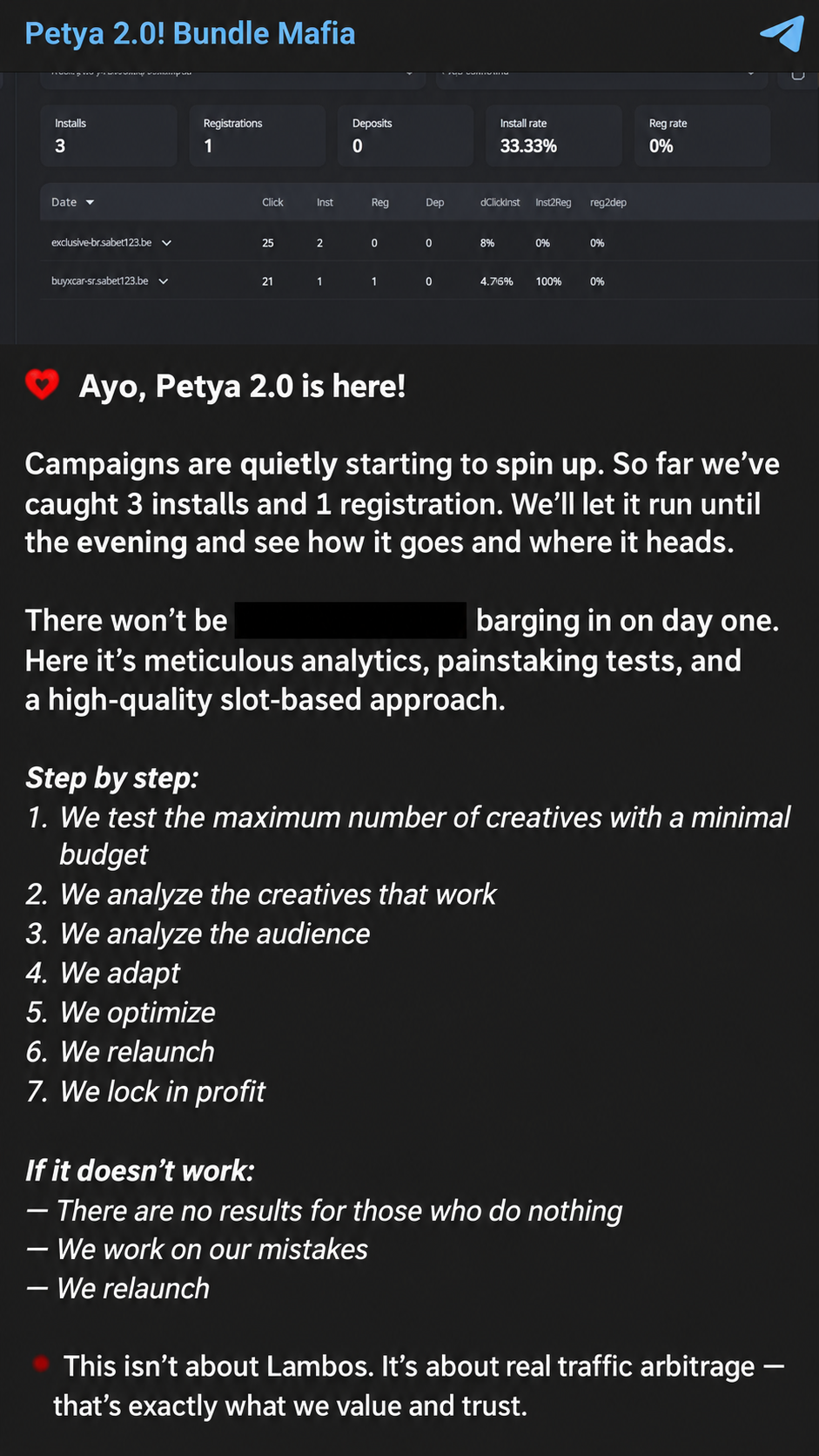
A traffic arbitrage workflow that can make money: continuous, painstaking work.
Strip away the glamour and a traffic arbitrage specialist is someone who tests ideas all day: launches ads, checks the numbers, switches off what fails, and scales what works. Practicing media buyer Petya Solovyov describes his routine (in Russian) in suitably ordinary terms: “meticulous analysis, painstaking tests… it’s not about Lambos.”
Two related job titles come up frequently:
- Media buyer—essentially the same role, but more often as an employee or team member responsible for buying traffic.
- Webmaster—a publisher who brings traffic from their own websites and SEO rather than paid advertising.
The boundaries are blurred, and job listings often use “traffic arbitrage specialist,” “media buyer,” and “webmaster” interchangeably.
A more useful distinction for beginners is how to work. There are several options:
- Working solo. Your budget, your decisions, and all the profit. The downside is that you carry every responsibility and need more starting capital per person.
- Running your own team. This is a business with defined roles, budgets, and hiring. Denis Denisenko, who moved from media buying into management, shows that you can earn without buying traffic yourself: build teams, establish processes, and take a share of the results. He says teams can have “from 30 to 250 people” (in Russian). But this is not an easy option either: the biggest losses can come from people rather than ads. “A large proportion of people fake their stats, invent a backstory, get onto a team, and put you in the red” (in Russian), Denisenko warns.
- Employment. You can join a team or larger business group as a media buyer, earning a salary plus a share of profit without risking your own savings.
- An advanced option is the SPEND model. Here, you run traffic using the advertiser’s budget rather than your own. However, as Petya Solovyov notes, “most people either don’t understand how to get into it or burn through the budget” (in Russian).
Is Traffic Arbitrage Legal?
Traffic arbitrage itself is legal: you bring in customers for a fee, which falls within Russia’s advertising law. The questions begin with what you promote. Gray-area verticals such as casinos and betting, and especially fraudulent schemes, can carry risks up to criminal liability. There is also a practical issue beginners overlook: Russian banks can block cards under Federal Law No. 161-FZ—as the author of this article has experienced—if you have not arranged formal registration and a lawful way to account for your income.
How Traffic Arbitrage Works
Traffic arbitrage is often called CPA marketing, short for cost per action. In simplified terms, it has three main components:
- Target action—the outcome the advertiser pays for: a registration, deposit, purchase, or completed order.
- Conversion rate—the proportion of visitors who complete that action.
- Offer—the advertiser’s proposition and terms: what you promote, which action qualifies for payment, the payout, eligible markets, and traffic restrictions.
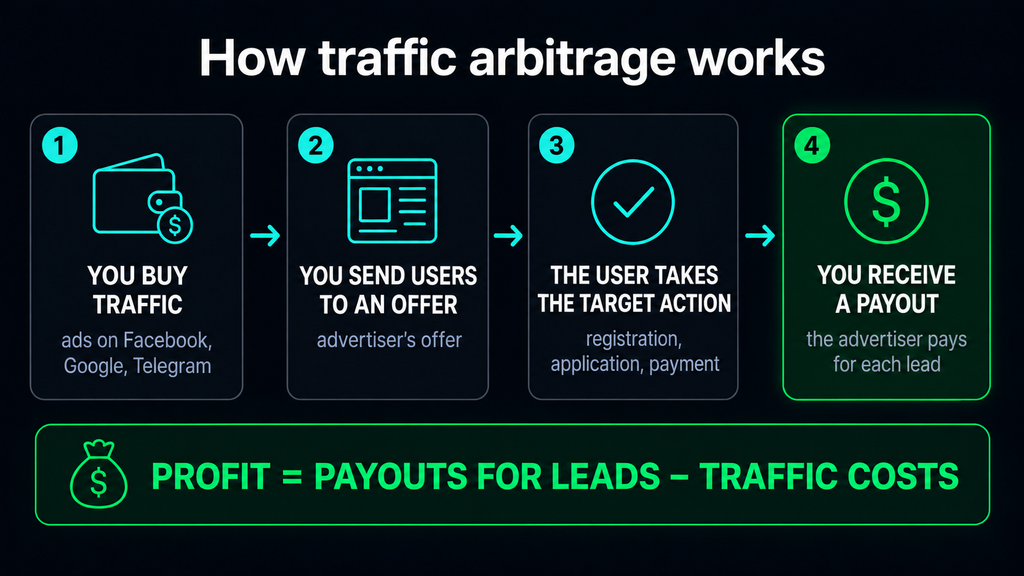
Traffic arbitrage in one diagram: buy traffic for less than you receive for the resulting actions.
Advertisers use different payout models, and the model determines how you calculate earnings:
- CPA (cost per action) is the umbrella term: payment is tied to the action specified in the offer. Other models beginning with “C,” such as CPI, are specific forms of it. The most common are usually listed separately, including these three:
- CPL (cost per lead)—payment for an inquiry or registration.
- CPS (cost per sale)—payment for a confirmed purchase or completed order.
- CPI (cost per install)—payment for an app installation.
Another model is revenue share, also known as RevShare or RS.
- RevShare—a share of the referred user’s spending over time, such as each casino deposit or in-app purchase. This requires patience: payments take time to build up but can continue for longer.
- Hybrid—a combination of CPA and RevShare: a fixed payment for the first action plus a share of later spending. Common in gambling, it pays for the initial deposit and gives you a share of subsequent play.
Here is a real offer to make the models more concrete:
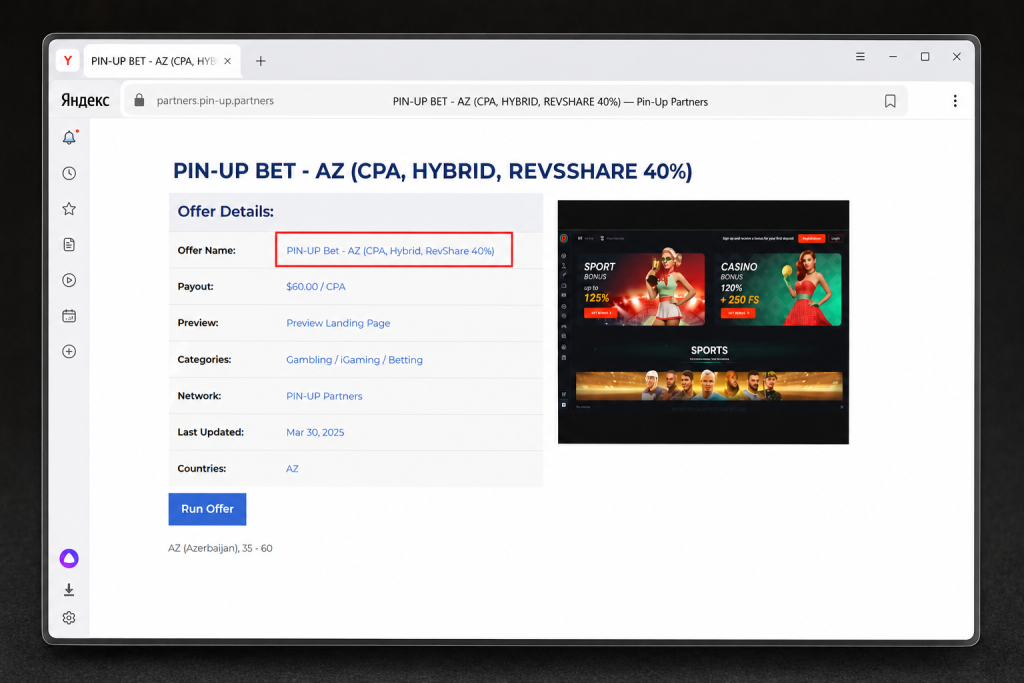
Now for the money, using actual figures—because this is where beginners can get the wrong impression. Spend $100 on ads → generate 5 leads paying $30 each → earn $150 in revenue, with a profit of $50 and an ROI of 50%. That looks good, but it is a simplified example in isolation.
In practice, you need to count more than ad spend. In December 2025, Petya Solovyov broke down the full cost of getting started in iGaming (in Russian) casinos: an anti-detect browser, proxies, accounts, and payment cards alone came to roughly $885. According to that breakdown, covering those costs at an average ROI of 30% requires about $1300 in traffic spend. The starting budget just to break even is therefore around $1685, even in the best-case scenario. “When someone tells you ‘five hundred is enough to test,’ know that it’s complete nonsense,” Petya concludes.
| Important. Operational resources—accounts, proxies, payment cards, and software—can cost as much as the advertising itself. Budgeting only for ads is a beginner’s biggest calculation error. |
Affiliate Networks and Direct Advertisers
You have found a traffic source and are ready to launch—but which offer should you promote? Direct advertisers rarely accept beginners; they prefer established partners. An affiliate network, also called a CPA network or affiliate program, therefore usually acts as the intermediary between you and the advertiser.
Advertisers need customers; you need offers. The network brings both sides together and manages the arrangement: tracking clicks and conversions, making payments, and resolving disputes.
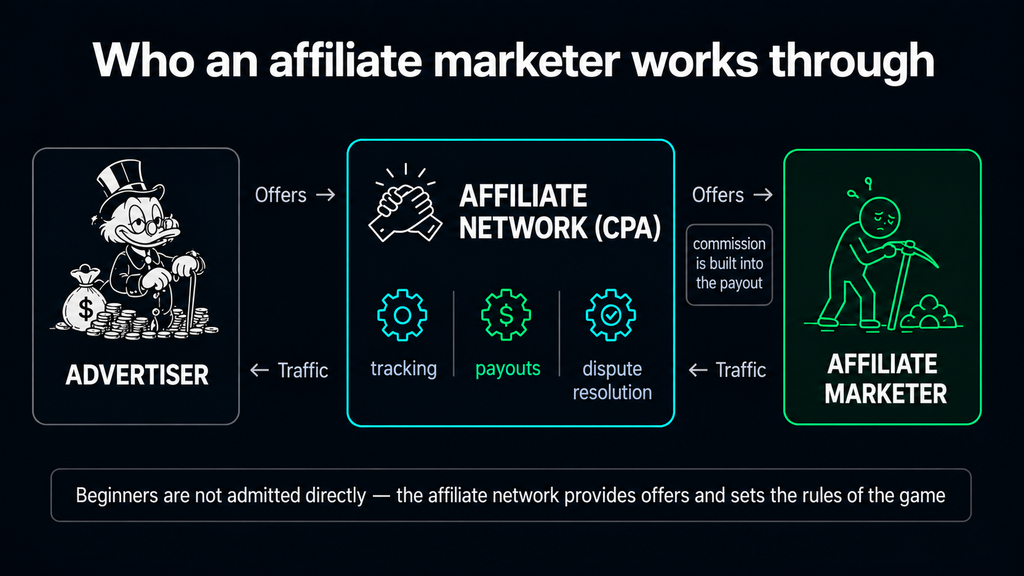
The affiliate network sits between you and the advertiser: it provides offers, tracks traffic, guarantees payouts, and takes its commission out of the payout rate.
The process is straightforward: browse the catalog → choose an offer → receive an affiliate link with a unique ID. Traffic through that link appears in your statistics. The advertiser pays the network, and the network pays you. Its commission is already factored into the offer’s payout rate, so the amount you see is what you receive.
Two details are worth understanding from the start:
- Hold period—the time an advertiser takes to check traffic quality before releasing payment, from a few days to a month.
- Payout frequency—networks usually pay more frequently than direct advertisers: once or twice a month, and sometimes weekly.
Networks can be specialist, focusing on gambling or nutra with higher payouts and more knowledgeable account managers, or multivertical, bringing offers from different niches into one catalog for easier testing.er expertise) or multivertical (offers from different niches in one catalog, convenient for testing).
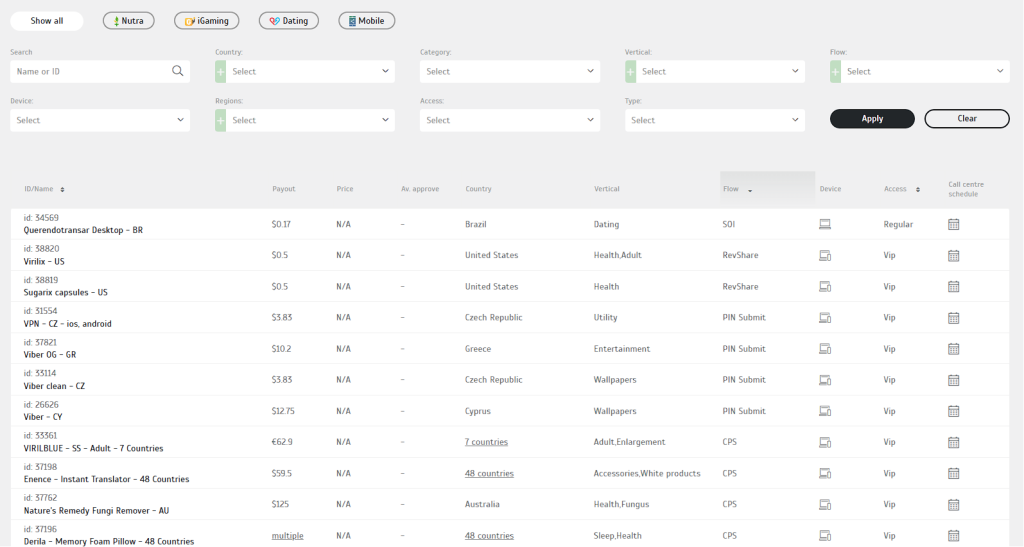
Affiliate networks also differ in how they operate:
- Traditional networks. Marketplaces for third-party offers.
- Advertiser-owned programs. These promote their own product and usually offer better terms, such as Pin-UP casino and its Pin-UP Partners program.
- Resellers. These resell offers from other networks.
Important. Choose a network as a business partner, not as a shop. Check five things: reputation—look for reviews about timely payments and withheld conversions; relevant verticals and target markets; terms such as payout rates, holds, and minimum withdrawals; a responsive account manager—two days of silence is a warning sign; and technical support, including reliable reporting and postbacks. The same offer can pay 10–30% more or less depending on the network.
Verticals: Which Offers Can You Promote?
Verticals in traffic arbitrage are the niches that offers belong to. The industry commonly groups them into three color categories. Dmitry Leto explains them particularly clearly:
- White-hat—“ordinary products and services that give people clear value” (in Russian): e-commerce goods, apps, VPNs, antivirus software, loans, and insurance.
- Gray-area—offers that operate at the edge of advertising platforms’ rules.
- Black-hat—outright fraud and theft. Leto is clear: “We condemn this and don’t teach it.” Payouts may be higher, but “you can end up in prison.”
Gray-area verticals account for much of the industry’s business, so they deserve a closer look:
- Nutra—health and weight-loss products, supplements, and products marketed for joint problems or hypertension. The barrier to entry is low and offers are plentiful, but ad moderation is strict.
- Gambling (online casinos) and betting (sports betting)—among the most lucrative and competitive niches, with high payouts for deposits and intense competition.
- Crypto—exchanges, wallets, trading courses, and services promising “magic” results. The audience has spending power.
- Dating—dating websites and apps, an evergreen niche.
Where should a beginner start? Choose a compliant vertical, or cautiously explore a gray-area one whose rules you understand. Starting with gambling in expensive markets is a reliable way to lose your budget before you understand the mechanics.
Traffic Sources
Where do you find users? That is the million-dollar question—sometimes literally. Traffic falls into three categories: organic, unpaid but resource-intensive, and paid.
Organic traffic arrives without paid ads, usually through search. Two main channels are:
- SEO—improving a website’s visibility in search, such as Yandex for the Russian-language web and Google internationally. Building traffic takes months, but afterward, with some luck, the site can attract visitors on its own.
- ASO—the equivalent for mobile apps in the App Store and Google Play. It is especially relevant to gambling, dating, and gaming.
Unpaid traffic, often called “conditionally free,” involves spending time rather than buying ads:
- Social media—Facebook, Instagram, TikTok, VK, and YouTube. Create content such as posts, Reels, Shorts, or livestreams, add links, and send users to a pre-landing page or Telegram.
- Messaging apps—Telegram and WhatsApp often serve as an intermediate step: build interest among the audience you attract, then convert them within the channel. Lighter moderation makes them popular for gray-area verticals.
| Note. “Conditionally free” means you are not buying ads directly; it does not mean there are no costs. Time, equipment, editing, and networks of accounts all cost money. Those costs vary, but unpaid traffic is never truly free. |
Paid traffic is the classic arbitrage model: buy ads, generate leads, and earn the difference. There are many formats; these are some of the main ones:
- Search advertising—ads for people already searching, through Google Ads or Yandex Direct. Auction-based pricing makes high-intent keywords expensive, so buyers look for narrower niches.
- Paid social—Facebook Ads, VK Ads, and TikTok Ads offer targeting by gender, age, location, and interests. Gray-area offers require bypassing moderation. The potential audience is large, but accounts can be banned in batches. Reliable operation requires a range of tools, including anti-detect browsers, proxies, payment cards, and ad intelligence services.
- Ad networks—push notifications provide cheap but cold traffic; popunders are more intrusive and open without being requested; teaser networks place clickbait ads on news sites. Entry costs are low, but conversions depend on a good pre-landing page.
- Influencer advertising—paid placements with content creators. They do not need millions of followers: a smaller creator with an engaged audience can deliver better conversions for less money.
Beginners often overlook another major cost. According to Leto (in Russian), on any paid source, operational resources such as accounts that “constantly burn out” can consume as much budget as the ads themselves.ves.
| Note. The cheapest starting points are unpaid traffic or push ads in lower-cost markets, where mistakes cost less. Facebook, Google, and SEO require larger budgets and more patience, so they are better left until later. |
Where to Learn Traffic Arbitrage
There are plenty of courses online, but many sell an unrealistic dream. Dmitry Leto, who produces training content himself, is blunt about other educators (in Russian). Put plainly, half the videos teach people to dream of easy money rather than run traffic. Leto runs MediaLeto, a channel about “traffic arbitrage without the fluff.” His experience and comments inform part of this article.
A practical approach combines different resources. There is plenty of free material:
- specialist YouTube channels run by practitioners such as Leto and Petya;
- forums such as FB-killa (in Russian), described as the largest affiliate forum in the CIS, with nearly 64 thousand members and a free knowledge base, tutorials, and case studies;
- official Facebook Blueprint training—Petya recommends it directly (in Russian): “Don’t underestimate training from Facebook itself.”
One of the training courses on FB-killa covers the basics of running gambling and nutra offers on Facebook.
Then set aside a small budget for your own tests: experience is the best textbook. How do you distinguish a scam course from useful training? If it promises a “secret campaign setup” and guaranteed earnings, walk away. Nobody sells a profitable setup that will keep working forever. Such setups do not exist.
| Important. Traffic changes constantly. What worked a month ago may no longer work today, so courses are already becoming outdated when they launch. As Petya says, training makes sense for a current, specific task, not as a fixed formula to memorize for years. The industry moves quickly. |
How Much Can You Earn? Real Examples
This is the most important part—and the part often left unsaid. Promotional case studies flaunt millions, but the reality is usually more modest.
Dmitry Leto writes (in Russian) about a female affiliate he knows: “She makes $2000 running nutra solo—not much, but 90% of this chat don’t make that from campaigns.” Even among a specialist channel’s subscribers, most therefore fall short of a couple of thousand dollars. He also sets out a realistic starting budget (in Russian): in 2026, it is “from $300 to $1000, and you must be prepared to lose that money.”
Here are specific examples of both earnings and losses:
- Leto’s nutra team reported “$36.6k in 68 days” (in Russian) due for payout. That was a team result, not one person’s.
- One of his losses: “Lost $2000 on Bangladesh, 513 registrations, 49 deposits” (in Russian). He has dozens of posts like this.
- Yoda Traffic’s team initially reached “$1k or more a week” (in Russian).
- Top media buying teams report volumes such as “200 million clicks” (in Russian), but that is a different league from one person with a laptop.
Denis Denisenko describes the broader trend (in Russian): “The era of easy money in traffic arbitrage is over. Affiliate marketing is evolving into a fully fledged digital business… those who know how to build a system will survive.”
| Important. Your initial budget is for testing, not immediate earnings. Expecting quick money is an almost certain route to losing it and becoming frustrated. Treating it as the price of experience gives you a chance to learn. That is perhaps the most important thing to understand before your first campaign. |
The earnings ceiling is high: teams and top performers make serious money. But only a few solo affiliates consistently earn more than $5000 a month, and getting there takes time. Most never do, so avoid assuming that you will be the exception. Consider an underrated alternative: taking a salaried media buying job.
Demand for Media Buyers in the Job Market
Yes, demand is substantial. As of mid-June 2026, hh.ru listed 164 media buyer (in Russian) vacancies in Moscow alone, with roughly as many results for the Russian search term “traffic arbitrage.” There are roles for juniors as well as experienced candidates.
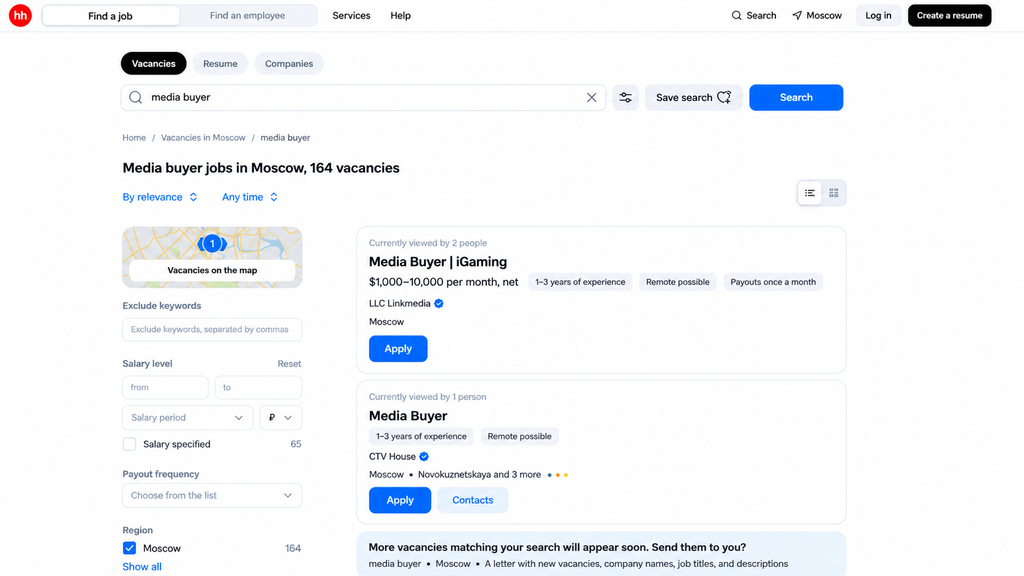
Approximate salary bands in Russia, based on hh.ru’s editorial data and job listings, are:
- Junior—RUB 30,000–80,000;
- Mid-level—RUB 80,000–150,000;
- Senior—RUB 150,000–300,000;
- Some listings advertise up to RUB 800,000 or $5–10 thousand, but those upper limits include bonuses and profit shares, not just base salary.
Many roles are remote, and listings often name the vertical: nutra, gambling, or microloans. hh.ru adds a useful qualification: these figures concern people who already have working campaigns, while “a beginner may spend several months just breaking even” (in Russian).
Behind the Scenes: How the Market Really Works
Glossy guides skip this section because their authors have a commercial interest in getting you to join their affiliate programs. We are not selling anything, so we will show the less polished side through the experiences of people working in the industry.
The affiliate carries the risk. Petya Solovyov puts it bluntly (in Russian): “Our industry has no legal standing. If you are cheated, the law will only work against you.” Advertisers and networks can cut payouts over a technicality: “There was a traffic KPI, and at reconciliation we were short by 0.15%… they rejected all our traffic and, instead of 15K, were prepared to pay just 3K.”
Everyone copies everyone else. Beginners imagine finding a unique campaign setup. In practice, Petya describes (in Russian) the cycle like this: “An offer appears → everyone rushes to an ad intelligence tool… sees a working creative → copies it → loses money → leaves.” There is also survivorship bias: those tools show you what everyone is already running, so the approach may be about to stop working.
The market is pushing out smaller operators. “Small teams no longer have a place in gambling,” Petya writes about 2026 (in Russian). Large players reduce conversion caps, cut margins over missed KPIs, and allow just 30 deposits for testing. Consolidation is pushing out independent publishers and solo affiliates in favor of larger groups.
Scams are part of the landscape. Kseniya Rusakova is direct: “scams and high-profile scandals have become our industry’s calling card” (in Russian). The usual pattern is simple: attractive terms draw an affiliate in; they send traffic; then the payout stage becomes an endless round of “we will pay, but we don’t know when.” Check a network’s reputation before sending substantial traffic, not afterward.” The classic scheme is simple: a partner is lured in with attractive terms, sends traffic, and then the endless “we’ll definitely pay, but we don’t know when” begins at payout. Check the reputation of a network before you send them large volumes of traffic, not after.
| Important. These risks are a reason to enter with your eyes open, not necessarily to avoid the industry. Understanding that you carry the risk and may not have the law on your side can separate people who survive and learn to earn from those who lose their first thousand and blame everyone else. |
Myths and Trends: Traffic Arbitrage in 2026
“Traffic arbitrage is dying.” The industry is declared dead every year. Petya’s response is straightforward (in Russian): the people predicting its demise admit that “the barrier to entry is higher, but the industry is growing and developing… it is dying only for people who have nothing to do with traffic.” It is becoming more professional rather than disappearing.
AI is changing the work. Denisenko says he has already “rebuilt the entire media buying operation around AI agents” (in Russian). They generate creatives, analyze competitors, create campaigns, and build landing pages. He reports that “new campaign setups now launch 7 times faster.” For beginners, this means AI handles more routine work, while judgment and strategy matter more than knowing which buttons to click. That also raises the barrier to entry.
Easy money is over, and consolidation continues. All four experts agree on the main trend: brands measure returns and traffic quality closely, and the market increasingly favors large operators with IT and analytics capabilities.
Petya illustrates this with an example (in Russian): “The iGaming market has split into 1WIN and everyone else.” The large operator reserves markets for its own teams, leaving less room for solo affiliates. According to Denisenko, the survivors will be “those who can build a system and manage the economics.”
Who Should Avoid Traffic Arbitrage?
This is another section that is usually quietly skipped.
Traffic arbitrage is not passive income. It requires resilience: losing budgets, unreliable tools, and unpredictable ad platforms are regular parts of the job. Dmitry Leto shares successful case studies but is also willing to discuss the personal cost (in Russian): “Constant burnout takes its toll; being in a small town without a community is tough.” He also speaks openly about recovering from alcohol and gambling addiction. The reality behind this supposedly easy online career was anything but easy.
Important. If you want a reliable paycheck on the 1st and 15th, cannot accept months of losses, and find account bans too stressful, traffic arbitrage may not suit you. That is fine. It is better to recognize it now than after losing money on tests.
If uncertainty does not put you off, and you are prepared to calculate, test, and learn from losses, you have a chance. A chance, however, is not a guarantee.
Conclusion
Traffic arbitrage is not a gold mine. It is an advertising job with considerable stress and no guarantee of stability. There is serious money in the industry, but the barrier to entry keeps rising, easy profits are gone, and most beginners lose their initial budgets.
The industry is still active, with many experienced operators who have worked through burnout and stayed. Demand for media buyers is also real, so even if working solo does not take off, salaried employment remains an option.
If you decide to try, use a budget you can afford to lose, track every test, and distrust anyone promising a million from $500. If you discover it is not for you, that is fine too. One honest test is better than years of wishful thinking.

FAQ
It's earning money by reselling attention: you buy ads for less, bring customers to the advertiser, and get paid more than you spent. The difference is your profit.
Start with theory (free videos and forums), a small test budget ($300–$1000, ready to lose), and one bundle: one source, one offer, one geo. And with a clear understanding that your first tests will likely be unprofitable.
It varies. Most beginners break even or lose money in the first months. The average practitioner makes from a few hundred to a couple thousand dollars, but only a few consistently make over $5,000 a month. As a hired media buyer in Russia—anywhere from 30,000 to 300,000 rubles depending on your level.
Affiliate marketing is broader—it's any sale via a partner link, including through your own organic audience. Arbitrage is its paid, aggressive version: you buy traffic and immediately send it to the offer.
By itself, yes, it's advertising. The risks are in gray and black verticals (casinos, betting, scams) and in dealing with unclear money flows. If you go white—register as self-employed or as an individual entrepreneur.
Not necessarily. There are plenty of free materials (YouTube, forums, Facebook Blueprint), and any course becomes outdated quickly—traffic changes all the time. It's often more useful to spend your test budget on practice than to pay for a “secret bundle”.

Comments (0)