


The choice of vertical with a budget from $1,000 to $5,000 depends on how quickly you can get your money back and how many attempts your working capital allows for testing bundles. Gambling and nutra have different payout terms and traffic quality checks, which directly affect the risks when working solo.
This article breaks down the differences between both niches in terms of consumable costs, approval specifics, and retention. We’ll also provide a rough calculation of how many tests a $1,000 and $5,000 budget will cover in each vertical.
Entry Math: How Many Attempts Your Budget Buys
The amount of working capital determines how many offers you can test before the money runs out. In nutra and gambling, the cost of a single test on Facebook differs by two to three times.
- Nutra: short bursts. Testing one offer costs about $300. Of this, $100 goes to technical setup: tracker, proxies, domains, and accounts. The remaining $200 is the traffic purchase budget.
- Payout in nutra is for a confirmed lead. Call results are visible within the first day, so you can stop a campaign with low approval right away. With a $1,000 budget, a buyer can launch 3–4 different offers. This allows you to try different approaches and GEOs without risking all your working capital on a single launch.
- Gambling: cap requirements. Simply put, one test run in gambling costs from $700. The main expenses here are app rentals and buying installs. As noted by Vitaliy, Head of MediaBuying at Ace Partners, drawing early conclusions based on budget is the main mistake beginners make. Turning off an ad set after spending $20–30 is pointless, as there’s too much randomness at such a low spend. To get data you can actually rely on, you need to wait for at least 30 registrations or 3–5 first deposits.
This need to break through the randomness threshold and generate enough volume for advertiser checks is what forms the final test cost.
Approval vs Retention: What’s Hard to Influence as a Solo Buyer
The final payout in both verticals depends on factors that are hard for a buyer to control. In nutra, the result depends on the call center’s speed, while in gambling it’s about the player’s activity inside the product after the first deposit.
- Nutra: in-house call center and call speed. With pay-on-confirmation, a lead brings money only after the client confirms the order by phone. At this stage, much depends on the advertiser’s infrastructure. If the call wait time drags on, the client loses interest in buying, which directly reduces the bundle’s profitability. To minimize losses, it’s worth choosing offers from affiliate programs with their own call centers. Such platforms are interested in maximum approval, so they call leads as quickly as possible. Working with a direct call center from the affiliate program lets you see the real situation with applications and avoid losing profit due to long waits on the advertiser’s side.
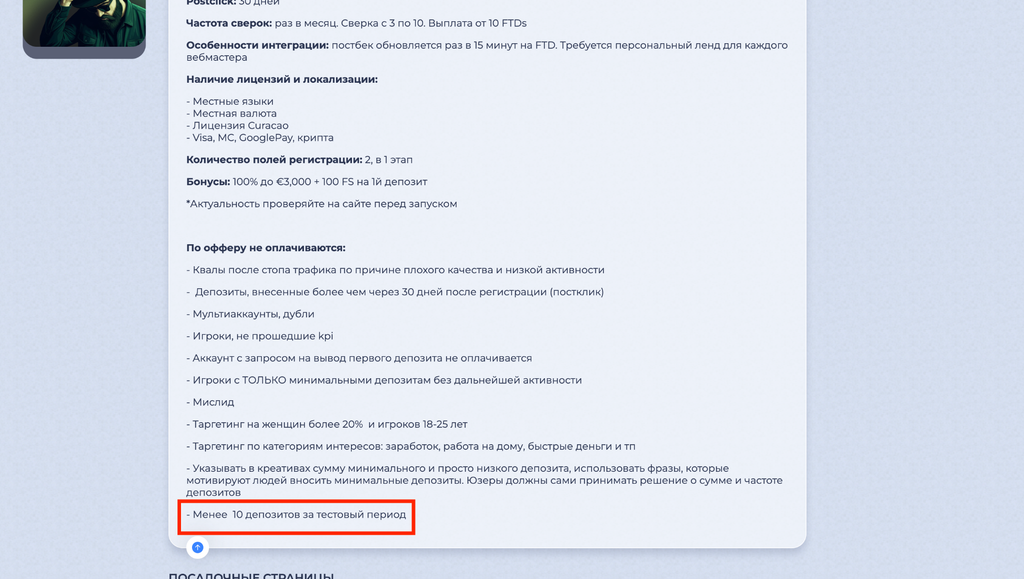
- Gambling: player activity in the product. In gambling, the first deposit is just the beginning. Advertisers analyze traffic using internal KPIs: registration-to-deposit ratio (reg2dep), total top-up amount, and retention (player returning to the casino). If users make only the minimum deposit and never return, this traffic is considered low quality. Advertisers are looking for players with high LTV. If creatives promise winning schemes or easy money, the app attracts an audience with low purchasing power. In such cases, the advertiser may revise the payout or limit the cap. It’s harder for a solo buyer to prove the quality of their traffic than for a team, so it’s important to attract players interested in the gameplay itself, not just quick earnings.
Creatives: approach lifespan and Andromeda in action
By 2026, visuals replace targeting settings. The Andromeda algorithm scans frames and banner text, independently determining which audience to show the ad to. The difference between verticals is how quickly hooks burn out and how many resources are needed to prepare new creatives.
In nutra, one successful creative can generate leads for up to two weeks. This is due to the broad target audience: health or weight issues are not tied to narrow interest groups. Andromeda finds a user segment and maintains the price on a single effective banner or UGC review.
Nutra approaches are often based on everyday scenarios, so they are less likely to trigger antifraud at launch. To scale, you don’t need to create dozens of creatives every day. Most of the time here is spent refining the funnel (pre-landers and landing pages), not on design.
After Andromeda was introduced in gambling, the focus shifted toward a more solvent audience: the algorithm primarily tries to buy users with a higher probability of registration and deposit. In small GEOs, this segment is quickly exhausted: within a few days of running a campaign with working creatives, the frequency of impressions to the core audience increases, and the cost of registration and deposit starts to rise noticeably.
Pavel Shvetsov specifically highlights this effect in his videos about Andromeda and auction updates: he shows with concrete examples how after the changes CPM rises, the same people see ads more often, and target actions become more expensive on already tested bundles.
For continuous scaling, you need to prepare batches of videos in advance:
- Changing hooks: swapping out the first 2 seconds of the video, where only the initial trigger (emotion or slot effect) changes.
- Batch uniqueness: creating 10–15 variations of one idea with different casino interfaces and local currencies.
- Template work: using ready-made projects where only the background and win amount change, while the core gameplay stays the same.
A solo buyer spends more time here on editing and video uniqueness than on all other launch stages combined.
Static creatives are still relevant: in some GEOs, they still outperform video. Banners can be quickly assembled and multiplied for different offers and countries without spending time on editing.
Petya 2.0 in his video about neural networks shows exactly how to create working static creatives in just a few minutes without a designer. He assembles a batch of banners using NanoBanana and Synx AI, changes the texts and visuals for different GEOs, and uses them as the basis for launches.
Scaling: volume management logic
It only makes sense to increase spend after the funnel has been consistently profitable for several days in terms of actual money, not just first leads or clicks. This approach is well illustrated by the author of the “Practical Arbitrage” channel in his breakdown of campaigns for Turkey and Portugal: first, the team looks at the real FTD cost and redeposit dynamics, and only then starts ramping up budgets on working campaigns.
Nutra: horizontal growth and call center control
Within nutra, scaling logically revolves around the breadth of infrastructure and careful budget management. The basic idea is simple: smaller daily budgets on adsets more often allow you to hit cheaper auction layers and keep lead prices stable, while aggressive spend increases drive up CPM and lead costs. Pavel Shvetsov clearly demonstrates this in his breakdown of working setups, including in the video about principles for finding stable funnels.
Against this backdrop, the logic for nutra looks like this:
It’s safer to scale by increasing the number of working campaigns and accounts, rather than sharply raising the daily budget on a single funnel. The more aggressively you increase the budget on an already running campaign, the higher the chance you’ll end up in more expensive auction segments: CPM and lead costs rise, and the funnel stops looking as attractive as it did at the starting bids.
Horizontal growth in nutra means duplicating successful ad groups to new accounts or within the same ad manager, and transferring working approaches to neighboring GEOs with similar mindsets, adapting creatives and funnels for the local market.
It’s also important to consider the call center’s capacity: before ramping up lead flow, you need to coordinate the cap with the manager. If operators can’t call leads in time, approval rates will drop simply because clients will lose interest.
Comment from the media buying team Traffic Light:
| “Facebook is probably the safest option to start with in nutra. For resources, count on an anti-detect browser, an agency account (about 5% commission), and cloaking. Tracker — Keitaro, you can’t do without it. If you want a cheaper entry — look at teaser networks: there, only Keitaro is essential. You can also start with Bigo: you’ll need Keitaro plus neural networks for video creatives. Yandex is a separate story. Technically it works, but be ready for account rotation, quality white pages, and a fair amount of nerves.” |
Gambling with PWA: Managing Spend and Pixel Data
In gambling, when using PWA apps, scaling is tied to pixel data: the more deposits go through Conversions API, the more accurately the algorithm finds similar players. In practice, it works like this: on a working setup, you first get a series of FTDs at an acceptable price, then gradually increase the daily budget, knowing that deposits at scale will cost more because you’re buying colder audience segments. This dynamic is shown by the author of “Practical Arbitrage” in the breakdown of Turkey and Portugal.
Another important element of scaling is how exactly to increase volume. In practice, campaign duplicates with different daily budgets are most often used: some setups run on a more modest spend, while higher limits are tested in parallel, buying up other layers of the auction and providing extra volume. Pavel Shvetsov uses this approach in his campaigns and explains the logic of working with duplicates and budgets in detail in his video on scaling methods in Facebook.
An important role in results is played by how Facebook now uses Andromeda and CAPI: the algorithm relies not only on clicks, but also on real events on the site and in the CRM, which helps it find similar audiences faster and at the same time increases CPM for more precise targeting. Pavel Shvetsov goes into detail on this point in his guide to launching ads via Andromeda, showing with examples how traffic quality and lead cost change when working through CAPI.
In practice, all this comes down to a simple logic:
- As spend grows, FTD predictably becomes more expensive, because along with the warm audience, you’re also buying increasingly cold layers;
- The key question is whether the economics can handle the rising deposit cost, taking into account redeposits and LTV.
Retention becomes a critical metric: if, as the budget increases, redeposit retention and overall margin remain healthy, scaling is justified. But if FTD gets more expensive and repeat deposits drop, it’s a signal that the algorithm has started sending empty traffic, and the setup should be relaunched with a new set of creatives.
Comment from Vitaly, Head of Media Buying at Ace Partners
| “A comfortable budget for Facebook is $10,000. However, in Africa and LatAm you can start with smaller amounts: traffic is cheaper and competition is lower. For budget structure: allocate at least $1,000 for ad spend, and calculate consumables as 10% on top of spend. Test benchmark: wait for 30 registrations or 3–5 first deposits. One test totals about $700.” |
Final Check: Choosing a Niche for Your Budget
The choice between nutra and gambling comes down to how many mistakes you’re willing to make. With a $1,000 or $5,000 budget, strategies will be fundamentally different. Below is a summary table of key metrics for a solo buyer in 2026.
| Parameter | Nutra (COD) | Gambling (PWA/CAPI) |
| Minimum Entry | from $1,000 | from $3,000 |
| Test Spend | ~$300 | from $700 |
| Money Return Cycle | 7–14 days | 14–30 days |
| Content Type | Static, reviews | Static, video editing, neural avatars |
| Critical Risk | Weak call center or callbacks | Failure to meet test cap |
Budget $1,000–$2,000: Nutra Territory
With this capital, nutra is the only option where you can survive solo. It allows you to run 3–4 full tests. If the first offer doesn’t catch on or the GEO gives a poor approval rate, you’ll still have funds to change the funnel or switch to another product.
The main advantage here is turnover speed. You get paid in a week, withdraw the money, and immediately relaunch. In gambling, with the same amount, it’s easy to get stuck on a single offer: you’ll drive 10–15 deposits, the creatives will lose traction, and your money will stay on hold because you didn’t hit the minimum cap of 25–30 FTD. For a solo buyer with a limited budget, this basically means stopping work indefinitely.
Budget $5,000+: Entering Gambling
With this capital, you can move into apps and work with long reconciliation cycles. This reserve is enough to calmly wait while the advertiser evaluates player quality and retention. While the first batch of deposits is on hold, you keep running traffic to the second and third offers, without worrying that your cards will be empty before the first payout.
With PWA and a $5,000 budget, you get the chance to scale volumes. If the pixel finds the right audience segment, you simply raise the budget and grab traffic until the creative burns out. In nutra, this budget is often excessive for one person: you’ll either hit the call center’s lead limits or just won’t be able to keep up with dozens of ad accounts.
Conclusion
The choice of vertical comes down to how quickly you need to reinvest your money. With a budget up to $2,000, nutra is objectively safer: it lets you switch offers in time and keep your cash flow moving.
In gambling, it’s easy to get stuck at the first cap, with your budget simply held waiting for quality checks. You should always have enough left for at least three full tests, so you don’t have to stop after the first failure. Start where your capital allows you to keep running campaigns, not waiting for a payout for a whole month.

Comments (0)