

Meet Daniel, an affiliate marketer. In 2021, he published apps on Google Play, bought some incentivized traffic, and pushed his app listings to the top of the rankings. Organic installs and revenue poured in. In 2023, he switched to Facebook, but it did not work out. In 2026, he decided to return to ASO. Now he is looking at the analytics and wondering: why are there fewer leads, and why is incentivized traffic no longer helping? The answer is simple.
In 2026, ASO is no longer the traffic source it was two or three years ago. The old methods work only in RuStore, if anywhere. App Store and Google Play algorithms have changed, developer accounts have become more important, competition between teams has intensified, and simple keyword-based strategies have almost stopped working.
Below, we explain what ASO actually looks like in 2026 and which verticals still deliver results through this traffic source. Spoiler: it is not just iGaming.
What Is ASO Traffic?
ASO traffic—ASO stands for App Store Optimization—is organic traffic that comes from App Store or Google Play search results and recommendations.
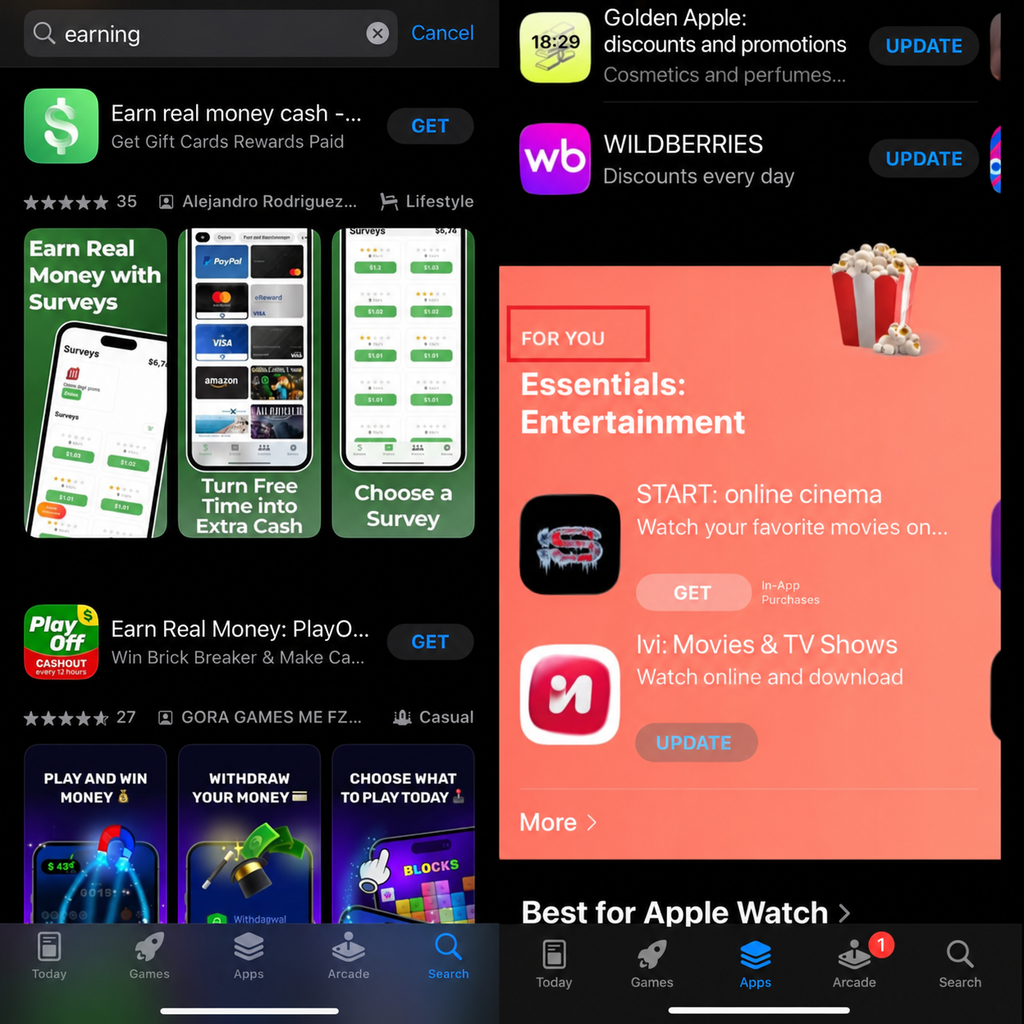
Users open an app store on their smartphones and then:
- Search for terms such as “slots,” “casino,” or “make money” and download an app;
- Browse algorithmic selections such as “For You” and “Recommended,” scroll through banners, and download games or other apps that catch their attention.
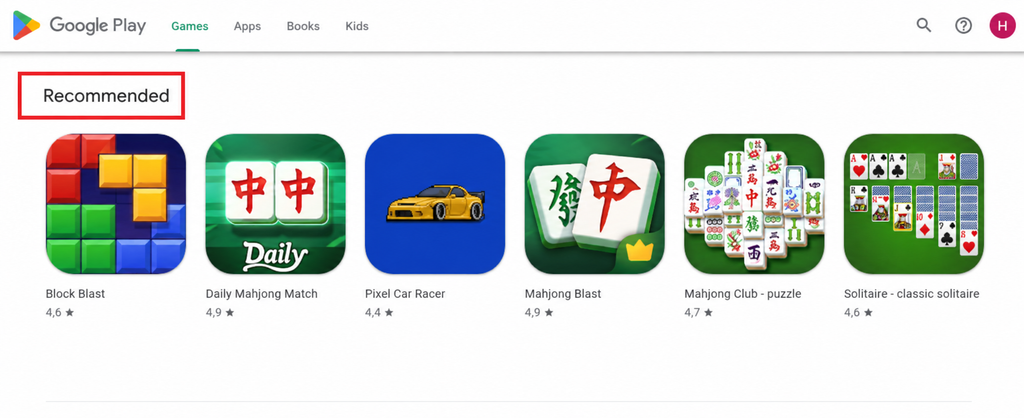
Someone searching for a specific app is already a high-intent user who knows what they want. Someone browsing a curated selection has not yet decided whether to download anything. You need to attract their attention with the icon or description.
The purpose of ASO for affiliates is to make an app visible to users in the stores. In simplified terms, the process looks like this:
- Optimize the app listing’s title, subtitle, and keyword-rich description.
- Create an appealing icon and engaging screenshots.
- Generate the first installs to improve the app’s ranking. These initial downloads usually come from paid traffic.
The approach is similar to traditional SEO for websites. If an app listing contains relevant keywords and a useful description, Google Play or the App Store may rank it higher in search results. Users can then find and download the app more easily, generating installs without further acquisition costs.
An affiliate makes a substantial upfront investment in promotion to generate installs that later convert into registrations and deposits. Unlike targeted advertising and conventional mobile user acquisition, there is no need to hook the user with an ad creative: they came to the store intending to install an app. The registration-to-deposit rate for ASO traffic can be two to three times higher than for Facebook or TikTok traffic.traffic arbitrage, you don’t need to hook the user with creative. The user comes to the store on their own and wants to install the app. Reg-to-Dep in ASO is 2-3 times higher than in FB or TikTok.
Is ASO Dead in 2026?
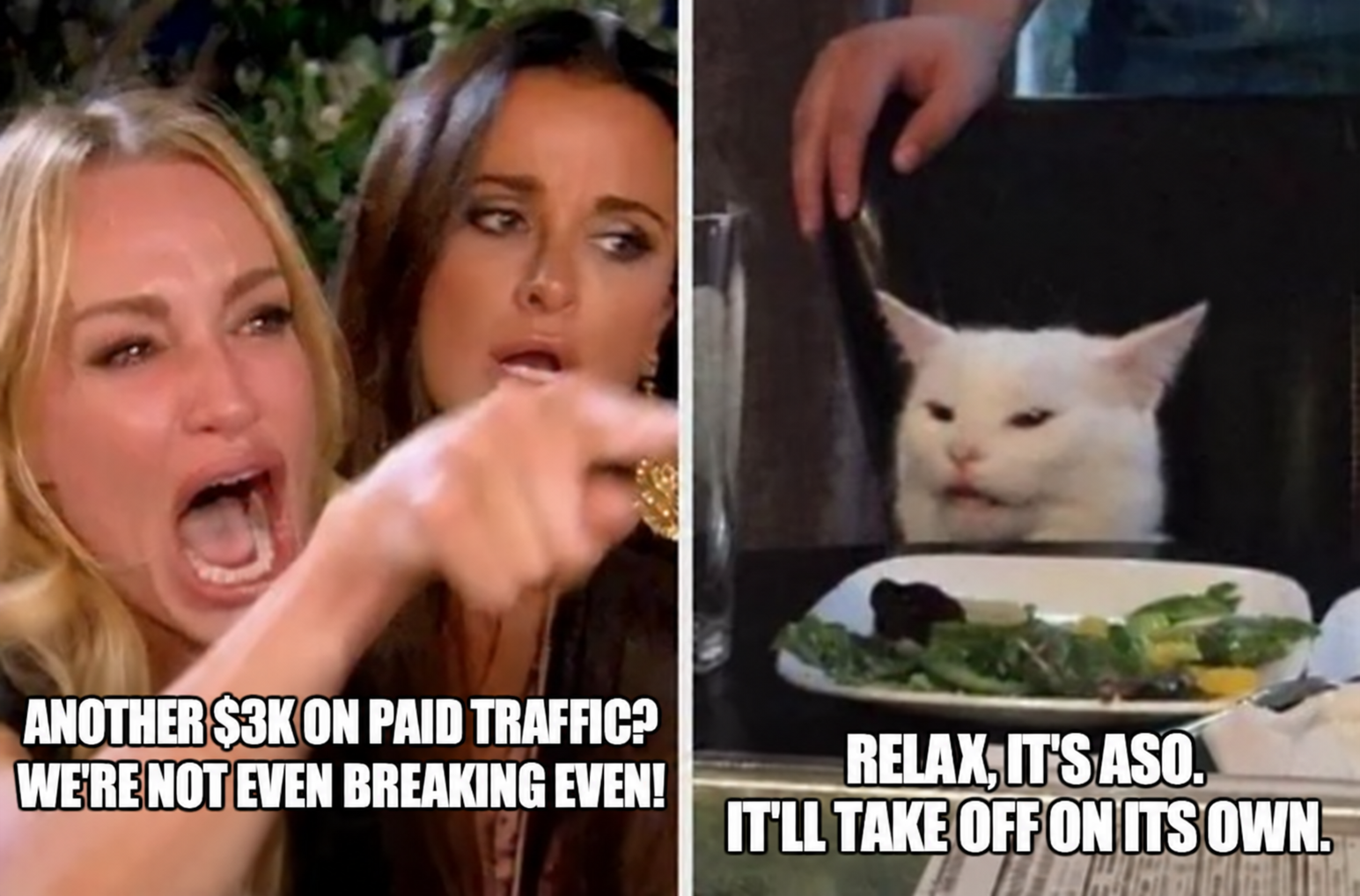
People have been declaring ASO dead in discussions on X and Reddit for more than a year.
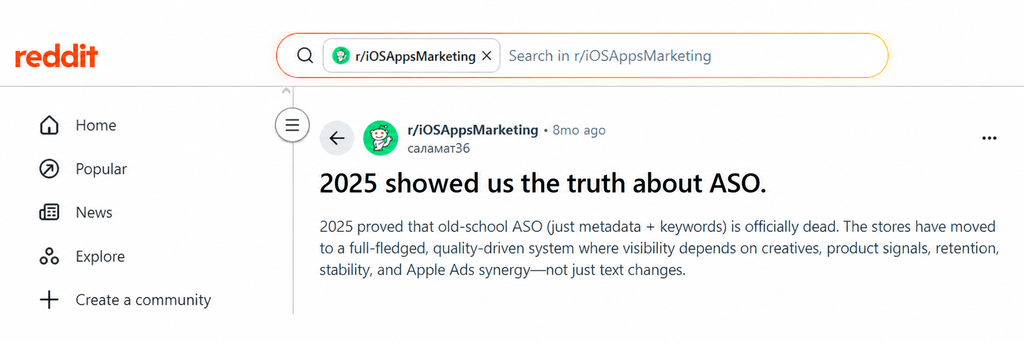
Affiliates complain that incentivized traffic no longer works and moderation keeps getting stricter.
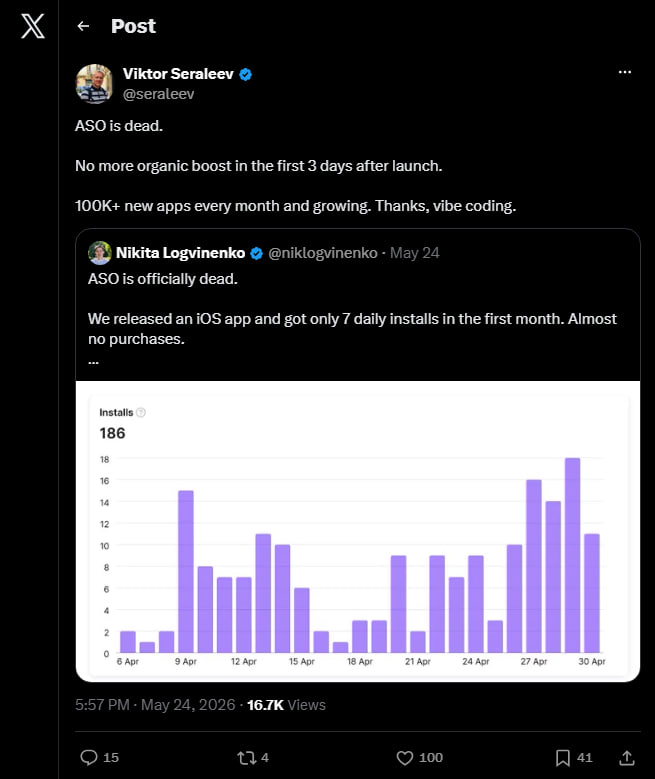
One report found that app downloads and in-app spending fell by 10% in the first quarter of 2026—but only in the United States. Installs and purchases on Google Play and the App Store are still growing across Europe and Asia.
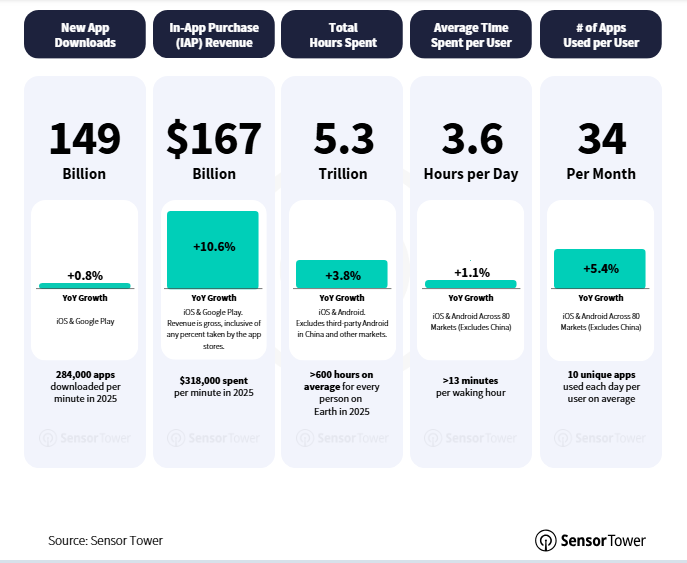
OOn average, subscriptions and downloads have increased by 10.6% since 2024. Users have not stopped downloading apps. The rules of ASO affiliate marketing have simply changed:
- Anti-fraud systems have improved. Until 2024, the standard formula was “placeholder app, high-volume keywords, incentivized traffic.” Anti-fraud systems—especially Google’s—have since become stricter, and algorithms now detect manipulation quickly. A gambling app may remain live on Google Play for no more than two weeks.
- User engagement matters more. App stores now analyze how users behave inside an app. If someone installs an app and immediately closes it, the App Store may lower its ranking. If one app receives 10,000 downloads and another receives 4,000, but the second has better first-day engagement, the second app may rank higher.
- High-volume keywords have become more expensive. Major companies bid on branded keywords, especially in gambling. Without a large budget, it is harder to rank for direct searches such as “Pin Up” or “Vulkan.” Increasing keyword density does not solve the problem either. It is better to target related lower-volume terms and relevant long-tail queries—for example, “lose weight before vacation” instead of simply “weight loss.”
In other words, ASO has become harder for newcomers without substantial budgets.
“Developing an iOS app costs around $600. But you have to consider the scale of your production pipeline. A team might develop 10–15 apps per month, for example, but only five get approved. That brings the actual cost per approved app to roughly $1,500–2,000,” said Matvey, co-founder of iRent and PWA.Market, in a Russian-language video on the DIVEROLI affiliate marketing channel.
That does not mean the traffic source is dead. It means that you need to analyze your methods and think through every step.
“ASO has always been and remains one of the key tools for promoting apps. I would not say it ever ‘declined.’ The market simply moves in waves: an app connects with the audience and takes off, then a ban or restrictions often follow—and suddenly you are back in a slump for a month or even longer,” said Alexander Sobko, CEO of LGaming, during a SiGMA Dubai recap on the Russian-language DIVEROLI affiliate marketing YouTube channel.
ASO is not dead. What is dead is the hope of acquiring traffic cheaply and easily.
What Changed in ASO Affiliate Marketing in 2026?
App stores no longer evaluate installs alone. App Store and Google Play algorithms have become more sophisticated. An install does not mean that the app will actually be used, so mobile apps promoted through affiliate campaigns now need to hold the user’s interest.
One store may leave an app listing in the same position, while another may move it up or down. Google Play and the App Store have changed their ranking principles. Their algorithms are similar in many respects: both assess engagement, user interest, and traffic quality. However, the two stores analyze these signals differently:
- The App Store analyzes behavioral patterns within the Apple ecosystem and considers Apple Search Ads signals;
- Google Play places more emphasis on search relevance and conversion.
ASO in the App Store: High-Spending Users and Strict Moderation
In 2025, consumer spending by iOS users exceeded $117 billion.
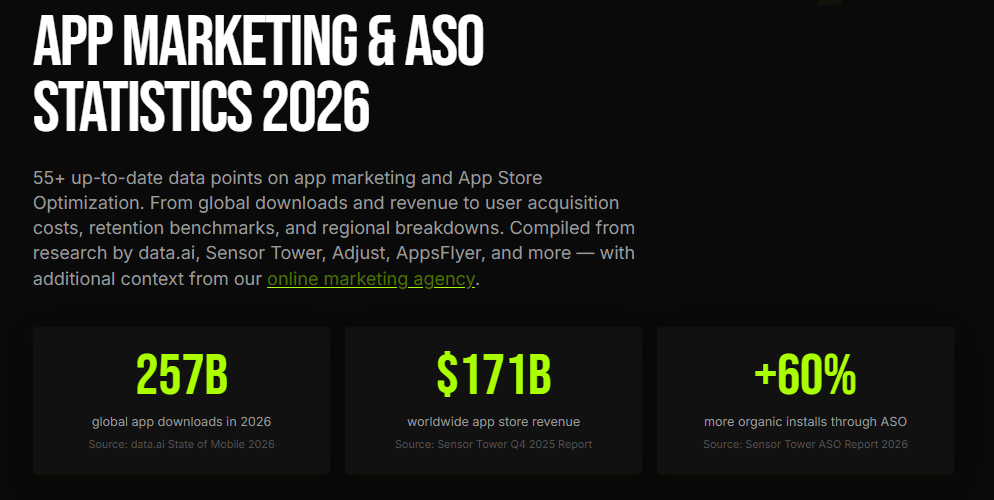
Apple device owners are generally considered a higher-spending audience. According to a Data.ai report, Apple accounts for only 27% of global app installs, yet recurring app revenue exceeds 65% of total revenue. iOS traffic may cost more, but Apple users tend to deliver a higher LTV.
In the App Store, visibility is optimized through the Title, Subtitle, and hidden Keywords field. The difficult part is avoiding duplicate keywords. Apple combines these fields and evaluates the text as a whole. Repeating a keyword provides no advantage and wastes characters that could be used for other relevant terms.
Visuals Come First
Screenshots on an app page are more than a storefront: they are a conversion tool. Visual content is usually the first thing users evaluate. At WWDC 2026, Apple introduced new discovery and conversion features. Organic search results can now include dynamic images and short videos in addition to the app icon and static screenshots. Affiliates can demonstrate a feature or interface in action, which can increase click-through rates.
Product Page Optimization, or PPO, can help test different approaches in these short videos.
Boosting with ASA
Apple Search Ads’ March update changed the familiar workflow for affiliates and directly affected ASO. Paid ads can now appear in several positions for the same query alongside similar apps. A user enters a keyword, sees an advertised app at the top, scrolls down, and may see another ad for the same app in the third or fifth position.
This makes organic promotion more difficult and pushes organic listings down. Even if you move an app into third or fourth place, users may see several paid placements first. With a high-volume query, they may never scroll far enough to reach your app.
The change can also work in your favor. Running ASA for your app can generate installs that help move it up the rankings. ASA and ASO work better together than either channel does on its own.
In 2025, Apple announced another feature: App Store tags. Developers can add tags that describe an app’s functionality, such as “offline access” for a travel guide or “family access” for a fitness app. When a user selects a tag, they see a collection of apps offering the same feature, which increases visibility. In 2026, the tag feature is available in the United States, Canada, and several European countries.
User Retention
iOS algorithms have become smarter. Driving installs is no longer enough; you also need to retain users. Apple considers retention, reviews, ratings, and how long an app remains installed on a device.
Apple maintains a high quality threshold in 2026. An app should have:
- A rating of at least 4.5 stars;
- Recent positive reviews—the more, the better;
- Regular updates, new features, improvements, and bug fixes;
- Proper localization for each GEO;
- Engaging video previews and screenshots.
Paid subscriptions, deposits, and other transactions inside an app can improve its ranking. Apple sees that people are using the app and paying for its services, which signals that users value it.
“In 2026, the winners will not be those who know the algorithm, but those who best understand the user and the economics of the product,” said Anastasia, a freelancer with more than ten years of ASO experience, in a Russian-language video.
One international app marketing case illustrates the point. Between February and June 2026, Reddit user Kritnc grew an app to $1,000 in subscription revenue. He had initially spent $5,000 on paid advertising, but the traffic was low quality and produced no return. After analyzing the situation, improving the app, and introducing a paid subscription, he began to see results.ts.
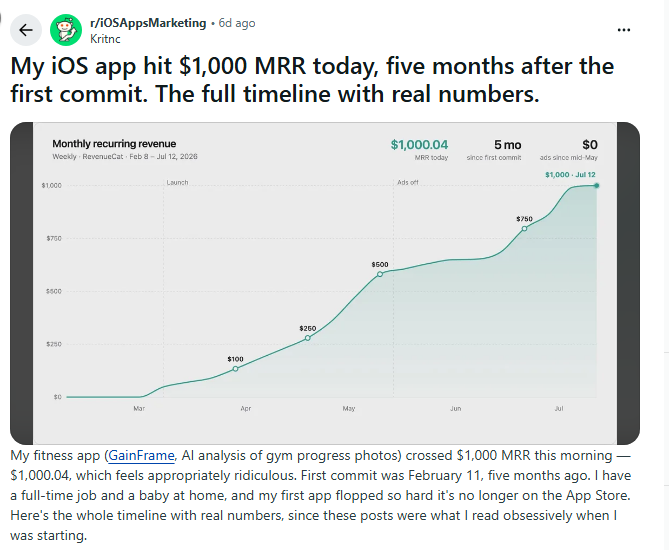
In 2026, App Store algorithms pay closer attention to user behavior. If people do not like the app, metadata, keywords, and compelling screenshots will not be enough to secure a strong ranking.
ASO on Google Play: Mass Bans and UAC Algorithms
SEO remains important for Google Play ASO in 2026. Its algorithms closely analyze the content of each app listing. The title and description help the store determine which searches the app should appear for.
Google announced a major change at Google I/O 2026: Google Play now uses Ask Play, powered by Gemini. Instead of entering a broad query such as “VPN,” users can search for something more specific, such as “free VPN for Telegram.” The feature is currently available in the United States and several other countries, but it is likely to expand further.
Stricter Moderation
Google’s moderation and anti-fraud systems improve every year. Automation allows the company to identify violations quickly and block both the developers and their products. In 2025, for example, more than 1.75 million apps failed to pass moderation.
Even if your app is approved, it is too early to celebrate. Google Play Protect now analyzes more than 350 billion apps every day. If an app does not meet Google’s security requirements, it may eventually be banned.
Android Vitals Affects ASO
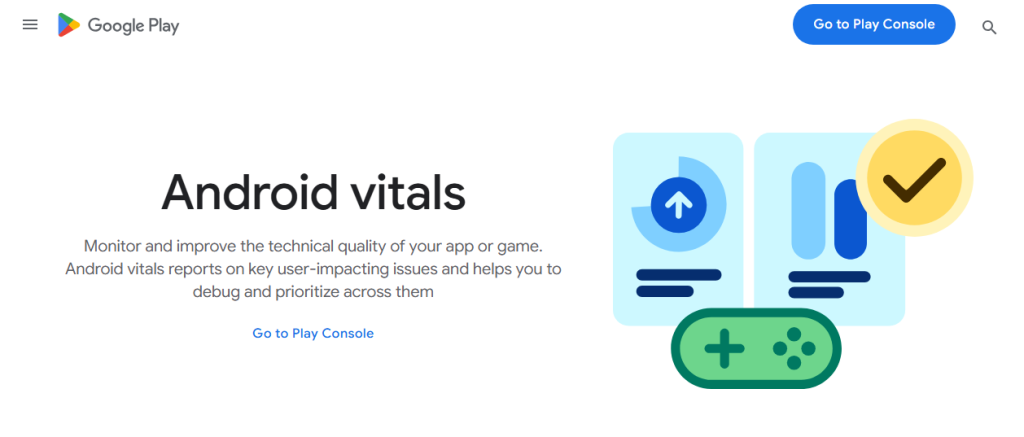
Android Vitals is designed to improve app stability. It tracks metrics such as:
- The number of “App Not Responding” errors;
- Crash rate;
- Battery consumption during use.
Google analyzes an app’s performance over 28 days. If its quality is poor, the algorithms may reduce its visibility on Google Play. Affiliates therefore need to monitor app performance more carefully. An app with persistent, serious issues may be removed from search results altogether.
Behavioral Patterns Matter
Like the App Store, Google Play is increasingly focused on user behavior and engagement in 2026. There is no precise public data showing how individual behavioral patterns affect rankings. However, if users install a game or fitness tracker and immediately remove it because of bugs, Google will notice and lower the app’s position.
User experience matters. Reviews help other people choose a game or utility, which is why apps with high ratings and detailed reviews tend to reach the top of the results more quickly and more often.
New ASO Entry Points on Google Play
At I/O 2026, Google introduced Play Shorts. In addition to traditional search, users will be able to watch app features and functionality in short TikTok-style videos. From a video, they can open the app page and download it. The feature is not yet available everywhere, but Google’s direction is clear: discovery is becoming simpler and more visual. It appears that 30-second VSLs may become part of ASO.
The Best Verticals for ASO
In 2026, choosing the right vertical accounts for roughly half of an ASO campaign’s success. An affiliate is like a prospector choosing where to search for gold in the app stores: selecting the right vertical is the first important step.
Gambling
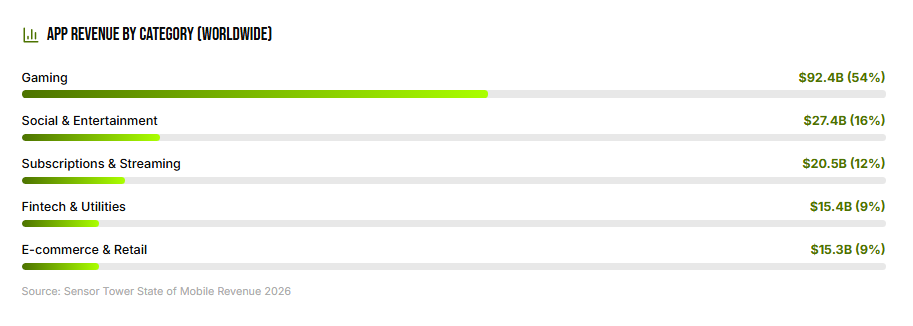
To continue the gold-mining analogy, gambling is ASO’s largest goldfield and its leading vertical. The comparison is not perfect, but the “Games” category generated more than $92 billion in the App Store in 2025. People clearly enjoy playing games, and some of them enjoy playing for money.
“The situation right now is roughly this: publishing an app has become difficult. In terms of traffic volume, apps designed around popular slots and crash games perform best, but getting them approved is very difficult. By ‘difficult,’ I mean the design has to resemble the original slot as closely as possible. The stores now use neural networks to detect patterns from popular slots. So many of these apps have already been uploaded that the systems have an enormous reference database. They are good at identifying clones because they have seen so many different approaches and visual concepts,” said Matvey, co-founder of iRent and PWA.Market, in a Russian-language video on the DIVEROLI affiliate marketing channel.
Competition in gambling is intense, particularly from established brands. Without effective cloaking, an app will not stay live for long. Still, the vertical may be worth pursuing: according to Statista, average revenue per player is $653.
Dating
Dating apps are popular in every country: people generally do not want to be alone. Revenue from dating apps exceeded $6 billion in 2025, while more than 23 million users were willing to pay for premium features such as private conversations with popular members, additional likes, and other benefits.
Finance
Finance and crypto are also popular ASO verticals. Everyone wants to make money, and users are willing to pay when an app is convenient and easy to understand. Reviews are particularly important. They should be informative and illustrate the opportunities users may be missing. Given legal restrictions and app store policies, disguising a crypto platform as a chart analysis tool can also help.
Nutra
Health and beauty matter to users in every market. If an app helps them achieve those goals, they may be willing to download it and pay for a subscription. Fitness trackers and training programs for weight loss or general health can generate a steady flow of installs—especially when the description ties the promised result to a specific occasion, such as losing weight before summer or Christmas or reducing puffiness before a meeting the next day.
Competition is intense, but most apps in this vertical are compliant, white-hat products.
AI Apps and Other Utilities
In the first half of 2026, users spent $4.25 billion on subscriptions and paid plans for ChatGPT and other AI tools.
AI services are unavailable in some countries. At the same time, developers are rapidly monetizing AI tools and limiting free usage. Build an AI aggregator and promise uninterrupted access, and the installs may follow.
Tools for bypassing online restrictions are also in demand worldwide, and users are willing to pay for online anonymity. In the United States, the share of paid subscriptions for changing GEO rose to 52%.
Conclusion
ASO stopped being a purely technical optimization exercise well before 2026, but the shift is now more apparent than ever. Organic traffic can still be monetized effectively, particularly in gambling, dating, and finance, but turning that traffic into results has become more difficult.
The teams that win are those with enough budget to replace apps that have been banned or removed. The key point to remember is that ASO is a long-term game. Even after a substantial upfront investment designed to generate high traffic volumes later, you still need to remain alert and keep working on the product.

FAQ
ASO traffic is the target audience that finds and downloads apps from store search by keywords, then takes actions: registration, purchase, subscription.
No, ASO isn't dead, but has transformed from a simple action algorithm into a multi-step combination. Now, keywords alone aren't enough to promote an app.
There are optimization differences. But both stores in 2026 have focused on app quality and user engagement.
Incentivized traffic means users are paid for searching by keywords and installing a specific app. A large number of installs pushes the app to the top of the rankings. But you need to use incentive carefully. Stores react negatively to mass installs, especially if the user doesn't search for anything else, downloads, and never opens the app again.
Gambling (betting) is the vertical that brings a large number of installs and deposits. Dating, financial products, and apps for weight loss, beauty, and health are also popular and drive target actions.
Mobile traffic arbitrage is a process where a specialist 'buys' (attracts) smartphone users and directs them to an app download page or to buy supplements, financial products, etc. The cheaper the arbitrager attracts users who buy, deposit, or register, the higher their reward.

Comments (0)