


When Alex was starting out, Google Sheets seemed like all he needed to track performance: one traffic source, around 5–6 creatives, and even fewer offers. Then he started running ads, and the plan fell apart. Facebook reported 800 clicks, the PWA service counted 630 visits, and the affiliate network showed 27 registrations and five deposits. Pasha opened his spreadsheet and tried, in vain, to work out which creative had actually made him money.

To keep campaign analysis from turning into an air crash investigation, you need a tracker. It connects the traffic source, click, landing page, offer, and conversion in one system and brings the data together on a single dashboard.
There are plenty of trackers on the market in 2026. Here, we look at Keitaro, the most popular and advanced of the lot. We explain how it works, what it costs to run, and when a dedicated server is useful—or more than you need.
What Is a Tracker, and Why Do Affiliates Need One?
A tracker is software that records clicks on referral links and connects them to what users do next. When someone clicks an ad, for example, the tracker creates a click ID and saves the parameters it receives: campaign, ad, platform, keyword, device, country, and other tags. The data stays in one place, so you do not have to piece it together from spreadsheets.
The system then sends the user to the appropriate landing page or offer. If they download an app, register, submit an inquiry, or make a deposit, the affiliate network notifies the tracker of the conversion. That notification is called a postback.
The media buyer can then follow the entire funnel:
Traffic source → campaign → ad set → creative → landing page → offer → event → payout.
Without a tracker, following the journey from the first click to the target action is much harder. Facebook, for example, knows about impressions and clicks, but will not know whether the affiliate network paid for that traffic unless you configure it separately. You could end up scaling a campaign setup that loses money over time.
Self-Hosted vs. Cloud Trackers: Which Should Beginners Choose?
Trackers fall into two categories: self-hosted and cloud-based. Here is a brief look at the differences.
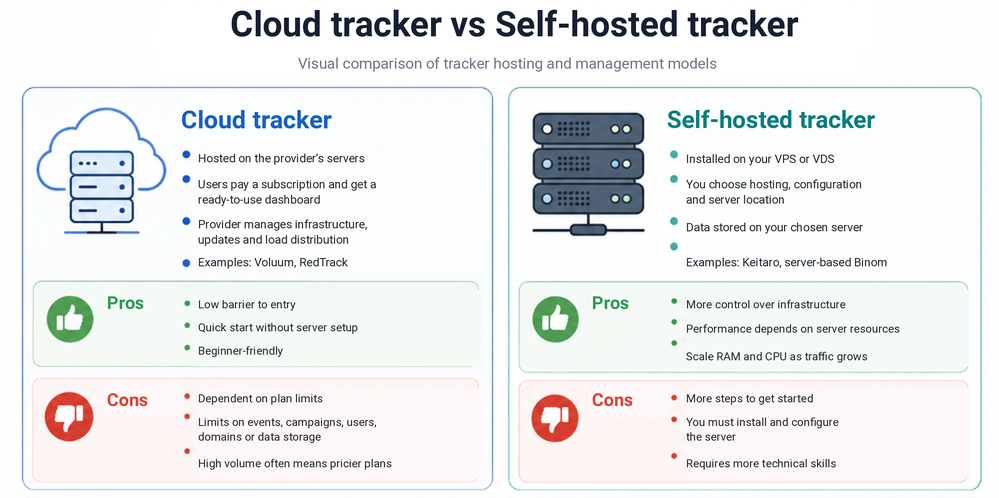
If you are just starting out and are unfamiliar with SSH and installing software packages, a cloud tracker is the better choice. It also makes sense when your traffic volume is below millions of events.
For affiliates who have tested more than one campaign setup and are ready to move on, we recommend a self-hosted option: Keitaro.
“Keitaro requires a dedicated VPS. That adds a small step during setup, but the benefits far outweigh the initial effort. Users get full control over their data, unmatched privacy, and, most importantly, avoid overpaying for events as they would with subscription-based cloud trackers. When you start scaling your campaigns and achieving bigger results, nothing holds you back or eats into your profits,” says Ivan Rud, Keitaro’s CMO.
The days of having to install a tracker on a VPS entirely by hand are over. You can give a representative of the tracker provider access to the server and let them handle it, or ask ChatGPT for help. I asked it to help me choose a hosting provider, shared the tracker’s documentation, and followed its instructions.
What Is Keitaro?
Keitaro is a popular self-hosted tracker for analyzing online advertising. It dates back to early 2009, though it became widely known in the affiliate community around 2014–2015 as affiliate marketing gained traction. Today, it is a complete analytics tool with numerous integrations: install it on a VPS, then connect almost any affiliate network or service with a click.
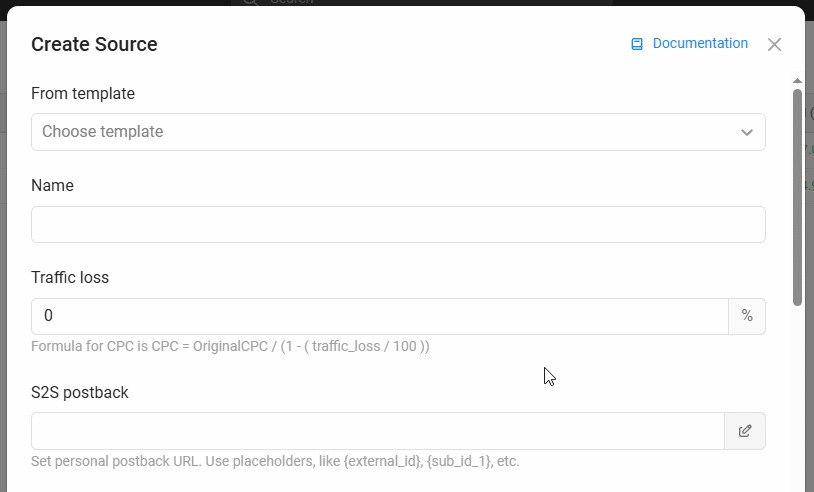
Keitaro can feel expensive when you are starting out, but its features justify the price.
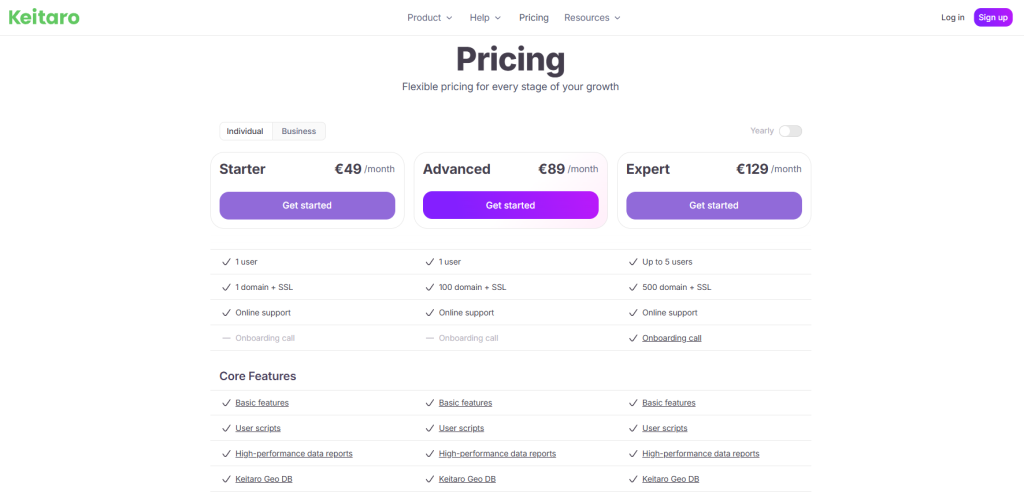
The tracker records dozens of parameters for each click, generates reports, runs A/B tests, and supports cloaking. It also handles S2S postbacks, multiple offers, and management through an API.
Keitaro’s Main Features
Covering every Keitaro feature would take another volume of War and Peace. Some teams even employ specialists whose sole job is integrating and configuring it.
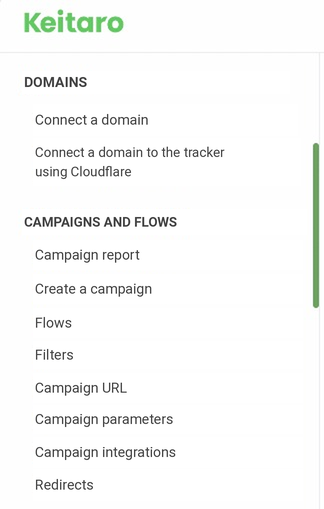
This review is not intended to be a complete manual, so we will focus on the main features.
Click and Conversion Tracking
Keitaro logs each incoming click on an affiliate link and saves the parameters passed by the traffic source in the URL. These can include campaign, ad group, and creative IDs, placement, keyword, or custom sub-ID tags.

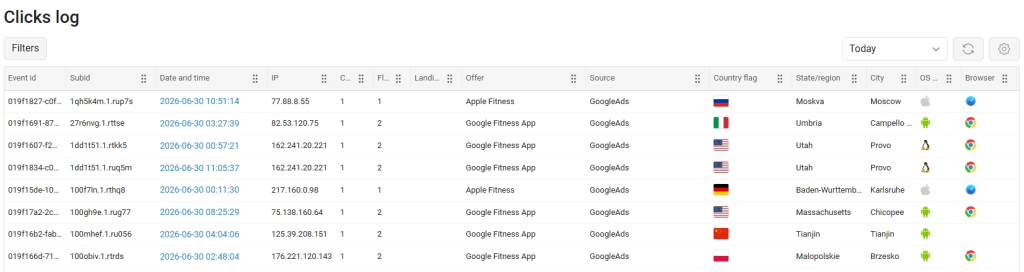
To connect a click to a conversion, the tracker generates a unique click ID and passes it to the affiliate network with the visitor. When the user completes an action, such as making a deposit, the network returns that ID in a postback. This lets the affiliate see whether the traffic is generating revenue. For example, a user clicks an ad and receives the ID abc123. Three hours later, they make a deposit. If everything works correctly, the network sends Keitaro a request containing the ID, event status, payout, and currency. Keitaro finds the click with ID abc123 and assigns the conversion to it. Here is how clicks appear in the statistics:

The default lead statuses are Lead, Sale, Rejected, Trash Registration, and Deposit.
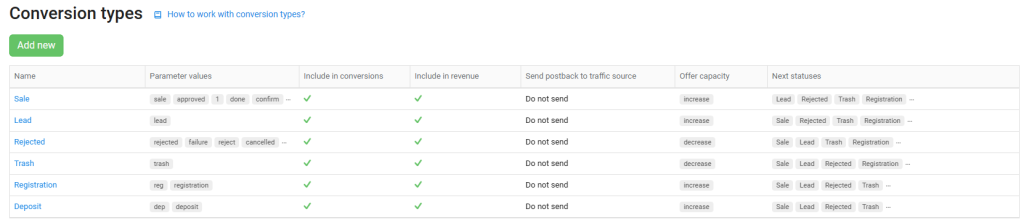

The affiliate can therefore assess the intermediate stages of the funnel as well as the final outcome.
Campaigns, Flows, and Rules
A Keitaro campaign brings together traffic source settings, campaign links, and traffic routing logic. Within a campaign, affiliates create three types of flow:
- Forced flow. Keitaro checks this first. It handles special conditions, such as a particular device, GEO, URL parameter, or tag;
- Regular flow. Handles the main audience that matches the configured filters;
- Default flow. Receives clicks that did not match earlier rules. It acts as a fallback: if a user does not qualify for any main route, the tracker sends them here.
You can filter by country, region, language, device, browser, operating system, internet service provider, connection type, and parameter values. Flows let you handle several routing scenarios within one campaign. Without them, you would need a separate link for almost every combination of GEO, device, and offer.
Split Testing
Keitaro can automatically distribute traffic between flows, landing pages, and offers. You assign each option a percentage weight:
- landing page A: 50%;
- landing page B: 30%;
- landing page C: 20%.
Once enough data has accumulated, the media buyer compares CR, EPC, ROI, and any other relevant metrics, disables the weaker option, and sends traffic to the best-performing funnel.
You can test more than page design. Different flows can contain different offers, affiliate networks, page loading methods, or localized versions of a funnel. This helps identify whether the problem lies in the creative, landing page, or product itself.
Cloaking
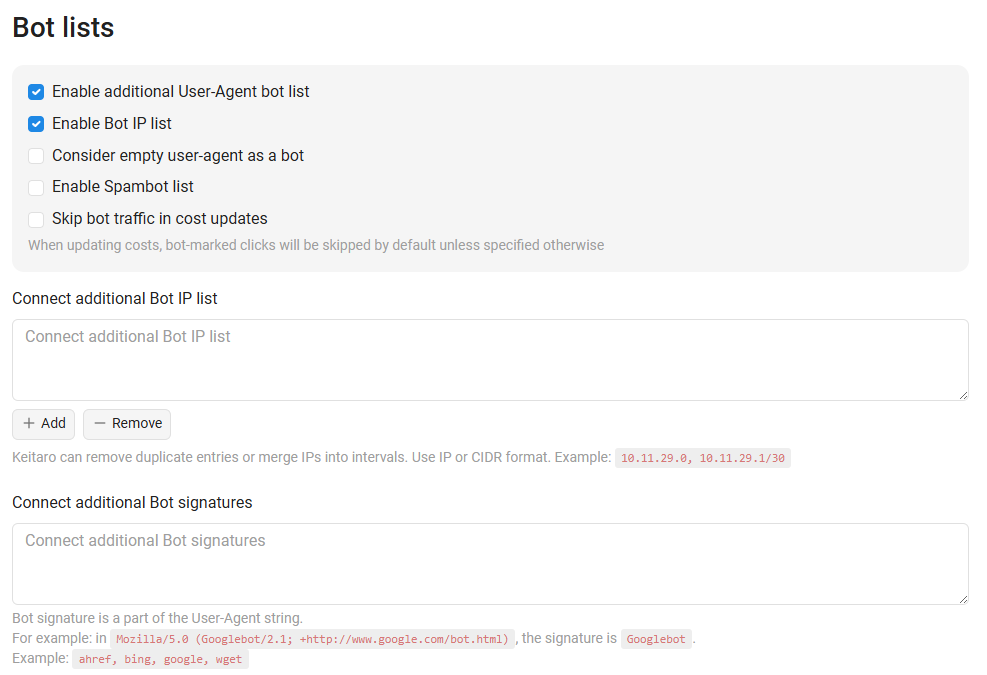
Cloaking deserves an article of its own. In Keitaro, it relies on flows, filters, and traffic routing rules. The affiliate specifies which landing pages ad reviewers see and which pages the actual audience sees. The tracker also lets you add lists of bot identifiers. for moderation and for the real audience. There’s a feature for adding lists with bot characteristics.
Reports and Analytics
Keitaro generates reports by campaign, traffic source, flow, landing page, offer, country, device, and passed parameters. You can start with overall campaign performance and drill down to an individual ad and offer.
A report might reveal that a campaign is profitable overall, but almost all the profit comes from one creative on Android. Without that breakdown, the media buyer could keep paying for iOS traffic that wastes the budget.
If the standard metrics are not enough, you can add custom metrics with your own calculation formulas.
Automatic Optimization
The tracker can take actions based on predefined rules. Flow monitoring checks landing pages and offers on a schedule. If a page stops responding or does not contain a required element, Keitaro can:
- disable the flow;
- replace the URL;
- retrieve a new link from an external source;
- send a webhook;
- record the event without taking automatic action.
The shortest checking interval is one minute, and the feature is not included in the entry-level plan. The tracker can also automatically disable underperforming routes and protect the budget if the affiliate sets limits. It is useful, but manual control is better when you are starting out: one incorrect rule is enough for the system to keep following it, even when it clearly pushes ROI below zero.
Integrations
Ready-made templates for traffic sources and affiliate networks are one of Keitaro’s biggest attractions. They contain the parameters and macros needed to pass click IDs, costs, payouts, and statuses. Direct integrations with Facebook, Google Ads, and TikTok send conversions back to the ad platforms and retrieve ad spend data. Affiliates working with SEO can also connect Cloudflare and Namecheap to manage domains.
In iGaming, where campaigns usually send users to apps, a PWA rental service often sits between the ad platform and Keitaro. It can then act as the traffic source in the tracker, passing its own click IDs and app parameters.
API
Keitaro provides a Click API and an Admin API. Beginners may not need them immediately, but they are worth knowing about:
- Click API. Lets you run a campaign remotely when the website or landing page is hosted on a different server from the tracker. This includes integrations using KClient PHP, JavaScript, and WordPress;
- Admin API. Provides programmatic access to administrative functions. You can create campaigns, modify flows, retrieve reports, and connect Keitaro to your team’s internal services. The Admin API is available on the Expert, Team, and Enterprise plans.
As your team grows, the API can automate campaign creation, statistics exports, link updates, and other routine tasks.
How to Install Keitaro: Requirements and Setup
Installation Requirements
Keitaro needs a dedicated VPS or VDS. Ordinary shared web hosting will not work. If you would rather avoid researching providers, Keitaro lists recommended services.
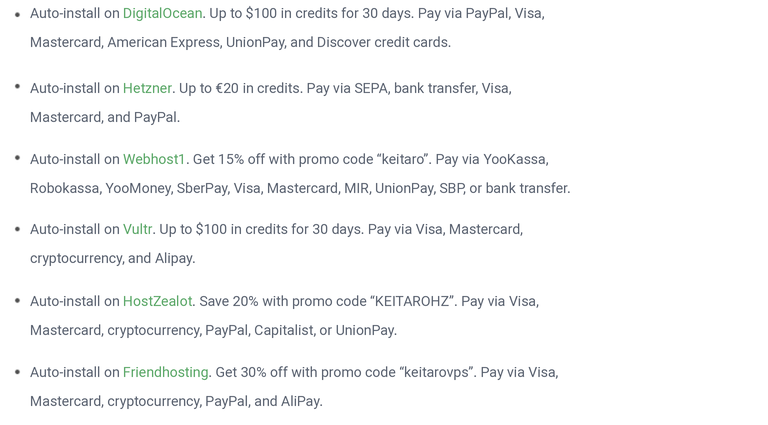
The minimum server specifications are shown below:
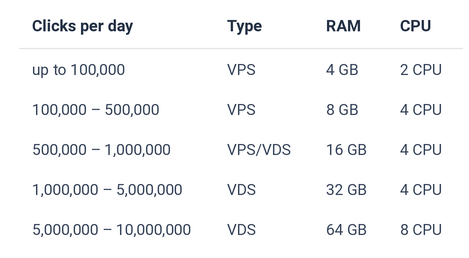
These are approximate guidelines, not a performance guarantee. Frequent API calls and resource-intensive reports increase server load, so the developers recommend leaving extra capacity for those workloads.
You will also need a domain. Point it to the server’s IP address and issue an SSL certificate so that campaign links work over HTTPS. The tracker can then act as the intermediary between the referral link and the landing page.
The Real Cost of Ownership
Remember that Keitaro runs on your server. You pay for the subscription, the server, a domain, and backups if you need them.
For example, the entry-level Starter plan costs €40 ($45.70) per month when billed annually. A Hetzner server with 2 vCPUs, 4 GB of RAM, and a 40 GB SSD meets the basic requirements and costs €7.90 ($9.03) a month.


We are leaving out any taxes and fees, so we will use those figures. Add a domain—for example, a .com from Namecheap, offered to new customers at $6.79.
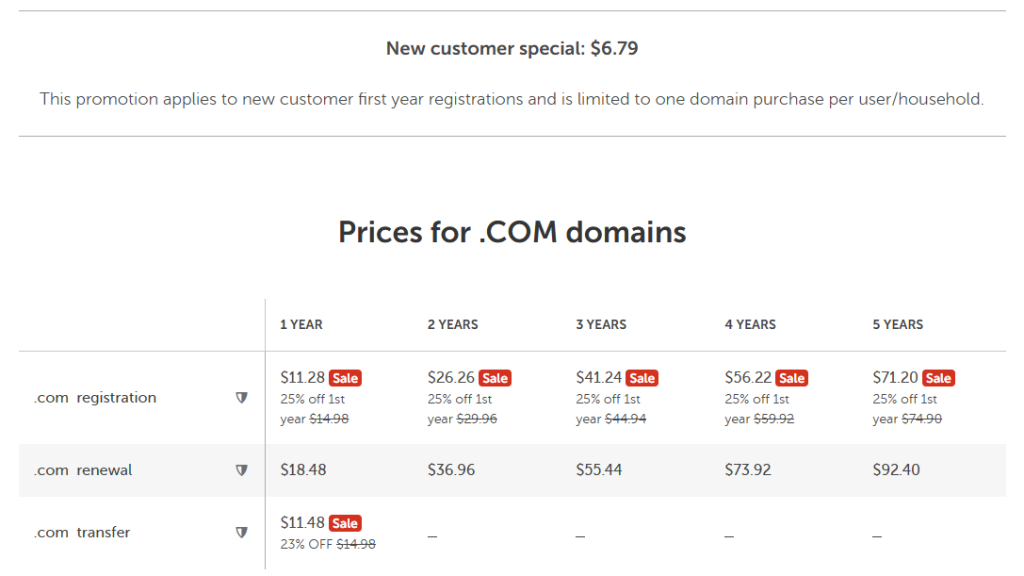
The total is $45.70 for the subscription + $9.03 for the VPS + $6.79 for the domain = $61.52 for the first month. Remove the domain charge from subsequent months, and the ongoing cost is $54.73 a month.
How Difficult Is Installation?
If you know how to ask ChatGPT or another AI assistant questions, installing the tracker is straightforward. AI can help you choose a hosting provider near your target GEO, select a server configuration, and walk you through installation using a command-line terminal. Keitaro offers a simpler route: use a partner VPS and install it in a few clicks (in Russian).
A manual installation takes a little longer. With a hosting provider that has no built-in Keitaro integration, you need to:
- provision a clean server;
- connect to it over SSH;
- run the installation script;
- activate the license;
- connect the domain;
- configure SSL;
- check updates and backups.
Installation itself does not require an engineering degree. Beginners usually run into related issues: the wrong operating system, OpenVZ instead of KVM, a DNS error, or a closed port. These problems can be resolved quickly by asking Gemini or ChatGPT to help you anticipate them.
Keitaro Pricing in 2026
In 2026, Keitaro offers 5 plans: 3 for individuals and 2 for businesses.
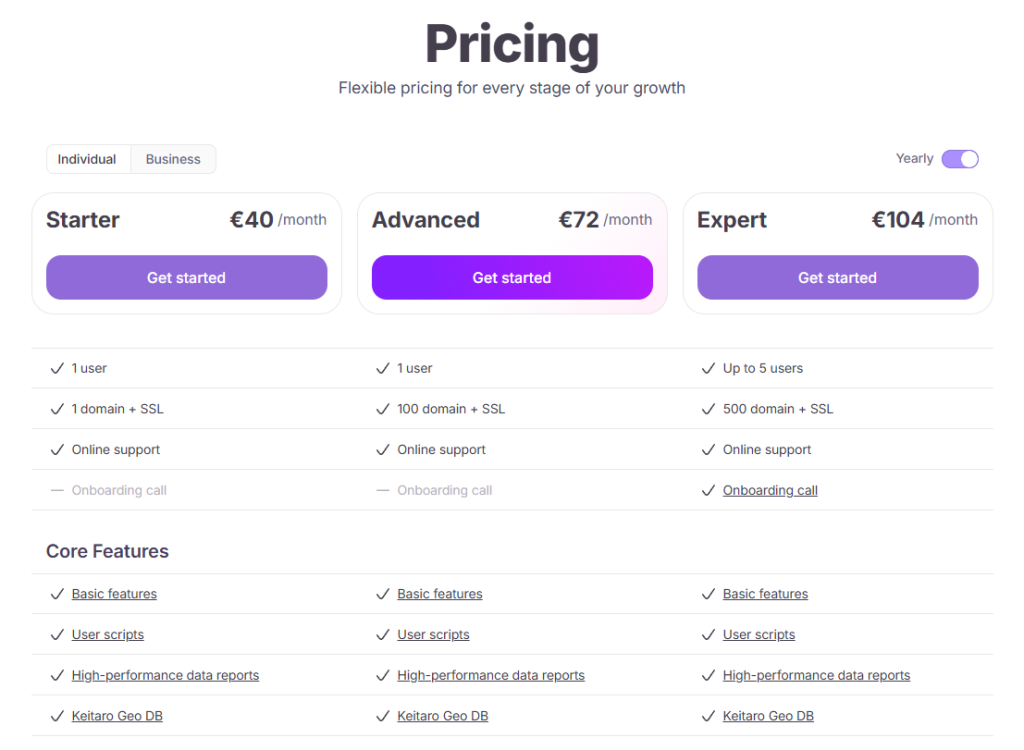

Beginners do not need the Business plans, though they may become useful later.
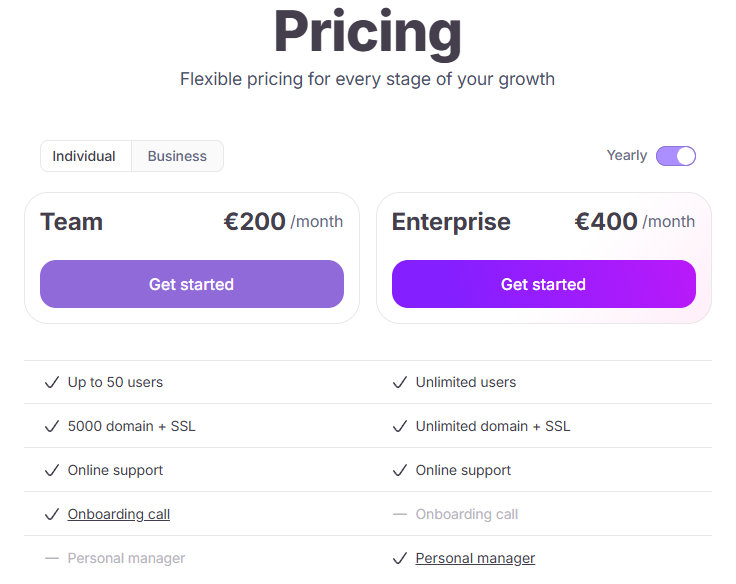
Starter’s main restriction is its one-domain limit. That is enough for a first project, but soon becomes restrictive if you regularly change domains or work across multiple GEOs. Advanced supports one user and up to 100 domains, making it the most balanced option for most solo media buyers. Expert allows up to five users and 500 domains. It also adds features for automation and teamwork, including the Admin API and flow monitoring.
Team and Enterprise add more users, domains, and integrations, along with an activity log, branding, and personalized support.
Keitaro vs. Its Competitors
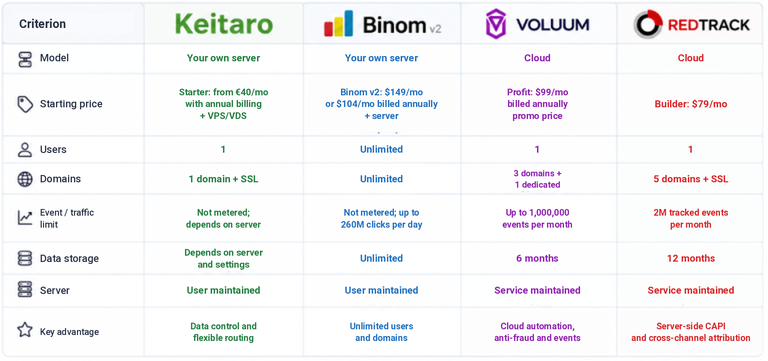
Binom is Keitaro’s closest competitor in terms of its operating model. Both trackers run on your own server, handle high volumes, and do not charge for each click processed.
Binom v2 has a higher starting price, but does not divide user and domain allowances into different plans. Media buyers can test it for two weeks and request a refund if needed. Keitaro therefore works out cheaper for solo buyers who do not need access for dozens of employees. You can start with Starter or Advanced and upgrade as you grow.
Voluum puts more emphasis on cloud-based automation. Its plans account for events, active campaigns, domains, and data retention. You pay more to avoid managing a server and to get campaign management tools in one dashboard.
RedTrack is also cloud-based, with a focus on attribution, ad platform integrations, and e-commerce. It suits users who do not want their own VPS.
The right tracker depends on your preferences. Cloud tools are easier for complete beginners, but costs grow with volume. Beyond accounts, proxies, working capital, and the rest of your setup, you also have to pay for the events processed by the tracker.

Keitaro’s Pros and Cons
Keitaro has plenty of advantages:
- your data stays on your own server;
- the license does not cap the number of clicks;
- you choose the location and capacity of your VPS;
- flexible flows and filters;
- split testing for landing pages and offers;
- locally hosted pages and a built-in editor;
- ready-made traffic source and affiliate network templates;
- S2S postbacks and multiple conversion types;
- integrations with Facebook, Google Ads, and TikTok;
- Click API and Admin API access.
There are also drawbacks:
- you pay for the server separately;
- you are responsible for infrastructure uptime;
- Starter is limited to one domain;
- the Admin API and flow monitoring are not available on every plan;
- you need to upgrade your VPS as traffic grows;
- Keitaro does not replace a full bid management tool;
- beginners need to learn DNS, SSL, and basic server management;
- there is no permanently free plan.
Who Should Use Keitaro?
Here is how Keitaro fits different situations:
- A beginner running one test campaign. A separate self-hosted tracker is not always necessary. If your budget is $200–300 and the affiliate network provides clear statistics, a simpler tool may be enough. Otherwise, your first week could go into server setup instead of testing the offer.
- A solo media buyer running several campaign setups. Advanced is a good fit. Starter’s one-domain limit soon gets in the way when you work across multiple GEOs, sources, or projects. Advanced gives you the analytics capacity to work at higher volumes.
- A small team of up to 5 people. Consider Expert: 5 users, the Admin API, and flow monitoring let you allocate access and automate some routine work.
- A media buying department. Team and Enterprise are the right options. Their value extends beyond higher limits to roles, activity logs, more integrations, and centralized analytics.
Choose Keitaro when you need control over your data, high traffic volumes, and complex routing. If your priority is launching one campaign without managing a server, a cloud tracker is simpler.

FAQ
Keitaro is a self-hosted tracker for analyzing advertising traffic. It records clicks and conversions, links them into a single system, and allows you to evaluate campaign performance down to the level of creative and source.
Keitaro is installed on your own VPS or VDS, so all infrastructure and data are under the affiliate's control. In cloud solutions, the server side and maintenance are handled by the service, and the user works through a ready-made platform.
The basic Starter plan costs about €40 per month with annual payment. You also need a VPS server (on average €7–10 per month) and a domain (~$6–10 per year). As a result, basic usage costs around $50–65 per month, not including backups and additional services.
Installation is possible via auto-installation with supported hosts or by following the instructions. The main difficulties usually arise not during installation, but when setting up the domain, DNS records, and SSL certificate.
A postback is a request from an affiliate network to the tracker after a user completes a target action. It transmits the click ID, conversion status, payout, and currency, allowing you to accurately link clicks and revenue.
Keitaro distributes traffic through flows and filters (GEO, device, IP, parameters, and other conditions). These mechanics allow you to segment the audience and direct it to different pages.
Yes. Keitaro supports passing campaign parameters and integrations with ad platforms, including sending conversion data back to ad accounts.
Both solutions are self-hosted trackers. Keitaro is often chosen for its lower entry threshold and flexible pricing, while Binom is preferred for having no user or domain limits based on plan.
There is no permanent free plan.
A basic VPS (2 vCPU and 4 GB RAM) can handle up to ~100,000 clicks per day. Actual load depends on reports, API requests, and overall server configuration.

Comments (0)