


While the rest of the market fights for space in Google’s search results, the world’s second-largest search engine remains largely untapped. The people already getting traffic from it kept quiet for as long as they could: SEO team MultiClick spent two years building its core business around Bing. “A year ago, we were better off keeping quiet about it. Now you can already see competition starting to grow,” co-owner Maksim admitted in a podcast on the PressAff channel (in Russian).
I’ll examine their experience alongside recent case studies, platform statistics, and pitfalls that get less attention. Beyond the MultiClick owners’ experience, this article draws on posts and case studies by Oleg Shestakov of Rush Agency and Black Flag SEO, SEO analyst DrMax, and recent analyses by Glenn Gabe of GSQi and the Peec AI team.
The key point: Bing is a separate search engine with its own ranking rules, very little competition in many niches, and a distinctive bonus: its index feeds answers in ChatGPT and Copilot. A single Bing ranking can therefore bring traffic from three sources.
Bing in 2026: audience and traffic potential
First, a few paragraphs of background. The numbers matter if you want to understand the opportunity.
Bing is Microsoft’s search engine and the world’s second-largest by market share. It accounts for roughly 5% globally, according to StatCounter. That sounds like a rounding error next to Google, until you translate percentages into people: statistics aggregators (in Russian) estimate its audience at 500+ million unique visitors and around 100 million daily active users. Its share is higher in the US, at around 7.5%, while on desktop it handles roughly 12% of searches worldwide.
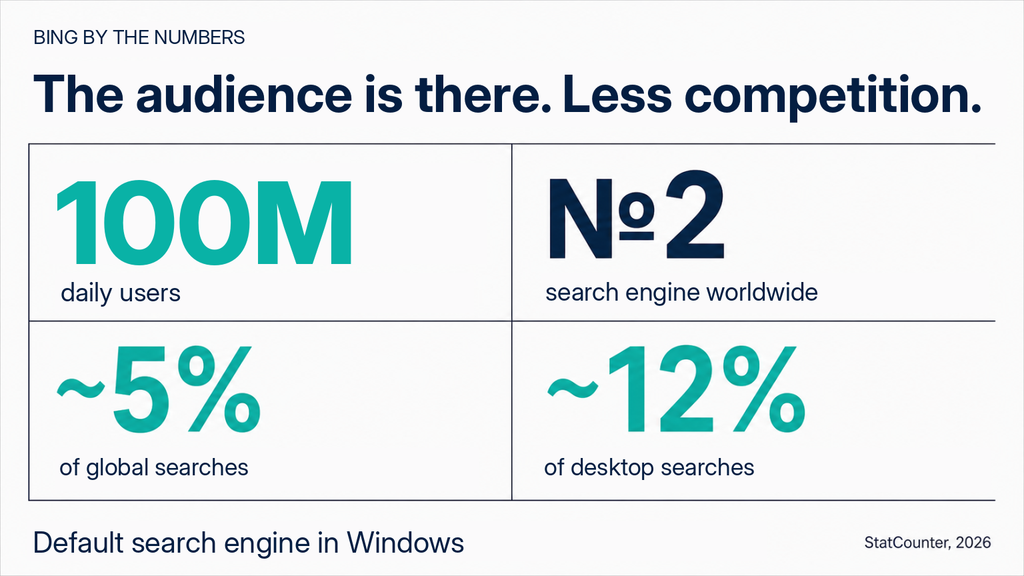
Five percent of global search means hundreds of millions of people who simply left the default settings alone.
Those figures are easy to explain. Bing is the default search engine in Windows and Edge, and it is integrated into Copilot, Microsoft’s AI assistant, which comes preinstalled on Windows. Many users simply leave those defaults in place. This produces a particular audience: older, more conservative, and more likely to search from a work computer.
For affiliates, that means an audience with spending power in Tier-1 markets such as the US, Canada, and Western Europe, with money to spend and credit cards to use.
Oleg Shestakov, founder of Rush Agency and Black Flag SEO, wrote in a June post on his channel (in Russian) that his tests put around 60% of Bing users in the US. For sites ranking in the top 3, he said, “there is traffic, and those users have real spending power.”
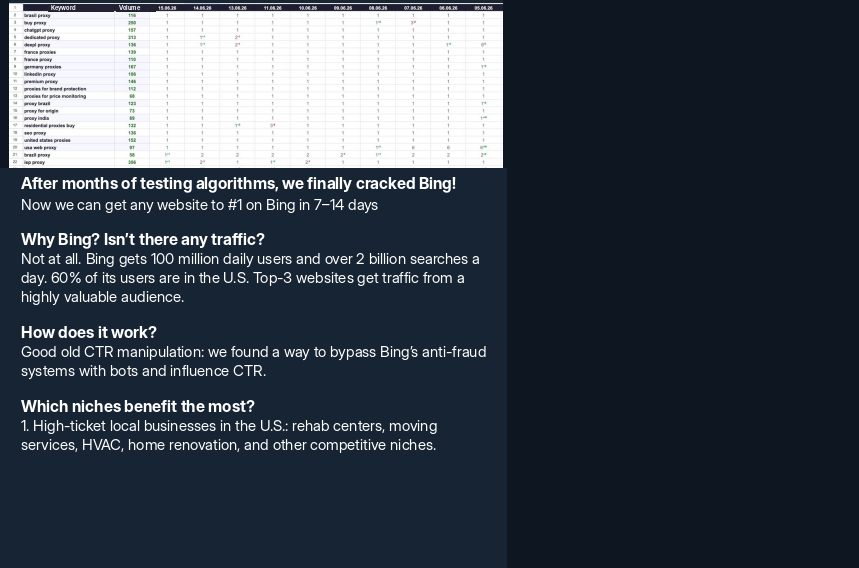
Screenshot from the Telegram channel of SEO expert Oleg Shestakov (translated from Russian)
Why SEOs and affiliates are looking at Bing again
Four factors explain the renewed interest in Bing among affiliates. Here is how MultiClick co-owner Maksim describes them.
1. Competition. This is the biggest reason. Winning commercial rankings in Google takes budgets large enough to hire whole link-building teams; in Yandex, it takes armies of bots. For a huge range of Bing queries, serious competition is still scarce. The industry spent years repeating “there’s no traffic there” without checking.
| “There was a period when everyone talked about Bing and said there was no traffic. We realized there was traffic for us. So we started getting it and gradually increased the volume.” |
2. Stability. Bing does not produce quarterly upheavals on the scale of Google’s core updates, which leave SEOs watching their rankings nervously for a week.
| “Their updates are infrequent and barely noticeable. Sometimes something drops out, but usually, once you take a top spot, you stay there until someone overtakes you.” |
3. Cost of entry. You do not need a Google-sized link-building budget. The main lever is different and considerably cheaper, as the next section explains. MultiClick even considers Bing easy to enter, with one caveat:
| “For us, Bing now feels like the easiest traffic source to enter. But when I speak to colleagues, they tell me they keep trying different things and still cannot make it work.” |
Simple does not mean intuitive.
4. A reason that barely existed a couple of years ago: Bing rankings translate into visibility in AI answers. That deserves its own section below.
Bing still cannot match Google’s traffic volume. Maksim himself describes it as their “first place to start.” But an accessible starting point with little competition is exactly what affiliates need most in 2026.
How Bing ranks: a mix of Google and Yandex
A common mistake is to bring your entire existing SEO playbook to Bing. That causes problems whether you come from Google or Yandex.
| “They are two different search engines: what works in Google is completely different from what works in Bing. People come over from Google, where links and outreach work well, and immediately try to pile those on, spending a lot of money. But they may get no results at all. Or they come from Yandex and think they can push behavioral manipulation as hard as possible. In reality, they overdo it and drop out of the index entirely.” — Maksim, MultiClick co-owner. |
BF — behavioral factors: signals about how users behave in the search results and on the site — which Behavioral signals describe how users interact with search results and websites: which snippets they click, whether they return to the results, and how long they spend on a page. In Yandex, manipulating these signals has been an industry in its own right for years.
In that respect, Bing’s ranking mechanics are closer to Yandex’s than to Google’s:
- Behavioral signals are the main lever. Improving these metrics moves rankings faster and more strongly than other methods. This explains why a Google-style strategy built on links without behavioral signals can stall.
- Links are a secondary signal. They help as a supplement. As Maksim puts it, “There is a little overlap with Google: you do need some links.”
- Excessive manipulation is penalized. People coming from Yandex can push too hard. In Bing, overly aggressive manipulation can lead to removal from the index, rather than simply lower rankings.
- Content quality is assessed during indexing. Bing Webmaster Tools has a separate Content Quality flag for excluded pages. Low-quality content may never make it into the index, making this a key filter against empty, low-value sites.
As noted above, updates are infrequent and relatively mild, so a top ranking can last. The other side of that stability is that if a competitor takes the spot, waiting for an update to remove them is unlikely to help. You have to outperform them yourself.
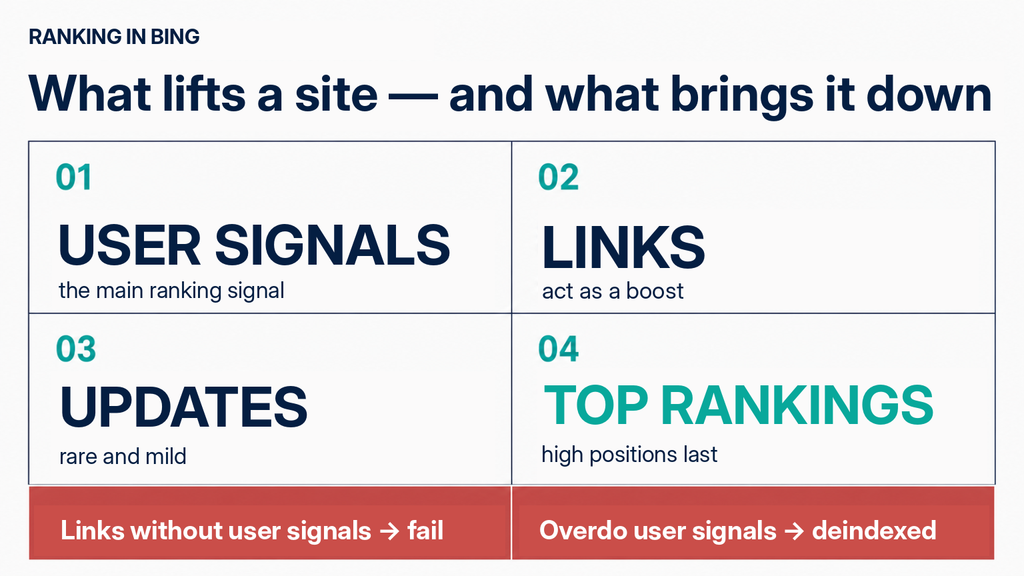
Yandex experience transfers to Bing more readily than Google experience does, provided you do not overdo behavioral signal manipulation.
Getting started with Bing SEO for affiliate marketing
Here is a basic starting plan based on expert recommendations. It uses white-hat methods, the foundation of any project.
Step 1. Register with Bing Webmaster Tools. This is Bing’s equivalent of Google Search Console. You can import a site from GSC in a couple of clicks, carrying its verification across automatically. Shestakov summed up the next step in advice to his subscribers back in spring 2025 (in Russian):
| “What should you do this evening? Add your site to Bing Webmaster Tools and set the crawl rate to its maximum. Yes, you CAN ADJUST this in Bing Webmaster Tools. And yes, it is free.” — Oleg Shestakov. |
Bing really does let you adjust the crawl rate manually, something Google users can only dream of.
Step 2. Submit a sitemap and enable IndexNow. IndexNow is an open protocol for instant indexing: notify Bing about a new or updated page, and it can enter the index in hours rather than weeks. WordPress plugins and most CMS platforms support it out of the box. For site networks and new websites, it is a key tool.
Step 3. Optimize your pages for Bing. Bing is more literal than Google in interpreting text: exact keyword matches in the title, H1, and opening paragraphs still carry considerably more weight. A clear structure also matters: short, meaningful sections with one idea per paragraph. In its report on grounding, Bing itself advocates structured, verifiable content because it breaks that content into passages for AI answers.
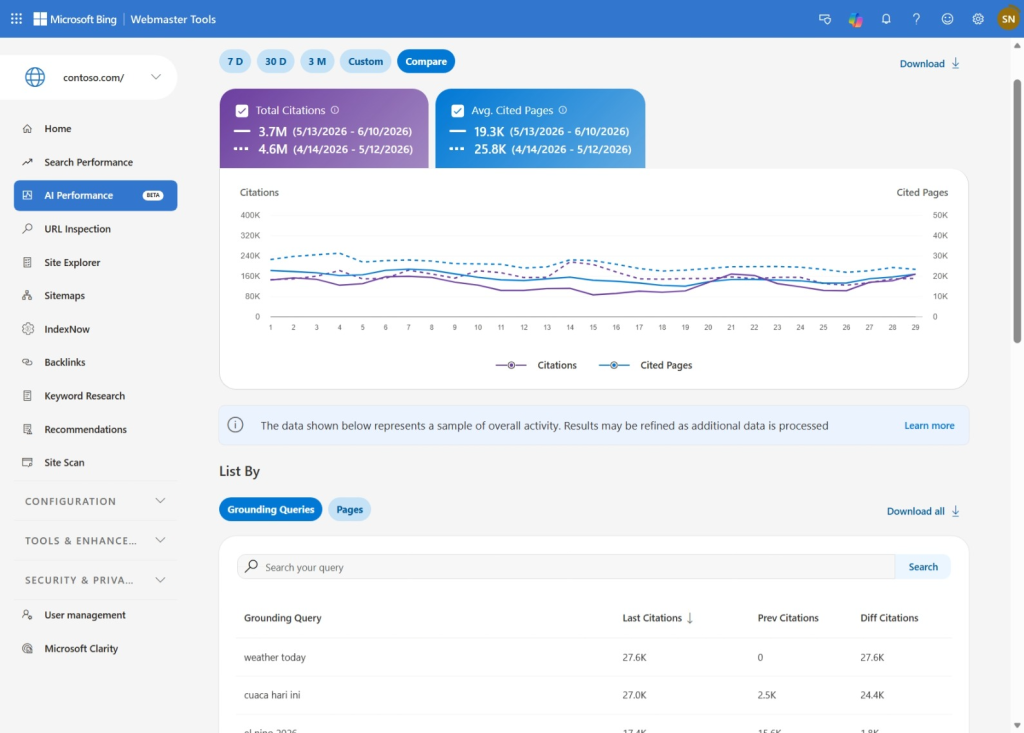
The AI Performance report for a demo domain, showing the citation chart and Grounding Queries table. Source: Bing Search Blog.
Step 4. Monitor the AI reports. In 2026, Bing Webmaster Tools added analytics that Google does not offer. The AI Performance report shows how your site is cited in AI answers: the queries involved, your share of citations through the Citation Share metric, and query breakdowns by intent and topic. SEO analyst DrMax called the update (in Russian) a “money button”: for the first time, you can see which pages actually appear in AI answers. The next step is to connect that visibility to revenue in your analytics.
Bonus: Bing as a route into ChatGPT and Copilot
This is why Bing is a more interesting proposition in 2026 than it was in 2024.
How it works: when ChatGPT needs a current fact from the web, it sends queries to Bing, OpenAI’s official search partner, rather than Google, and builds its answer around those results. This is called grounding: anchoring an AI answer in retrieved search results. Microsoft’s Copilot follows the same principle even more directly. A Peec AI analysis of Deep Research logs published in July 2026 found that every search query in ChatGPT’s research mode carried the label web_with_bing, with no Google searches used. The discipline already has a name: Generative Engine Optimization, or GEO, which means optimizing content for inclusion in AI answers as well as traditional search rankings.
A practical example comes from SEO consultant Glenn Gabe’s case study. A YMYL site, covering money and health topics that search engines scrutinize closely, used mass-generated content. Google pushed it beyond the seventh page of results, yet it was cited across 90,000+ ChatGPT prompts.
Bing turned out to be the source. It had 88,000+ pages from the site indexed, compared with 45,000+ in Google, and the site ranked for the very queries that led to its ChatGPT citations. Its Bing rankings translated into AI visibility it would not otherwise have had.
Russian-speaking practitioners report the same trend with smaller figures from their own projects. In a February post (in Russian), DrMax shared his results:
| “More than half of my Bing traffic comes specifically from AI citations.” — DrMax. |
Shestakov also noted a side effect in his case study on behavioral signal manipulation (in Russian): higher Bing rankings increase visibility in Copilot, which draws on Bing’s results and is built into Windows computers.
| An important caveat: in his August update to the same case study, Gabe found that Bing had eventually deindexed the entire site. Yet ChatGPT citations continued to grow, suggesting that OpenAI is also building its own index. Researchers had already observed a shift toward hybrid search sources in ChatGPT in autumn 2025. |
The practical takeaway: the “Bing → AI answers” route works today, but do not assume it will work forever. Keep monitoring the AI reports described in the previous section.
Bing SEO case studies: who is earning, and what can go wrong
Now for the promised case studies. What does this look like in commercial terms?
MultiClick: two years in gambling, with sites lasting around a year. The company’s core is a Bing SEO team working in gambling: single-brand sites dedicated to individual casinos, plus slot-related content, rather than review aggregators. The team has automated the full workflow, from generating websites and content to managing its network and servers and buying domains. Its key measure of staying power, in Maksim’s words:
| “Most of the projects we run have already been live for around a year.” — Maksim, MultiClick. |
For a gambling site relying on search traffic, that is a substantial lifespan.
Black Flag SEO: a No. 1 ranking in 7–14 days, sold as a service. In February, Shestakov’s team published a case study (in Russian) in the white-hat B2B niche of services for casino businesses. They began manipulating behavioral signals in December, and by mid-February the site ranked No. 1 for almost every target query. In June, they announced (in Russian) that they could get sites to No. 1 in Bing within 7–14 days through CTR manipulation, using bots to inflate snippet click-through rates. They offered this as a service for $1,000–1,500 a month, depending on how competitive the niche was.
Based on their experience, target niches include high-ticket local businesses in the US, iGaming and sweepstakes, SaaS, and AI services. This is not a recommendation to buy CTR manipulation. It is a sign of how far the market has developed: an ecosystem of services with clear pricing has formed around this traffic source.
A white-hat example for balance. US agency TM Blast reports a case study in which organic Bing traffic grew by 288% in a year, from 1,290 to 5,001 sessions, through technical fixes and consistent SEO alone. The absolute figures are modest, which is part of Bing’s reality too: a white-hat site gets a steady, inexpensive addition to its traffic, rather than a gold rush.
Next are the pitfalls experienced SEOs have already run into.
The main risk in gambling is not the algorithm, as Maksim from MultiClick makes clear:
| “Local regulators can still step in and take your site down. Sometimes brands file DMCA complaints too.” |
A DMCA complaint alleges copyright infringement and can get a page removed from search results while the dispute is resolved. For single-brand sites, this is a routine threat.
Other risks include:
- Overdoing behavioral signal manipulation. Bing can remove a site from the index rather than merely lower its rankings. Rebuilding a deindexed site can be easier than reviving it.
- Mass-generated content is under scrutiny. Gabe’s case also serves as a warning: Bing eventually deindexed the site it had allowed through for six months. Search engines are learning to identify patterns in low-quality AI content; Bing is simply behind Google.
- Traffic volume. In most niches, Bing delivers several times less traffic than Google. It is an additional source or a starting point, rather than a replacement.
Bing SEO traffic checklist
- Add your site to Bing Webmaster Tools by importing it from GSC.
- Submit your sitemap, enable IndexNow, and set the crawl rate to its maximum.
- Research keywords specifically for Bing. Demand and competition differ, so do not simply reuse your Google keyword list.
- Optimize pages with exact keyword matches and short, self-contained sections.
- Treat behavioral signals carefully: excessive manipulation can cost you your place in the index, rather than just your rankings.
- Monitor AI Performance and Citation Share to measure visibility in AI answers.
- If the approach works for one site, scale it across a network while the opportunity remains open.
That window is closing, as it tends to with overlooked traffic sources. A year ago, people making money from Bing kept quiet. Now they give interviews and sell services. You can guess what comes next.t comes next.

FAQ
Microsoft’s search engine, the second largest in the world by market share (about 5%). It’s the default in Windows and Edge, so the core audience is people who don’t change settings: conservative, older, solvent, mostly from the US.
Almost not: Bing’s share in the Russian internet is tiny, with demand taken by Yandex and Google. Bing is about the West, primarily the US and Tier-1.
Register in Bing Webmaster Tools (you can import from Google Search Console), upload your sitemap, enable IndexNow, and manually set the maximum crawl speed in the settings. All free.
An open instant indexing protocol: the site itself notifies the search engine about new and updated pages. Supported by Bing and Yandex, built into popular WordPress SEO plugins.
The main signal is behavioral factors, not links; exact keyword matches work better; updates are rare, rankings are stable. Google experience doesn’t transfer well to Bing, Yandex experience works better, but without overdoing behavioral factors.
Rank for your target queries in Bing: ChatGPT generates answers based on its results, and Copilot does too. You can track your performance in the AI Performance report in Bing Webmaster Tools.
Cheaper than Google: you barely need a link budget. The market benchmark for manipulation is $1000–1500 per month for a moderately competitive niche; white-hat promotion mostly comes down to content and technical optimization.
Microsoft Advertising is a whole separate topic: the auction is cheaper than Google’s, but moderation and advertiser verification are stricter. And this is no longer SEO — the topic deserves its own article.

Comments (0)