


In recent years, Google has been regularly rolling out updates that shake up the SERPs for gambling-related queries. Everything gets hit: drops, EMDs, generated content, polished native texts, and sites with exclusive links from in-house link building teams.
It’s during these times that affiliates remember about whitehat (usually just to drop it a week later, saying “there’s no money there”).
Below is an analysis of what’s really happening in white verticals. We’ll mostly focus on SEO, but won’t ignore paid traffic, Avito, and white affiliate programs either. The article is universal and useful no matter what traffic source you work with.
What is a white vertical and where’s the “get offer” button?
A vertical is the niche you drive traffic to: gambling, betting, nutra, dating, finance. White means the product is legal, advertising doesn’t break platform rules, and the advertiser operates as a regular company with legal status and accounting.
Sounds like a textbook definition, but the real difference is elsewhere:
- In white verticals, companies often don’t have affiliate programs. And this breaks the usual affiliate logic before you even start.
- Affiliate programs do exist in white niches, and there are plenty—banking, insurance, service-based, more on those below—but the more offline and expensive the niche, the less likely you’ll find a “get offer” button.
There are no affiliate programs in jewelry, heavy equipment, and other very offline sectors. It’s a huge exception that hardly anyone’s heard of. Here, it’s more about “client–contractor” relationships.
This is how Andrey explains it, author of the “Tikhiy Chas” channel—a solo specialist who runs networks of sites for heavy equipment in Russia and Europe. He’ll be the main character in this article: he has what most leadgen guides lack—real numbers and real failures.
Here’s the first fork in the road: working in white means either client SEO paid by the client (SEO, PPC, any other traffic), or pay-for-results. All the interesting stuff happens in between.
Lead generation—what it is in simple terms
Lead generation is about attracting contacts of people interested in buying: a form submission, a call, an email, a filled-out questionnaire. So a lead isn’t a buyer yet, just someone who’s raised their hand. After that, the advertiser’s sales team takes over, and how they work determines your income.
I’ll come back to the point about someone else’s sales team: it explains the story about 800,000 rubles.
Where did the idea come from that “whitehat pays pennies”
This myth is persistent, and it has a clear origin: people compare extremes.
The story that “there’s only pennies in white-hat SEO” is greatly exaggerated. People usually compare a typical e-commerce affiliate program with a 3–7% commission to gambling, where a single player can bring in hundreds of dollars. But between these extremes, there are plenty of niches with expensive leads or high LTV. This includes services with average checks in the hundreds of thousands, B2B subscriptions, financial products, and offline businesses with high LTV. The difference between pennies and real money isn’t about the vertical’s color, but two things: how much a lead costs and what payout model you’re on. Let’s start with the models.
Three payout models in white-hat
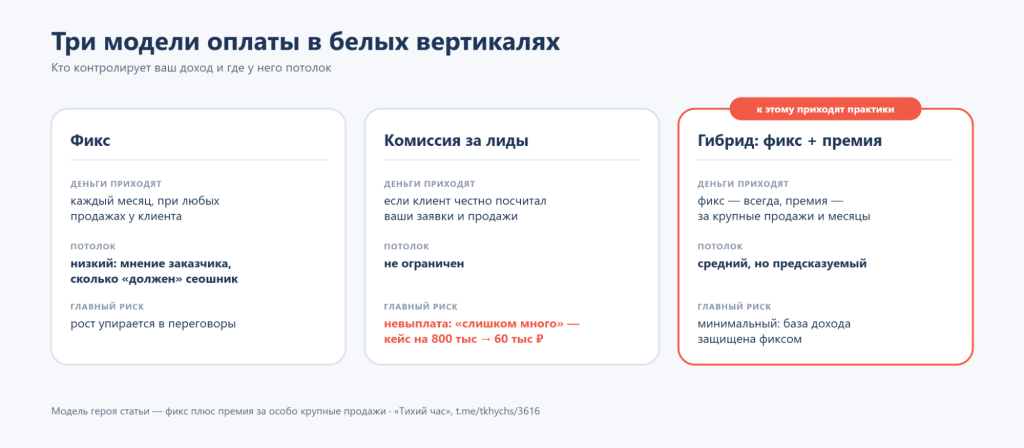
Fixed fee — predictable but capped
The classic client setup — SEO, PPC, ad campaigns: you manage the project and get paid monthly. The upside is obvious — you get paid regardless of how the advertiser handles the leads. The downside: your ceiling is whatever the client thinks an “SEO specialist should earn.”
Pay per lead — high ceiling, high risk
You get a fixed amount per lead or a percentage of sales. In theory, there’s no cap. In practice, your ceiling is set by the person who counts and pays the money — and they have their own idea of what’s fair. More on that in the next section.
Hybrid — what experienced pros choose
Fixed fee plus a bonus for especially large sales or profitable months. That’s exactly how it worked out for Andrey and his main client in heavy equipment:
| “In the end, we settled on a fixed fee plus a bonus for particularly large sales or especially profitable months. This hybrid works for me — I count on the fixed part first and foremost.” |
The client was willing to pay per lead and always paid on time. The affiliate himself turned down the commission model — “I was done with the rollercoaster.”
Why leadgen breaks: an 800k story
The most common failure in white-hat leadgen isn’t weak traffic or bad creatives. It’s when you come to collect your accumulated commission.
| Almost every time, I never got my full payout. Once I even wrote about it — it was around 800k, and they just told me, SEO guys don’t make that much, here’s your 60k. |
Then Andrey describes how the refusal works — and it’s not about greed, it’s about their worldview:
| All our reasonable arguments like “but this is just a commission, you’ve already made your profit, you’ve already earned” would crash against the irrational “it’s too much.” |
Your arguments in this dispute carry almost no weight:
| All these phone checks, call recordings, email verifications, etc. — are very weak arguments in a dispute. You have to be a very powerful lead supplier, literally organizing the system and business, for your word to really matter. |
It’s easy to decide this is just one person’s bad luck with poorly chosen partners. The problem is, another practitioner tells the same story, with no connection between them.
Denis Vorontsov had 39,000 rubles in “available for withdrawal” status for the second month in a major white CPA network. When he asked to withdraw the money, the manager replied that nothing could be withdrawn and he had to wait for the advertiser’s final reconciliation.
| I guess I just got used to gambling affiliate programs, where they’ll meet you halfway, give you early payouts, and communicate understanding the value of the webmaster and their traffic. But here — just for asking for my earned money, I ended up being “the rude guy who thinks everyone owes him.” |
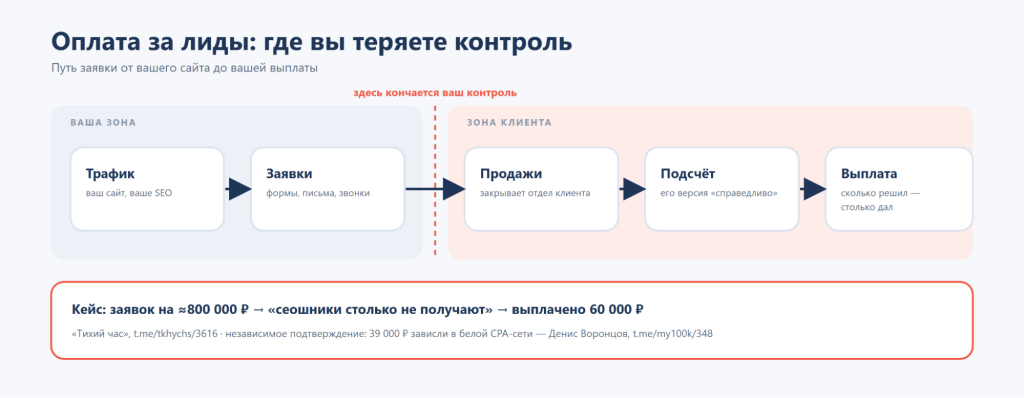
This is the main surprise of white verticals for someone coming from gambling. You leave the gray zone partly for predictability, but end up in a market where payments are slower, disputes are more common, and webmasters are treated like contractors who are basically being done a favor. The irony: the only field where payouts come on schedule is the one usually considered dirty.
Who Really Lives on Leads
There are people who have lived on commission for years. But it’s a separate profession, and it looks nothing like most imagine.
Andrey describes his client — the one in special equipment, who employs four webmasters, runs a bunch of sites, and works with partners strictly on leads:
| This is a completely different mindset: no family, psychological manipulation, constant checks, their own people on the phones, and so on. Sometimes you hold back traffic a bit, sometimes you create a fake order, then a test order, and so on. This way of doing business is unbearable for almost everyone — he just enjoys it. |
Read that again and compare it to the list of reasons people usually go white. Holding back traffic, submitting fake leads, having your own people on the phones — these are exactly the tactics that make gray niches seem dirty. The only difference is, here they’re aimed not at the user, but at the business partner.
The rule from this story: in lead generation, the money goes not to the one who drives the traffic, but to the one who controls the entry point to the deal. Always.
What it looks like in its purest form
The best illustration of the mechanics is a story retold by the SEO channel Mike Blazer, referencing Szabo.
A plumber from Tucson died in 2023. His Google listing stayed up: 212 reviews, a 4.9 rating, and for eleven years the city knew to call that number when there was water on the floor. The family canceled the phone plan, the number went back on sale, but the reputation remained.
Szabo’s acquaintance bought the released number for $40, pays $12 a month for call forwarding, and answers as a dispatcher. Every call is routed to a licensed plumber two miles away, and he takes 15% from each closed job.
Results for the month:
- 34 calls;
- 19 real requests;
- 11 closed deals;
- average ticket $740;
- about $1,200 in revenue.
For comparison, Google charges local plumbers in the same city about $55 per lead.
No website, no traffic, no SEO. The person simply owns the point where requests come in. The scheme is, of course, shady: the niche is white, the method is not.
Verticals map: where the money is in white niches
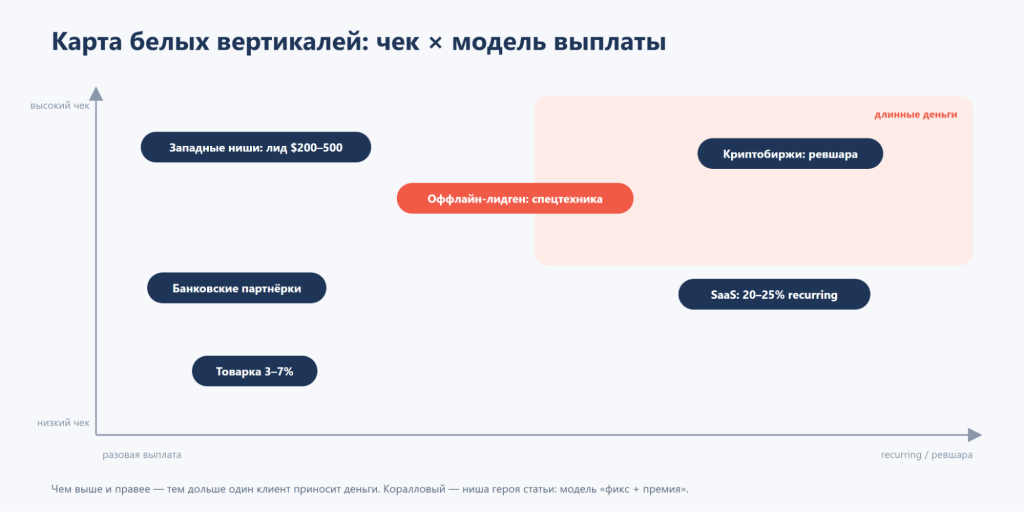
Bank affiliate programs — the largest white vertical in Runet
Banks are the only white niche where everything works as affiliates expect: offers, rates, tracking, payout for an approved product. Demand is huge — just for Alfa-Bank’s affiliate program in Russia there are about 2,160 searches per month, and for banking affiliate programs overall, around 4,300.
For this reason, it’s also the most crowded. Finding the programs is easy: major banks have their own CPA networks — T-Bank has T-Partners — plus banking offers are aggregated by showcases like Pampadu and networks like GuruLeads.
Most queries are navigational — from people already in the program looking for their dashboard — and the informational results are dominated by the banks’ own reviews. There’s a model feature often forgotten at the start: payout is tied to approval, so if the bank’s scoring rejects the application, you don’t get paid. Going head-on with “top 10 debit cards” is too late; the working niches are left in narrow scenarios — business accounts, products for freelancers, brokerage accounts.
White CPA networks: e-com, finance, services, travel
Affiliate programs with white offers do exist, and there are more of them than it seems from the gambling crowd. The check here is more modest than gambling: commissions are usually in the hundreds of rubles, not hundreds of dollars. But this is the only white corner where entry looks familiar: register, take an offer, drive traffic.
Here’s a short selection — just to give you an idea of where to look when starting out.
- Admitad — e-commerce and services. The largest white-hat CPA network in Runet: 1700+ offers from marketplaces to subscription services, payouts in rubles, Russian-speaking support. Most people start here — and in terms of variety, it’s still the broadest entry point into white-hat affiliate marketing.
- Leads.su — finance in all its forms. On the market since 2010: 1000+ offers and 300+ advertisers — microloans, credit and debit cards, mortgages, business accounts, insurance, even bankruptcy.
- Pampadu — showcase of insurance and banking products. OSAGO, CASCO, mortgage insurance, cards, deposits, plus HR offers. 340+ advertiser companies and 57,000+ webmasters and agents.
- ServiceLead — leads for repair and household services. Payment for confirmed leads, 550–3000 rubles, payouts weekly. More details about it — in the Avito section below.
- Travelpayouts — travel. 90+ brands, including Aviasales and Ostrovok: hotels pay up to 8% commission, tours — from 10%. Average checks are small, but demand is constant.
- Perfluence — white-hat for those with an audience, not just websites. CPA marketplace for bloggers: 200+ projects from banks to marketplaces, works via promo codes, entry from 2,000 followers.
Crypto Exchange Affiliate Programs — Lifetime Revshare Without Negative Carry
A niche that’s surprisingly under-discussed in affiliate circles. Denis Vorontsov describes it like this: revshare earnings, the referred user is locked to you and brings in money for their entire active period, the niche is quite gambling-oriented — yet fully white-hat.
The key difference from gambling is the risk:
| Here you get a % of the exchange’s income from user trading commissions. No signals, no payment calls, none of that shady stuff. You simply bring a trader to the exchange and earn a lifetime % of the exchange’s revenue. |
Plus, an important clarification: we’re talking specifically about affiliate programs of exchanges, not the “invite a friend” referral links from your personal account, where you get a one-time $10 and that’s it. And not about crypto offers with binary options, where the goal is to squeeze the user for as much as possible and move on.
The economics are distributed like in gambling: small depositors bring in pennies, but one high roller on leveraged futures makes the bank.
As for traffic sources, the niche is omnivorous. Vorontsov lists them directly: “SEO, UBT, PPC, ad placements, influencer (not the shady kind) — you can work with whatever you know best.”
B2B and SaaS — Recurring Instead of One-Time Payouts
The most underrated niche for those skilled in content and SEO. Andrey recommends looking here first:
| CRM, hosting, VPN, email marketing, SEO tools, website builders, AI services, accounting software, business automation, telephony, helpdesk, HR, developer tools. Here you’ll find affiliate programs with a recurring model: bring in a client and get a percentage of their payments for several months or longer. |
It’s worth backing up the estimate with market numbers. According to an analysis of 116 active programs as of June 2026, the median commission in SaaS is 20%, the average is 23.3%, and the most common range is 20–25%. Moreover, 83% of programs pay a percentage, not a fixed amount. So the lower end of Andrey’s range is actually the market norm, and 50% is much less common than one might hope.
Specific examples: HubSpot pays 30% recurring with a 180-day cookie, Hostinger gives 40% from hosting sales, Shopify — $150 per referral. The spread is wide, so you need to check the terms of each program, not just rely on average reviews.
Here’s the most practical advice from all the insights. Instead of another “10 best CRMs” article, Andrey suggests actually installing these ten CRMs, running identical scenarios, and comparing costs for 5, 20, and 100 employees, database import, integrations, API, plan limitations, and support speed. Or build a calculator: “which plan is more profitable for a given team size.” The difference between this and rewriting someone else’s reviews is like the difference between a working website and a doorway page.
Offline Goes Online — Heavy Equipment, Warehousing, Construction
This is Andrey’s own niche and, in his words, the most comfortable for your mental health:
| Any business that exists offline is pleasant and easy to grow online… there’s clear search results, competition, and predictable outcomes. You’ll have plenty of real communication and less burnout, with a sense of real life instead of just sitting at a computer all day. |
The scale of demand in these niches is solid: just “special equipment rental” gets over 20,000 searches a month in Russia, not counting brands, cities, and equipment types. There won’t be an affiliate program here — you’ll be dealing directly with a specific business owner.
Services and Media for the Industry Itself — “Sell Shovels”
A separate white-hat vertical that affiliates for some reason don’t consider a vertical, even though they’re in it every day. The logic is simple:
| If we already know that the gambling gold rush is in the same room with us, and there are more and more gold diggers every day, maybe it’s time to focus our efforts on making shovels? |
Shovels are agency accounts, payment systems, CRMs, processing, PWA app services, anti-detect browsers, behavioral boosting and draining tools. Everything a gold digger can’t do without. And as Vorontsov notes, his favorite type of shovel in this market is media resources: from affiliate media outlets to webmaster Telegram channels.
The article you’re reading was also made by shovel sellers, according to this same terminology.
High-paying niches in the West — Charles Float’s list
If you work with English-speaking traffic, the benchmarks are different. SEO specialist Charles Float compiled a list of white niches, sorted by investment-to-profit potential:
- Timeshare exit — leads go for $200–500 and up. According to Float, a 30-page site with a year of link building and about $15,000 invested is enough to reach $10,000–20,000 per month.
- Rehabilitation centers — one of the most expensive niches per lead. High entry barrier: legal restrictions and strict moderation, but competition is easier behind that wall.
- Tax debt relief — the hardest on the list and one of the most profitable.
- Medical tourism — veneers, hair transplants, IVF. Clinics pay from $10 to $1,000 per lead.
- Equipment financing — construction machinery, medical equipment, restaurant outfitting. Large deal amounts, and general finance sites without expertise often rank at the top.
- Citizenship and golden visas — the service costs $10,000–50,000, so payouts are generous.
- In-home senior care — demand grows as the population ages, with four- and five-figure commissions.
Float’s formula: high deal value + boring topic + weak SERP + geo scale. “Equipment financing” from this list is the same heavy machinery niche, just from the money side.
Economics: entry costs and returns
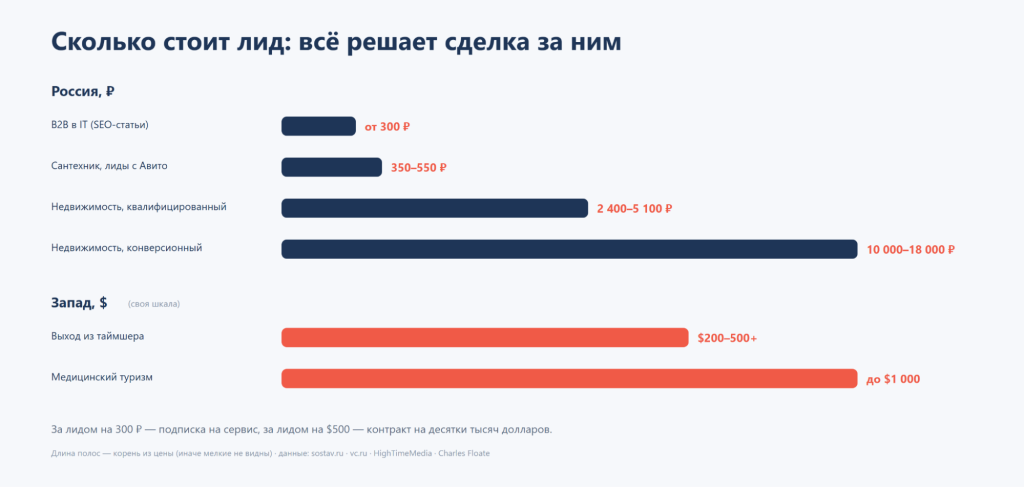
Let’s ground the idea of an “expensive lead” with numbers. Figures for the heavy machinery niche come from someone working in it.
How much it costs to build a site:
- an optimized site for selling heavy machinery — 40,000–80,000 rubles;
- a basic catalog, when you need to recreate an existing site — about 40,000;
- the most expensive project, with all improvements, cost 180,000 in total.
Markup comes from filters and their functionality, ratings, comparisons, reviews, parsing and uniqueness complexity. Then there’s ongoing support: according to Andrey, it’s project-based payment or 30,000–80,000 rubles per month while work is ongoing. He notes himself that “there aren’t really any clear price lists.”
What this brings in terms of leads:
- warehouse equipment: with 50–100 unique visitors per day, you get 3–10 inquiries via email and forms;
- traction batteries: with 20–50 uniques — 2–5 inquiries.
Important detail: the count is based on traffic, not the age of the site. And this is only emails and forms — calls are not included in the stats, since the client handles the phone.
For comparison: in real estate, a qualified lead costs from 2,400 rubles on VKontakte to 5,100 on Cian and Avito, while Roman Makarov and Denis Borisov from HighTimeMedia report in their case study getting B2B IT leads from 300 rubles through publications in industry media.
The gap between a Russian B2B lead for 300 rubles and a Western timeshare lead for $500 is not about the skill of the marketer. It’s about the deal size behind that lead.
Avito and Aggregators: Competitor, Not Channel
A separate story where beginners in whitehat stumble. It seems that since there’s high demand on Avito, you can get leads from there and sell them to businesses. In reality, aggregators in search results work against you.
| Not quite sure about your geo, but almost certainly for almost any query you’ll see Profi.ru and Avito. You won’t outrank them, but after six months of hard work you can still get your share of orders. |
This is Andrey’s reply to someone entering the service niche. It’s a sober view: aggregators almost always rank higher, there’s no point trying to outrun them — you take your share of demand next to them.
At the same time, Avito itself is a perfectly viable paid lead channel, just from the other side of the counter. An analysis of six niches shows that a plumbing lead in Moscow costs about 550 rubles, in Tyumen — 350, and the difference is driven not by demand, but by competition for bids. For business, this is a direct competitor to your site in terms of acquisition cost: if your leads are more expensive than the platform, the conversation about cooperation will be short.
Entire affiliate programs are built on this traffic. ServiceLead is a CPA network with offers for repair and household services and 20+ categories from washing machines to “handyman for an hour”: they pay from 550 to 3,000 rubles per confirmed lead, and not only do they accept webmasters from classifieds — they also teach how to get this kind of traffic in their own ServiceLead Business School.
It’s interesting to see what demand looks like around making money on Avito itself. “How to make money on Avito” is searched about 2,000 times a month, and another 772 for “making money on Avito.” But if you look at what’s behind it, it’s reselling, reviews, and side gigs with no investment. The “supplying leads to business” model doesn’t exist at all in the public mind.
For you, that’s actually good news: in this space, it’s resellers competing for attention, not lead generators.
How to Go White Hat? Spoiler: Gambling Methods Work
This section is about going white hat through websites, like Andrey does; the next one is about ad accounts. The main misconception about white hat is that everything is slow and you have to polish a single project for years. Assembly-line approaches from gray niches transfer here almost unchanged and often work even better: competitors in these SERPs aren’t used to real competition.
Andrey describes this kind of transfer directly—the post is even called “Gambling Approaches in Special Equipment”:
| We try the approach of churning out monobrands on anonymous hosting, sending leads to a fearless sales department. <…> And maybe this sounds obvious, but these branded sites get to the top so easily! I barely have time to get some of these equipment brand sites indexed, and they’re already getting traffic. |
Monobrands for equipment brands, drops, fast indexing—all familiar. The difference is, leads go to a real sales team, not an affiliate program, and no one blocks your domain for the topic.
At the same time, Andrey sets the entry barrier not where people usually look for it:
| Semantic collection. Traffic forecasts by keywords. Spying on competitors’ traffic. <…> Building the site is pure pleasure. Optimizing it for the right keywords—not a problem at all. But you need to understand your chances. |
And the method for choosing a niche, worth highlighting separately: make a list of 10–15 industries where you’re genuinely interested in testing a couple dozen products and writing a hundred pieces of content about them. Then overlay affiliate economics and SEO competition on the list. You’ll be left with two or three directions that both make sense to you and have reasonable economics.
Where to Find Clients If There’s No Affiliate Program in the Niche
The main organizational question in offline white niches remains: who to sell leads to. Andrey’s answer sounds unusual for someone used to signing up for an affiliate program and grabbing an offer:
| How do you find lead buyers? The same way you find SEO clients. Social networks, networking, conferences, negotiations, self-promotion wherever possible, and alcohol. |
The story of how this looks in practice is in his summary from the “Partnerkin” voice chat. A friend got him into an Admitad party, and the pass unexpectedly turned out to be VIP:
| So I’m sitting, having a drink, joking with some girls. A man in a suit joins us and asks who I am. I say I’m just an SEO guy. He points to my badge and replies, “No, you’re not just an SEO guy.” We exchanged contacts. That’s how I started promoting a major jewelry store. |
The moral is not about alcohol: in offline niches, the decision to cooperate is made by a real business owner, not an affiliate manager — and you find them the same way you find any other clients.
What to Do With All This
White-hat verticals don’t promise a safe haven. The risk profile is different: lower one-time payouts, longer time horizons, but you won’t get wiped out by a single update along with the whole niche.
The price for this is more often working with people than with an affiliate interface. White-hat affiliate programs do exist — for example, banking, insurance, service industries — but the payouts are noticeably smaller, and the most lucrative niches are still conquered by siege (read: negotiations). You’ll have to negotiate in person, calculate money manually, and argue about commissions with someone who has their own opinion on how much you should earn.
The main thing to remember: it’s not the vertical that matters, but the payment model you agree on upfront. Andrey tried commission, did the math — and has been working in white-hat on a fixed fee with a bonus for years.

FAQ
Attracting contacts of people ready to buy: applications, calls, emails, completed forms. The lead becomes a buyer later — after the advertiser's sales team does their job.
It depends on the deal amount behind it. In household services, it's hundreds of rubles: a plumber request via Avito costs about 550 rubles in Moscow and 350 in Tyumen. In real estate, a qualified lead ranges from 2,400 to 5,100 rubles depending on the channel. In B2B IT, they claim to get leads for 300 rubles through publications in industry media. In expensive Western niches like timeshare exit — $200–500 and up.
You can't, if we're serious: fake reviews are a gray-area side job that gets both the seller and the executor banned by the platform. Making money on Avito for this article looks different: it's a lead generation platform for businesses — a plumber lead in Moscow costs about 550 rubles — and the money in this chain goes to the lead supplier, not the review writer.
In SaaS, the median recurring commission is 20%, the usual range is 20–25%, and some services go up to 30–40%. One-time payouts are around $150 per client. In e-commerce, the commission is 3–7% of the check — that's what created the myth about pennies in white-hat.
Attracting applications from companies, not individuals. The sales cycle is long, several people are involved in decision-making, and contract values are high — that's why leads are more expensive and quality requirements are stricter.
Someone who builds a flow of leads for a business: semantics, platforms, forms, analytics, responsible for the volume and quality of inquiries. In terms of payment, it can be a full-time employee, a contractor on a fixed fee, or a partner on a percentage.
Three working models: fixed fee for support, commission per lead or sale, or a hybrid of fixed fee and bonus. The third option is more stable — for reasons explained in the 800 thousand section.
What affiliate programs do banks have and how much do they pay?
Almost all major players have programs; it's the most popular white-hat vertical in Runet. Rates depend on the product: debit cards, loans, settlement and cash services, and brokerage accounts are all priced differently, so you need to check the terms of each specific program.

Comments (0)