

In affiliate marketing, sweepstakes often attract attention because the target action seems so simple. In gambling, you need to get the player to make their first deposit; in nutra, you wait for the client to confirm the order by phone and pick up the package at the post office. With sweeps, everything appears much easier: the user is offered a chance to win a hypothetical iPhone or gift card, and to participate, all they need to do is fill out a form or enter their email.
In this article, we’ll break down how the sweepstakes vertical works: why advertisers buy user data in the first place, the differences between SOI, DOI, and CC Submit models, which pre-landing formats perform better, and what nuances to pay attention to when working with traffic.
How Earnings from Sweepstakes Work
In an offer card in an affiliate network, you’ll usually see the SOI (Single Opt-In) model, a payout of around $2–4 per completed form, and familiar brands like Amazon or Walmart. It seems like launching such a funnel is easy: grab a prize creative from a spy service, set up a pre-landing with a fortune wheel, and drive traffic to the survey.
In practice, it turns out to be more complicated. Classic banners like “Congratulations, you’ve won a prize” have been appearing on sites for over ten years, so standard iPhone giveaways attract less and less attention. Users in the US or Europe have long gotten used to such pages and are reluctant to leave their contacts on just any site.
The second challenge is low payouts. When you get only a couple of dollars per confirmed lead, the campaign heavily depends on click costs and how many people actually fill out the form. If the ads are expensive and visitors leave the site before entering their email, the campaign simply doesn’t pay off.
To earn a decent income with such small payouts, you need to buy a lot of cheap clicks and generate hundreds of leads every day.
Nevertheless, sweepstakes traffic keeps flowing steadily. Teams buy volumes for thousands of leads per day, but now operate on completely different principles: instead of template roulette wheels, they build more thoughtful funnels, test unconventional prizes, and adapt their funnels to how exactly the affiliate network monetizes the collected contacts.
Why Advertisers Need User Data
No one is going to give away expensive gadgets or gift cards to random people at a loss. In sweepstakes, the prize draw is a way to cheaply collect a contact database. The user enters their name, age, zip code, phone number, and email, hoping to win a prize.
In countries like the US, this data is immediately resold to third-party companies for direct calls and mailings. The main buyers of such databases are auto insurance, health insurance, and private utility service providers.
For this reason, advertisers closely monitor the age of the audience. It’s hard to sell contacts of people under 25: they rarely have their own home, car, or need to change insurance. The main profit for advertisers comes from users aged 40 to 55, so traffic with a younger audience is either cut off or gets lower rates.
This resale chain directly affects how the tracker credits a conversion. It often seems like the money is credited the very second a person enters their email and clicks the button on the site. But in reality, the advertiser doesn’t pay just for the fact that the form was submitted, but for the user’s behavior on the following screens.
Grigory Voevodin, team lead of the Atlas buying team, explained this behind-the-scenes process in detail:
| With SOI, you’re basically not even getting paid for the application itself. This is called Bucket Pixel: when a user brings in roughly $3–3.50 in revenue to the advertiser on the backend, only then do you get a conversion fired. Until the user goes through all the pre-monetization steps, you won’t see any money. It used to be like this: enter email, click confirm — and you’d get paid. |
After the first form, the user isn’t sent straight to the prize draw page. They’re shown several more screens with offers from sponsors: calculate insurance, get a discount card, or sign up for internet. For each of these actions, sponsors pay the advertiser a small amount.
Until the user you brought goes through these screens and brings the advertiser the required revenue, the affiliate network simply won’t count this lead, and you won’t get paid. If the user enters a fake email, a random phone number, or closes the site at the first question, the advertiser earns nothing and the application gets rejected.
Payout Models: How SOI, DOI, and CC Submit Differ
Depending on what specific action the user needs to take on the site, sweepstakes are divided into several main payout models. This action directly affects the payout per lead, the complexity of the funnel, and the budget you’ll need for testing.
SOI (Single Opt-In). The most common format, where a lead is counted for filling out a simple one-step form: the person enters their name, age, phone number, and email.
The payout here is small: for countries like the USA or Germany, affiliate networks pay on average from $2.5 to $5 per lead. Because of the low rates, the net profit from a single conversion is modest, so earning with SOI is only possible through large traffic volumes.
Mikhail Petrov, managing partner of the Atlas team, described the economics of this model in an interview on the “Arbitrage Microphone” channel:
| SOI is an absolutely whitehat story. You can scale it, keep two or three million dollars in turnover easily, but it’s low-margin. With CC Submit it’s different: the turnover might be lower, but the margins are higher. |
DOI (Double Opt-In). A two-step flow: after filling out the form on the site, the user must go to their email inbox, find a message from the service, and click the confirmation link.
Because of email verification, the affiliate program pays more for such a lead, but in practice this format is rarely used. In sweepstakes, any extra step drastically reduces conversion: most users simply won’t bother opening their email just to participate in a giveaway.
Grigory Voevodin, team lead of the Atlas buying team, talked about this as well on the Partnerkin podcast:
| “There is DOI, but it’s quite rare, I haven’t seen it in a long time. That’s where you confirm via email: you need to go to your inbox and verify the registration.” |
CC Submit (Credit Card Submit). In this model, the user is required to enter their credit card details and a small amount—usually $1 or $2—is charged as a trial period or prize shipping fee. After a few days, the free period ends and the service starts charging the full subscription price on a recurring basis.
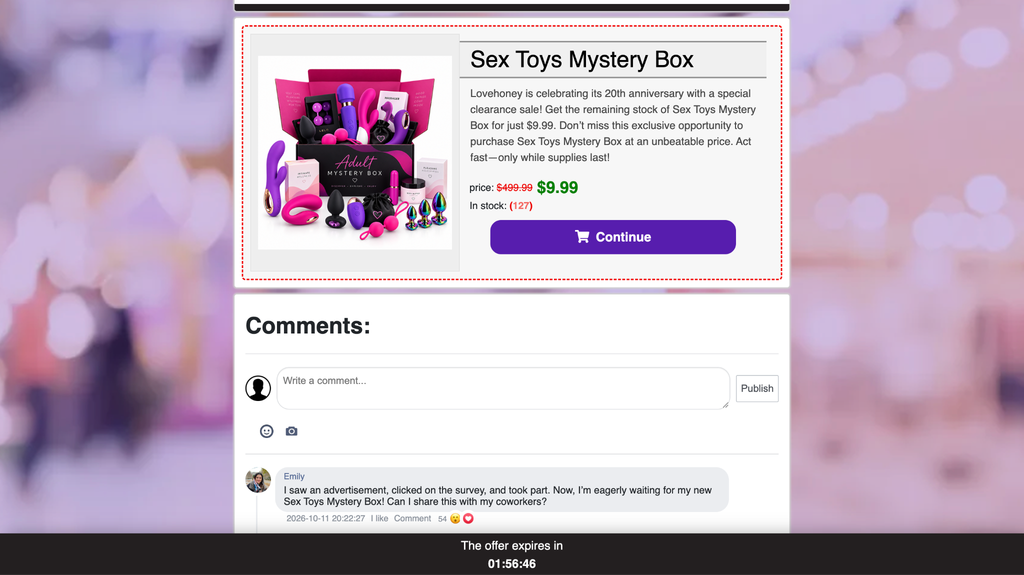
Payouts on these offers are noticeably higher: for one card binding in a Tier-1 affiliate program, you get from $15 to $35 or more. But the entry barrier is much higher. Convincing someone to enter their payment details is much harder than just submitting an email: conversion rates are much lower, so you need significantly more clicks and budget for testing. To get your first payments and gather decent stats, you have to drive much more traffic than with simple lead forms.
The main problem with CC offers is the advertiser’s payment gateways. If the user’s bank declines the payment or requires 3D-Secure verification, conversion drops sharply. In addition, Facebook strictly bans ads that collect payment data directly, so you can’t run these offers without cloaking.
Because of these nuances, teams usually combine formats. According to Grigory Voevodin, Atlas splits their traffic as follows:
| “Initially, we mostly worked with SOI, and then added CC Submit. Now the ratio is about 70 to 30 in favor of SOI.” |
PIN Submit and IVR. A separate category of mobile subscriptions, more common in Latin America, Asia, and Africa, where credit card penetration is lower.
With PIN Submit, the user enters their phone number and confirms the subscription with a code from an SMS. With IVR, they receive a call from a robot and confirm the action via a voice menu. Payments for these services are charged directly from the mobile operator balance, but payouts to webmasters here usually don’t exceed $0.5–1.5.
How prelanders work: the difference between Sweep Flow and E-com Flow
In sweepstakes, traffic almost never goes directly to the advertiser’s form. If a person clicks an ad and immediately sees a form asking for contact details, they’ll just close the tab. No one leaves their email and phone number on an unfamiliar site without a clear reason.
That’s why a pre-landing page is always placed between the ad and the offer. This page explains the promo terms, removes suspicion, and leads the user to fill out a form. Currently, there are two main formats for such pages in the vertical: Sweep Flow and E-com Flow.
Sweep Flow is built on excitement and the mechanics of a prize draw. Depending on the country and product, the page is created using one of two approaches: a short interactive quiz or a long survey.
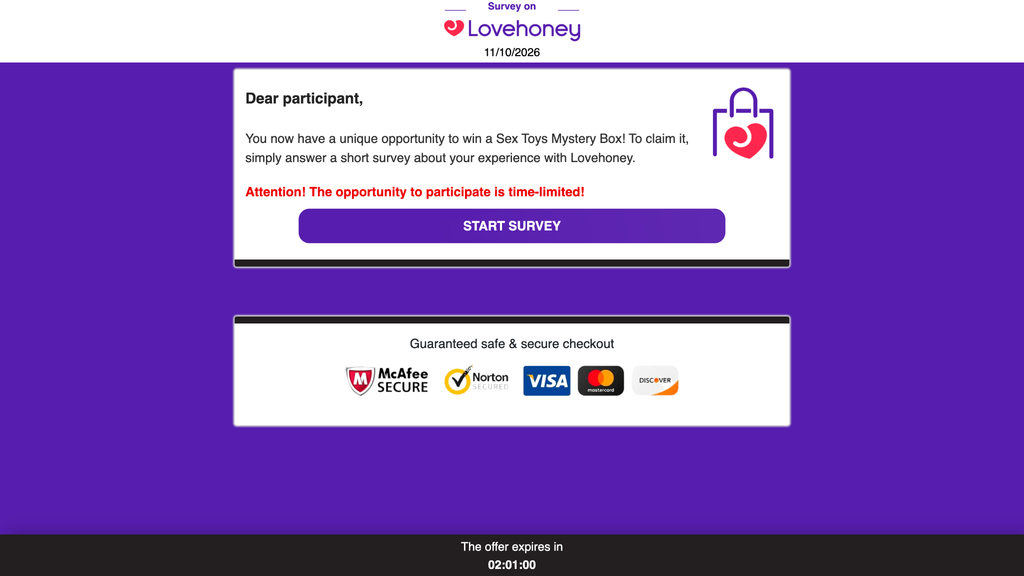
In the first case, the user is asked 3-4 simple questions (such as gender, age, or how often they shop online), and then invited to participate in a draw—like opening gift boxes or spinning a wheel.
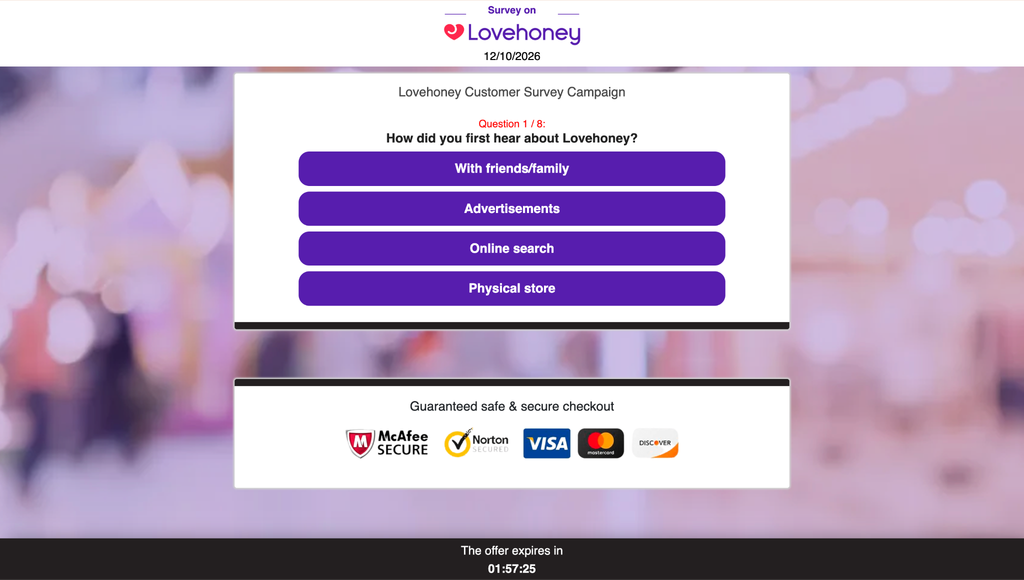
The prize never drops on the first try: the box is empty, and the win only comes on the second or third click. This creates a sense of random luck, after which the user is taken to the contact form.
The second option is a long survey with no game elements. Grigory Voevodin, team lead of the Atlas buying team, explained the difference between these approaches:
| “Our structure is more or less the same. The first type is a short quiz: three or four questions, a hero image, then comments and a second screen with interactivity like boxes or a wheel. The second type of lander, which is most often used in the US, is a long quiz. There are no boxes, it’s more tailored to the user: for each product, we create eight engaging questions. They’re not default, but written specifically for the product.” |
The E-com Flow format is different: there are no boxes or wheels, and the page is designed like a regular online store or a sale showcase.
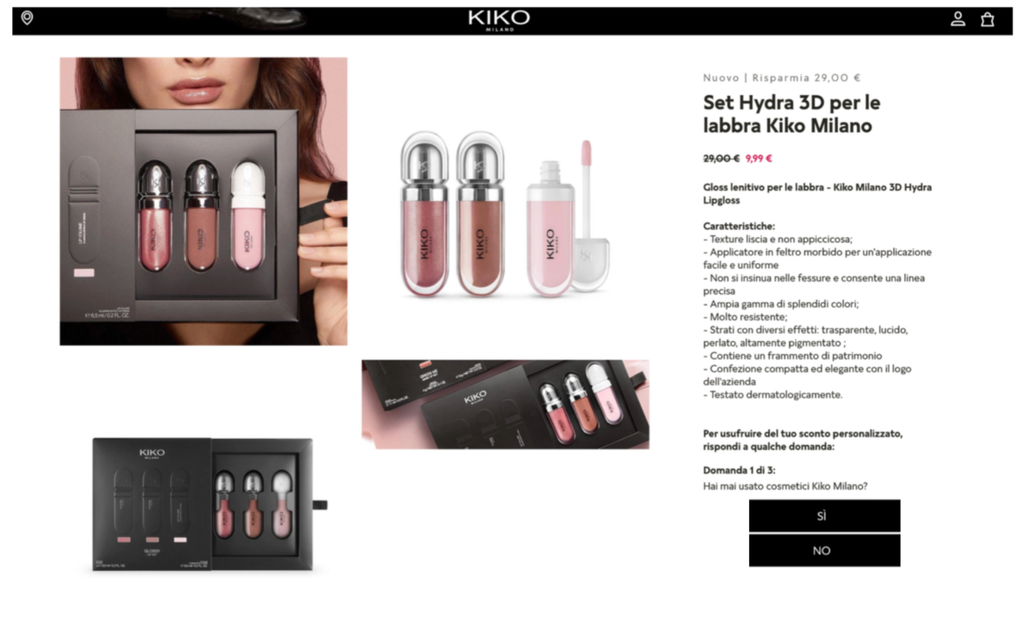
The user isn’t offered a free gift out of nowhere. Instead, they see a specific product with a 95–99% discount and a logical explanation for the promo: warehouse closing, last year’s stock clearance, or damaged factory packaging.
E-com Flow is most often used for CC Submit offers. When a person believes they’re buying a real item from an online store and only paying for shipping, they’re more comfortable entering their card details than on a page with a suspicious giveaway.
When preparing such pages, beginners often make the same mistake: they try to design a beautiful, modern website. In practice, perfect layout in sweepstakes often just lowers conversion.
A site that looks too polished and branded raises suspicion: people know that official resources won’t give away expensive items for a dollar. But a simple, slightly rough page is perceived as a real survey or an internal service form.
Grigory Voevodin gave a telling example of how audiences react to the appearance of pages:
| “We’re used to making beautiful websites, great designs, and focusing on usability in the CIS. But, for example, in LATAM, this approach works very poorly. There was a case: a woman went to work in Brazil, and they told her: ‘Make a payment form.’ She made a beautiful form, and they said: ‘This is all wrong, it won’t work.’ ‘Their logic is: if the form looks nice, it must be a scam. You need to make the form as clunky as possible, with awkward questions like ‘What was your first dog’s name?’—that’s when people believe it’s a legit form.’” |
The same rule applies to the ads themselves. The founder of a buying team, Maxim Tamarov, confirmed this with his experience using simple visuals:
| “For a long time, we worked exclusively with graphics and photos. They looked as bad as possible, but they performed extremely well. Maybe it was exactly because of how they looked.” |
Because of this, teams don’t rebuild prelanders from scratch for every launch. Basic templates last for years: you just take the ready-made structure and swap out the product photos, questions, and the review block.
Grigory Voevodin explained why there’s no point in constantly complicating the layout:
| “After a certain number of iterations, I always think: I should probably redo the landers, maybe they’re not working. But in reality, they work just as well as they did a year ago. We make the reviews unique, change the avatars, update the questions, but we don’t do anything radically new—the same templates keep delivering results.” |
That’s why, instead of constantly tweaking the design, the focus is on clear copy, reviews with real unboxing photos, and adapting the page to the language of the target country.
Selecting offers and creatives: what products to test and how to build ads
At the start, many people test offers with the latest iPhone: it seems like everyone wants a new smartphone, so there will be more clicks.
But in sweepstakes, ads are launched on behalf of major retail chains like Walmart, Amazon, or Target to build trust.
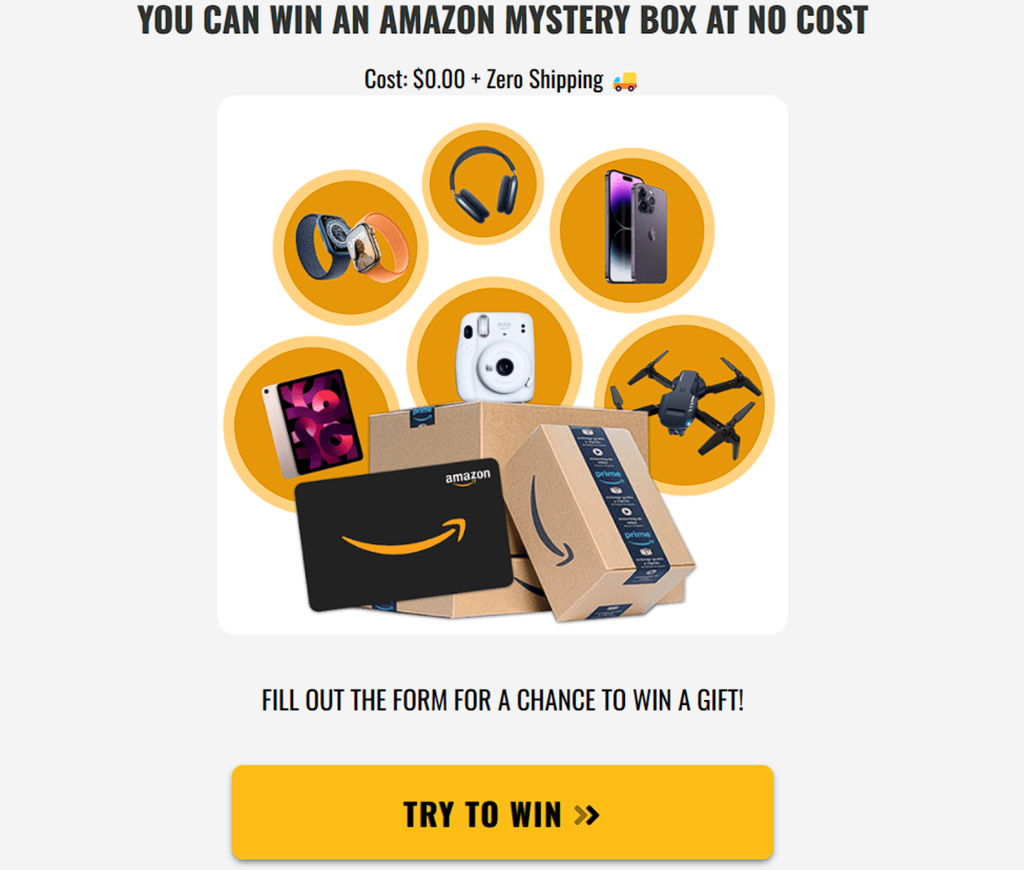
And when someone sees an offer in their feed to grab the latest iPhone, they immediately have doubts: why would a store give away a brand-new device for free when there are already lines for it?
Grigory Voevodin from the Atlas team talked about this disconnect:
| “Everyone who comes into sweeps immediately thinks: ‘Oh, the new iPhone, let’s run it, it makes sense.’ But that’s where the disconnect is. Why would a brand raffle off the latest iPhone that just launched? The story with last year’s model makes much more sense: ‘A new phone is out, we’re clearing out old stock, emptying the warehouse.’ That’s why we don’t work with those kinds of products at all.” |
Instead of new arrivals, they choose products where the promotion is easy to explain: last year’s models, batches with damaged packaging, or clearance sales of leftover stock from the warehouse.
When choosing, they look at two parameters: retail price and everyday usefulness. There’s no point in raffling off cheap items—an adult won’t waste time filling out a form for something trivial. That’s why they go for products starting at $200: tool sets, grills, stylers, coffee machines, or robot vacuums.
To avoid picking such items at random, they check marketplace statistics. In the Amazon Movers & Shakers section, they find products with a sharp sales spike in the last 24 hours, then check the trend in Google Trends for the target country over the past 12 months. If demand is stable or growing, they take the product for testing.
Straightforward calls to claim a gift don’t work in ads. The copy is usually built around simple everyday stories:
- A story from an acquaintance: “My sister works at the checkout and tipped me off on how to get a cookware set almost for free.”
- Revenge on management: a former employee leaks a store promotion after being recently fired.
- Clearance sale from the store itself before a new shipment arrives.
When it comes to ad formats, teams most often use static images—casual, amateur photos of boxes, receipts, or the product in hand. Simple phone camera shots look like posts from real people and inspire more trust than polished advertising images.
Maksim Tamarov talked about working with simple graphics:
| “For a long time, we worked exclusively with graphics, with photos. They looked absolutely terrible, but they worked really well. Maybe precisely because of how they looked.” |
Facebook Ads Launch Practice: Atlas Team Setup
Usually, when launching ads on Facebook, standard ads are set up with call-to-action buttons like “Shop Now” or “Learn More.” But the Atlas team found a different approach through experience: they promote regular posts from business pages (fan pages).
Such posts don’t have the usual button. The link to the pre-landing page is placed directly in the post text or in the first comment below. In the feed, it looks like a regular post from a real person or blogger sharing feedback about a received product.
Because of this format, Atlas builds campaigns in the ad account strictly following a 1-1-1 scheme: one campaign, one ad set, and one ad.
The thing is, the long website link is shortened to look neat in the text. But shortened links don’t pass Facebook’s dynamic UTM tags, which the tracker uses to determine which specific ad the click came from. If you upload several different images into one ad set, you won’t be able to track statistics for each one separately.
That’s why each creative gets its own campaign in the ad account and a separate link in the tracker.
Skipping ad buttons also changes audience behavior. Grigory Voevodin, Atlas team’s buying lead, talked about the difference between launches with and without a button:
| “When you run with a button, the traffic gets cheaper because the audience is more likely to click. But if you launch without a button and hide the link in a comment or in the post text, the click costs more, but the audience is of higher quality.” |
The second important point is setting budgets. Beginners often set a minimum limit of $50-100 per day during tests and wait for results. But at Atlas, they abandoned small budgets because they create problems when scaling up.
With a small budget, Facebook starts showing ads to the cheapest audience, who click on any link but rarely finish a long survey. And when the funnel is profitable and you try to increase the budget, the algorithm starts searching for a new audience from scratch and results drop.
That’s why Atlas launches campaigns with large budgets right away: they set $500 per ad set, and if they’re confident in the funnel, they go straight to $1500. With this spend, the campaign gathers enough data in the first 24 hours. The algorithm immediately finds an active audience, after which the budget can be gradually increased further.
This logic was explained by Grigory Voeyvodin in an interview on the “Arbitrage Microphone” channel:
| “The CPA rate might be three or four bucks, but we’ll still set a big budget—like $500. You just buy data faster and quickly see if your funnel works or not. We used to launch with small budgets, and that made scaling harder: it’s much more difficult to go from $100 to $500 than from $500 to $1000. With a hundred, the algorithm picks a cheap layer of audience, but with bigger budgets, the funnel optimizes quickly within the first day.” |
To keep the algorithm from getting confused during the day, the time zone in the ad account is always set to match the country where the ads are running.
On Facebook, the daily limit resets exactly at midnight according to the account’s time zone. If you run US traffic from an account set to Moscow time (+3 UTC), the budget will reset around 4–5 PM New York time. That’s exactly when Americans finish work and social media activity peaks.
Because of the reset in the middle of the day, the campaign starts redistributing impressions right during peak evening traffic, the click price jumps sharply, and results become unstable.
After one or two weeks of running, buyers often face rising ad costs. The campaign starts with a normal CPM (cost per thousand impressions) around $20-30, but over time this figure grows to $60-80, and the funnel’s ROI drops.
Many think the ad has become stale for users and start making new creatives. But in reality, it’s not the creative that burns out, but the business page the ad is running from.
Negative comments inevitably pile up under the post over time, and some people hit “hide post” or send complaints. Facebook picks up on these signals, lowers the internal trust rating of the page, and starts charging more for showing its posts.
Grigory Voevodin explained how this problem is solved here:
| “When CPM skyrockets, almost everyone thinks the creative is burned out. In reality, it’s not the creative but the fanpage that’s burning out. People start leaving negative comments, complaining about the ad, and Facebook lowers the page’s trust. You just swap the old fanpage for a new one—and CPM instantly goes back to normal.” |
In these cases, the creative and text stay the same: you just detach the old spammed-out page and relaunch the exact same ad from a new, pre-warmed fanpage.
Spy analysis: effective approaches to creatives and landings
Spy tools and the Facebook Ads Library don’t have a separate filter for sweepstakes. You can find these ads by searching for survey phrases: fill out the form, quick survey, no credit card required, mystery box, or chance to win.
If you break down the ads currently running at scale, you’ll see four main approaches.
Native posts with order screenshots and receipts
The most common format is when the ad is disguised as a personal recommendation from an ordinary person in the feed.
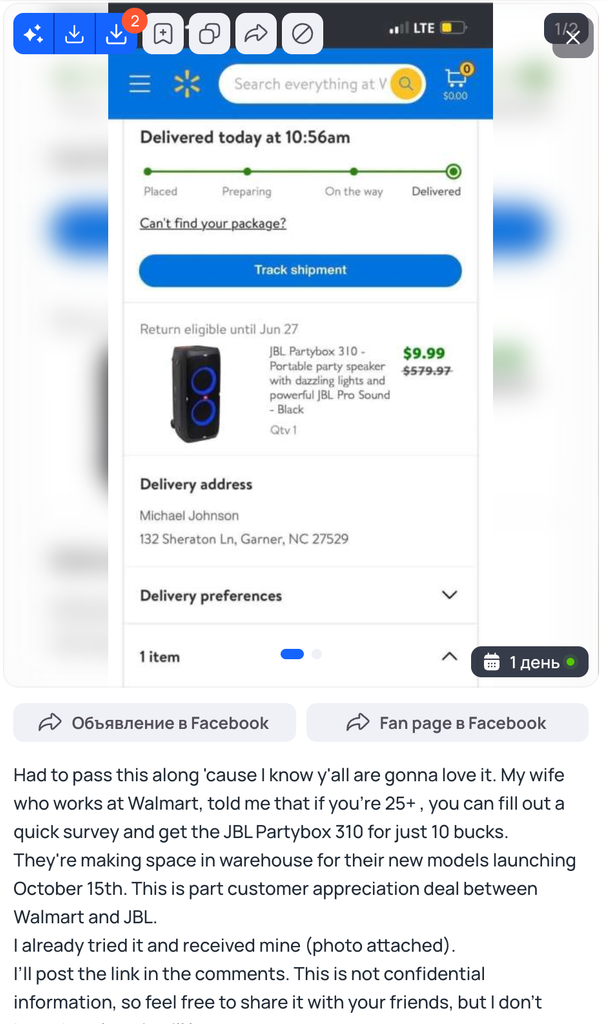
For portable speaker ads, they use a screenshot from the Walmart app. It shows the successful delivery status, the recipient’s name, and a crossed-out real price of several hundred dollars, replaced by a symbolic amount around ten bucks.
The copy gives a clear everyday backstory: the wife works at the store and tipped off about a promo where electronics are sold for pennies before new stock arrives. The author promises to drop the link in the comments so the post looks like a regular update, not a direct ad.
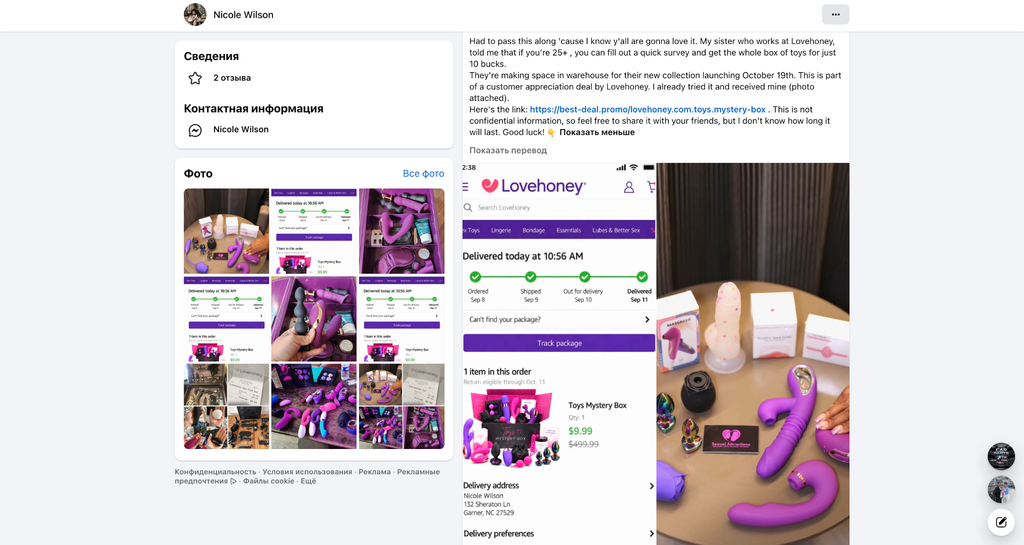
The same approach is used in other niches—for example, for adult offers from Lovehoney.
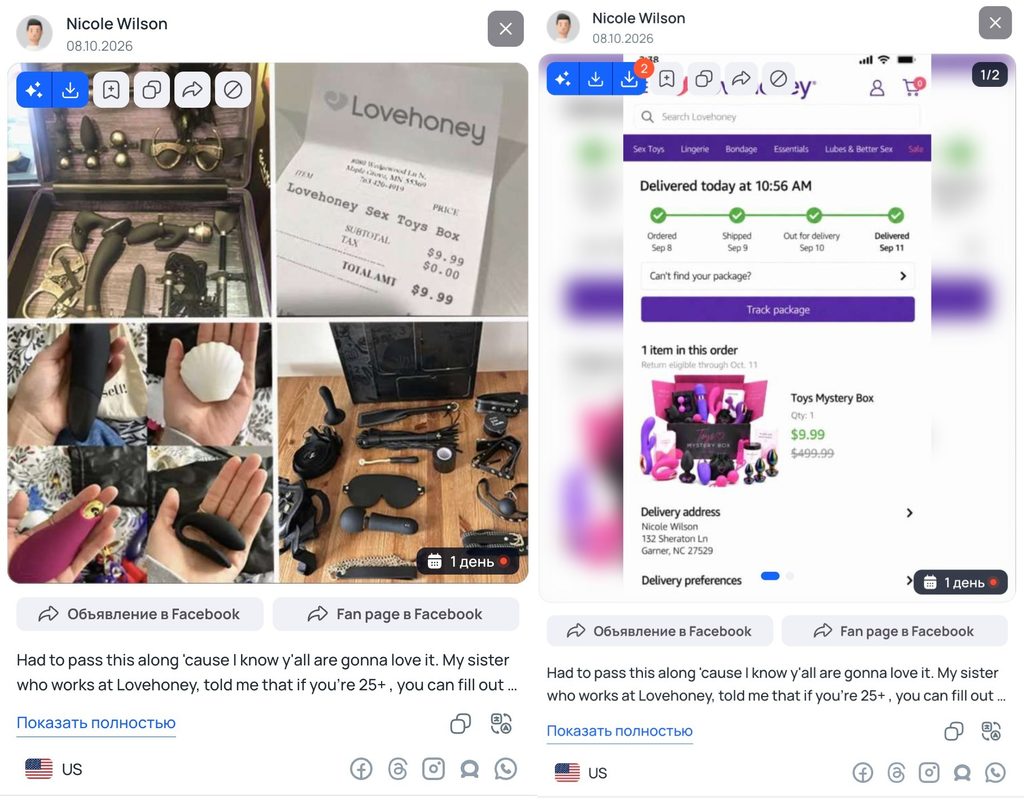
The ad shows amateur photos of the product being unboxed on the floor or in someone’s hands, plus a store receipt for a couple of dollars. The text repeats the same story: a sister works at the company and shared how to grab a box almost for free before the new collection drops.
This works great thanks to a logical explanation for the deal: the store is just clearing out inventory before a shipment. The “25+” age restriction badge adds a sense of a real, closed promo.
Prize selection for different audiences
Another option is running ads on behalf of online survey services, where people can choose which prize they want to claim.
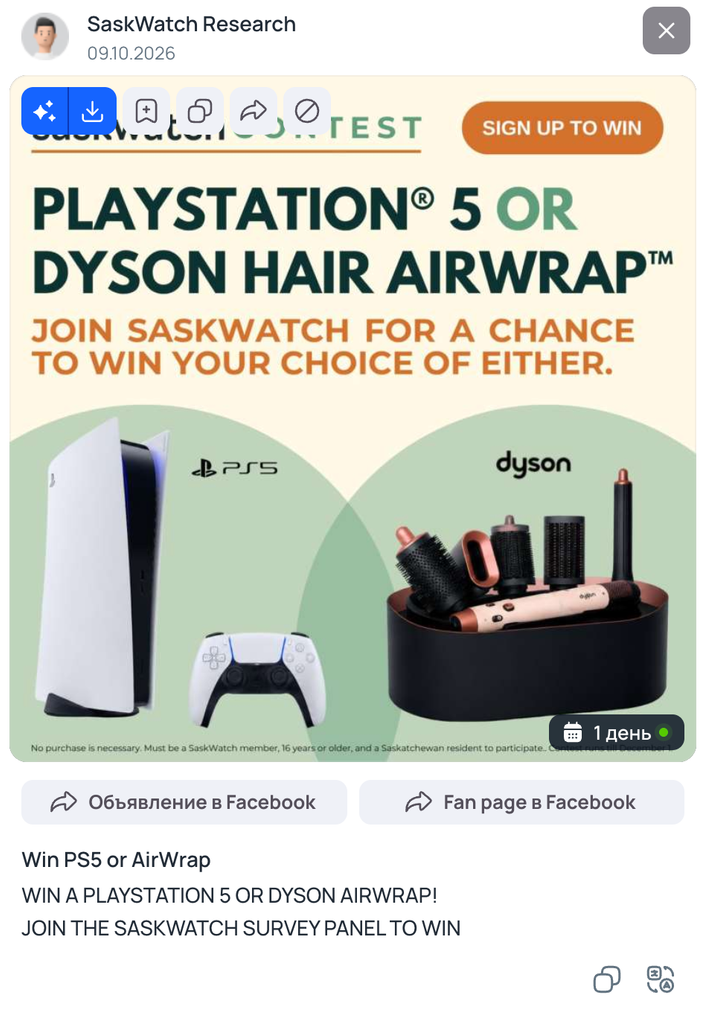
One banner combines a PlayStation 5 console and a Dyson styler. This instantly covers two different audiences: the console attracts men, the hair tool appeals to women. The participation terms are written in fine print at the bottom, so the ad looks like an official research program.
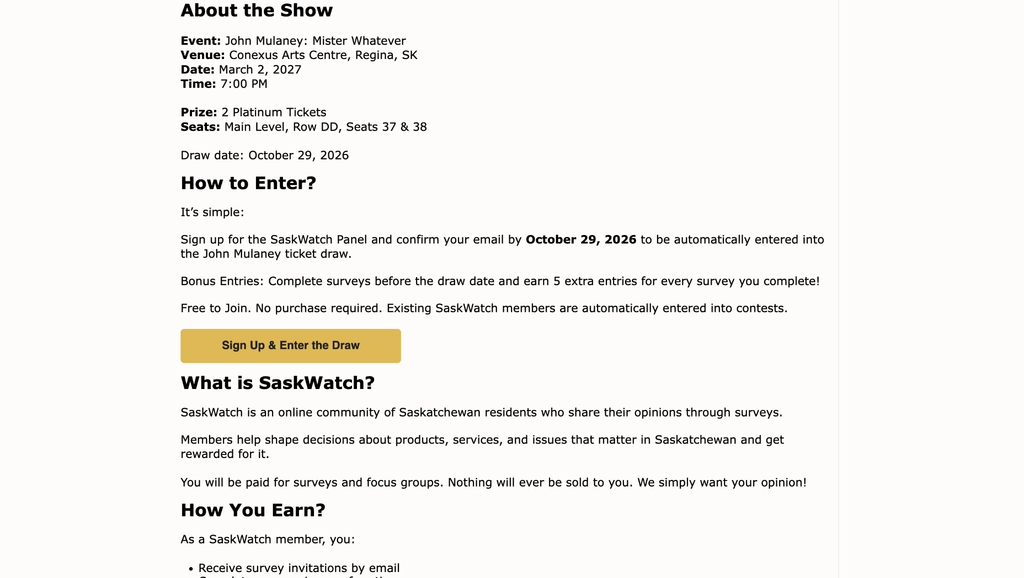
The pre-landing page is styled strictly like a survey site. No roulette wheels or boxes: just a calm white background, clear rules, and a specific drawing date.
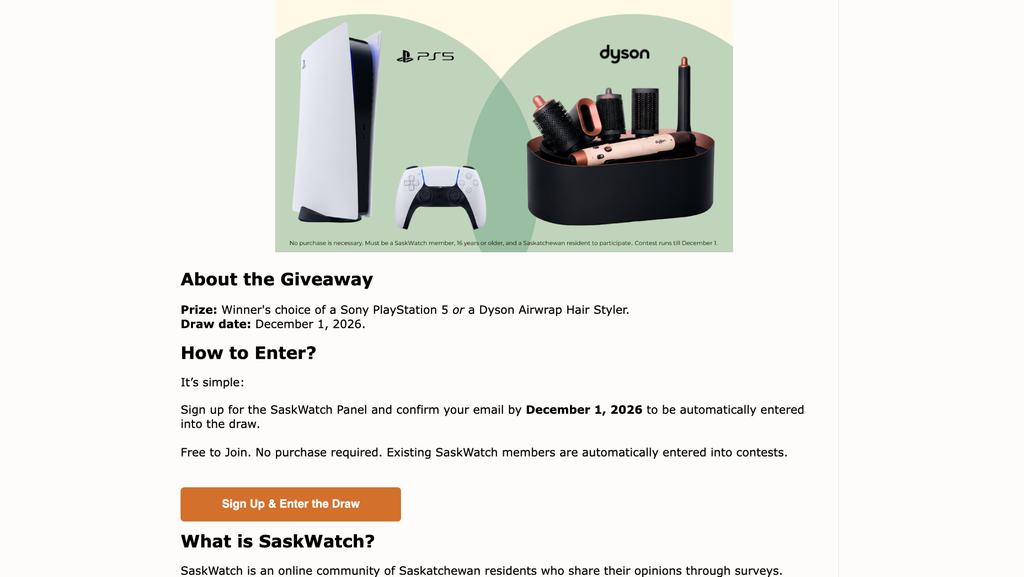
The user is simply asked to register and confirm their email. The page looks solid and doesn’t raise unnecessary suspicion
Tickets to local concerts and events
A less obvious but effective approach is ticket giveaways for events in a specific region.
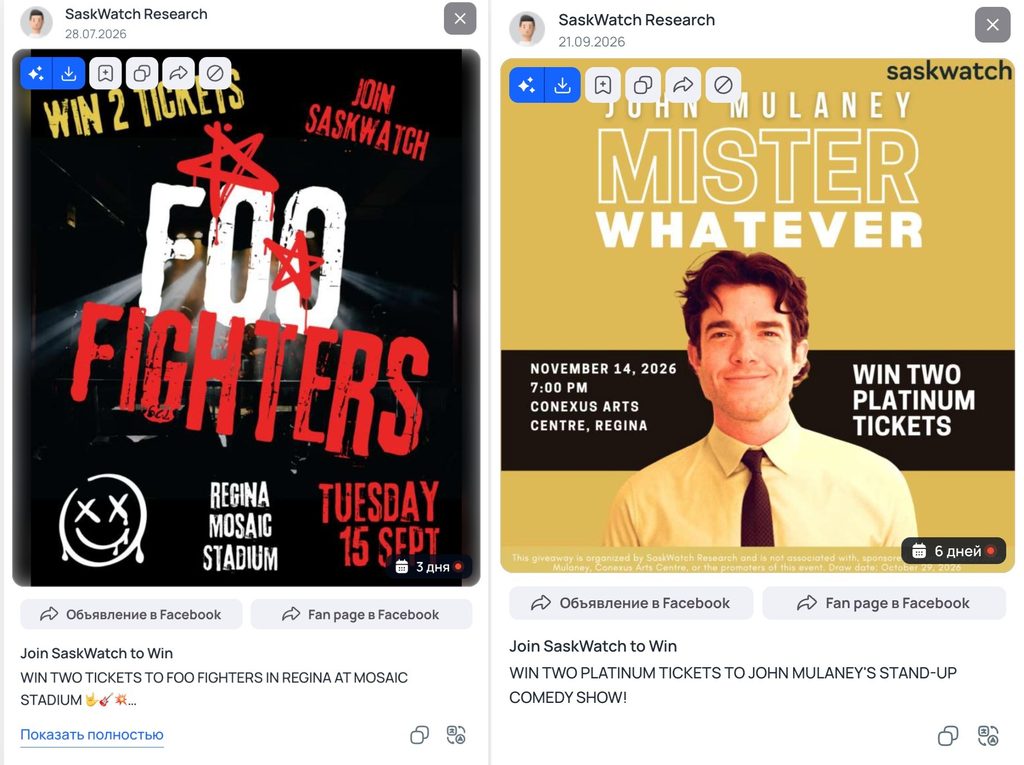
Instead of home appliances, people are offered a chance to win a pair of tickets to a Foo Fighters concert at the city stadium or to a popular comedian’s stand-up show at the local art center.
These campaigns are launched with targeting for a specific city. When someone sees a familiar artist’s poster for a real venue in their city in their feed, the trust in the survey is much higher than in yet another smartphone giveaway.
Special topic: the phenomenon of Sweepstakes Casinos in the US
Alongside classic gadget giveaways, a separate industry has emerged in the US with a turnover of over $7 billion, which formally operates under the same sweepstakes laws but in reality functions as online casinos — Sweepstakes Casinos.
In most US states, online gambling is prohibited, and where it is legal, operators need expensive licenses and strict audits. But US law has a provision: a company can run prize draws with cash prizes if participation does not require a mandatory fee.
On this basis, platforms like Chumba Casino, Pulsz, McLuck, or Stake.us have built a dual-currency system.
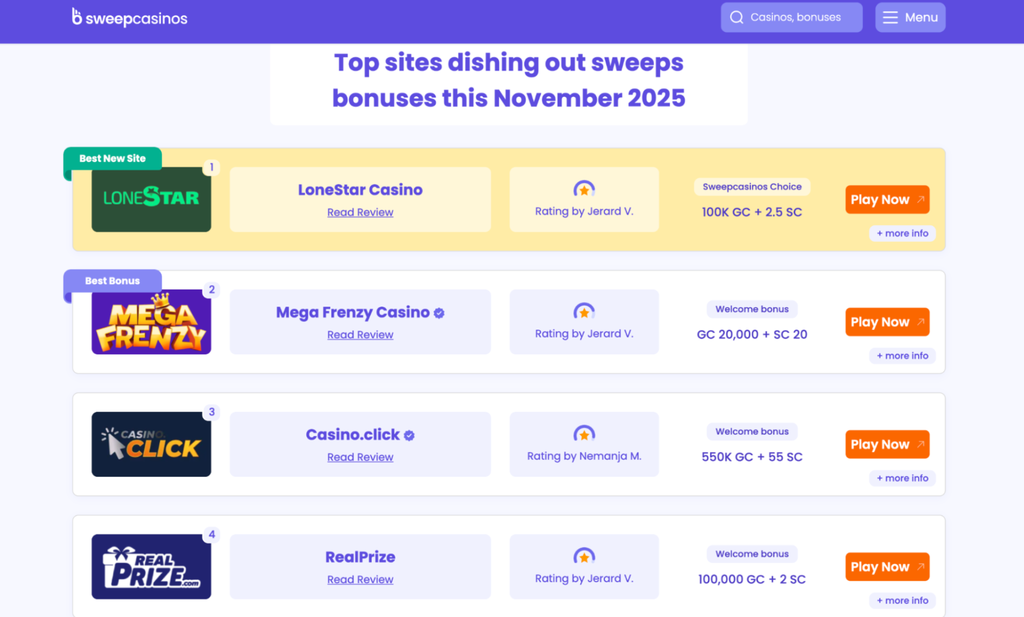
Users are offered to buy a package of virtual chips — Gold Coins (GC). These can be used to spin slots for fun, but the coins have no monetary value and cannot be cashed out.
However, along with the purchase of chips, the site credits the user with a second currency — Sweeps Coins (SC). Formally, the player does not buy them but receives them for free as a bonus with the order.
To fully comply with the law on free participation, the service allows users to get Sweeps Coins without money as well: for example, for daily logins or by sending a handwritten letter to the company’s physical address.
Bets with Sweeps Coins are made in the same slots, and the coins won can be exchanged back to dollars at a 1:1 rate or redeemed as gift cards.
This loophole has created a huge market for media buying. Since, legally, the platform is running a promotional campaign and not gambling, such services are openly advertised on Facebook, Instagram, and Google without cloaking or the risk of instant bans.
Payments also go through white-hat gateways: users buy coin packages directly via Visa, Mastercard, Apple Pay, or PayPal, so advertisers have no issues with transaction approval.
While the turnover was in the tens of millions, no one paid attention to the model. But when the market volume exceeded billions of dollars, regulators and traditional casinos started to take notice.
Native American gaming associations (including California) and major licensed operators who pay hundreds of millions in taxes for official licenses began openly demanding a ban on such platforms.
They claim that the free distribution of coins is simply a cover for illegal casinos without age checks or licenses.
The pressure has already led to the first results: the Michigan Gaming Control Board sent warnings to major operators like Virtual Gaming Worlds (owners of Chumba Casino), forcing them to completely shut down operations in the state.
Similar bans have been introduced in Nevada, Idaho, and Washington, and regulators are preparing legislative amendments to close the dual-currency loophole at the federal level. As a result, the sweepstakes casino market is gradually being squeezed, making it increasingly difficult to operate legally.
Conclusion: Economics, Volumes, and Prospects
Case studies and open discussions often mention astronomical ROI figures of 100-150%. In reality, such numbers are not achievable at scale in sweepstakes.
This is a classic low-margin vertical, where earnings rely solely on turnover: teams run large budgets with a relatively modest net profit percentage.
The real profitability was discussed by the founder of a buying team, Maksim Tamarov:
| “Sweepstakes is a vertical where you’re happy with 30% ROI. And you basically win by volume.” |
Similar numbers were mentioned by Grigory Voevodin from the Atlas team:
| “Our average ROI at scale is between 30 and 40%, with a median around 33–35%. We know other teams who also run at scale, but their ROI is even lower. They’re willing to work for 10–15% because it’s fast money.” |
To earn a significant income with a 30–35% return, teams have to spend tens of thousands of dollars every day. At Atlas, a department of seven buyers generates 2,000 to 3,000 confirmed leads per day, with daily ad spend in the tens of thousands of dollars.
It’s hard to keep up this pace alone: you need a constant flow of consumables, fresh fan pages, manual work with comments under posts, and regular product testing.
The second important factor in this economy is pronounced seasonality.
The most profitable period starts in November and lasts until the end of winter: Black Friday, Christmas holidays, and sales. During these months, the audience is actively shopping online, so people are more likely to believe in warehouse liquidations and gift cards.
By mid-summer, the market predictably slumps. Grigory Voevodin talked about the summer downturn on the “Arbitrage Microphone” podcast:
| “For sweepstakes, the worst months are July and August. It’s vacation season: people spend less time online, traffic gets more expensive, and conversion rates drop.” |
In 2026, you won’t be able to just grab a fresh iPhone creative from a spy tool and instantly turn a profit in sweepstakes.
The market has grown: classic roulette offers no longer attract people, advertisers only pay for users who are profitable on the backend, and on Facebook you have to regularly switch fan pages to new ones.
Here, it’s not about luck when launching a campaign, but about teams with established processes, where buyers understand the funnel, calculate the math at every step, and select clear household products with stable demand.

Comments (0)